Artificial Intelligence and Big Data Research Center, Sejong Medical Research Institute, 20, Gyeyangmunhwa-ro, Gyeyang-gu, Incheon, Republic of Korea.
VUNO, Seoul, South Korea.
Scand J Trauma Resusc Emerg Med. 2020 Mar 4;28(1):17. doi: 10.1186/s13049-020-0713-4.
In emergency medical services (EMSs), accurately predicting the severity of a patient's medical condition is important for the early identification of those who are vulnerable and at high-risk. In this study, we developed and validated an artificial intelligence (AI) algorithm based on deep learning to predict the need for critical care during EMS.
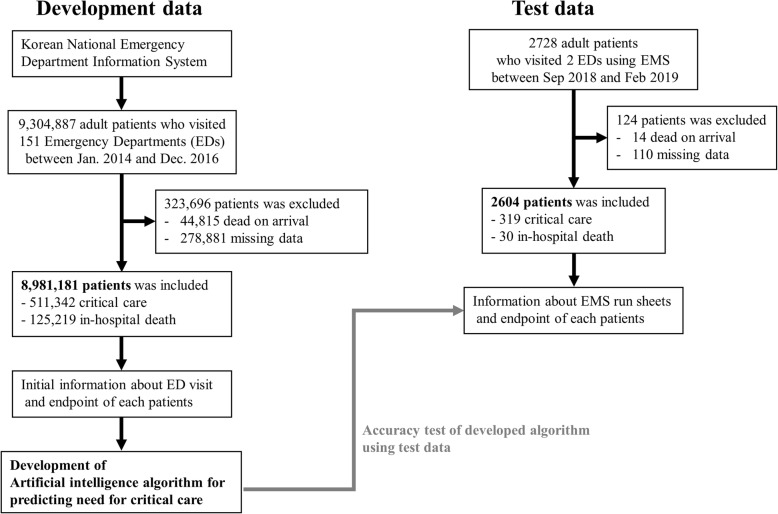
We conducted a retrospective observation cohort study. The algorithm was established using development data from the Korean national emergency department information system, which were collected during visits in real time from 151 emergency departments (EDs). We validated the algorithm using EMS run sheets from two EDs. The study subjects comprised adult patients who visited EDs. The endpoint was critical care, and we used age, sex, chief complaint, symptom onset to arrival time, trauma, and initial vital signs as the predicted variables.
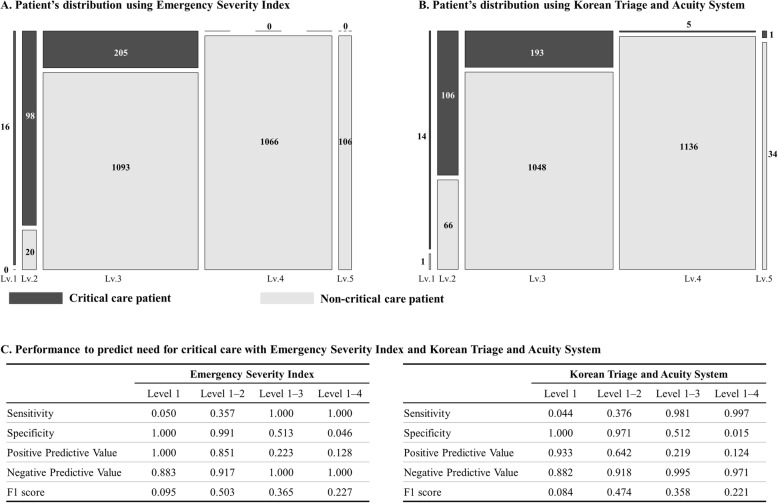
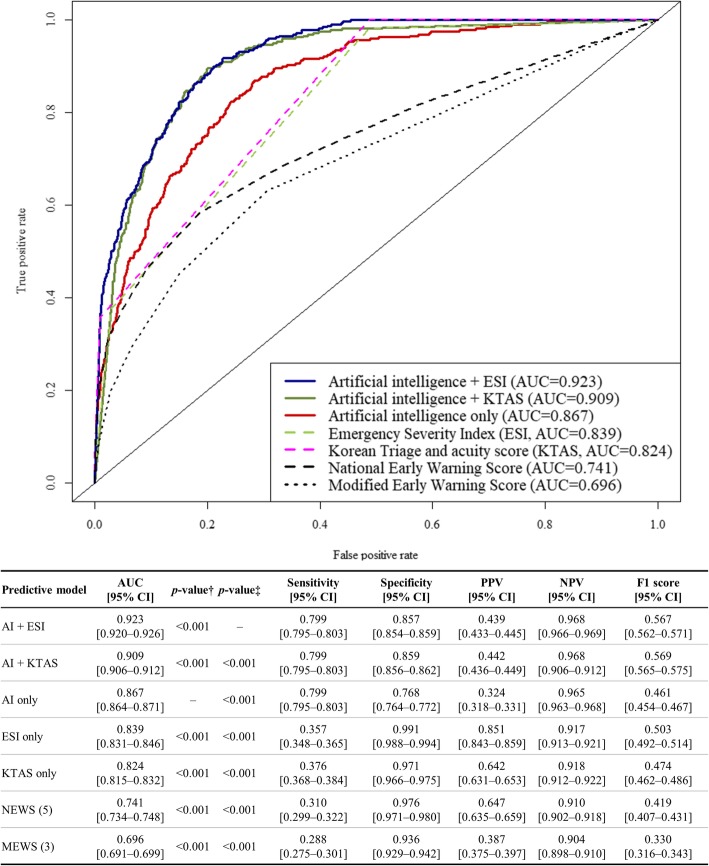
The number of patients in the development data was 8,981,181, and the validation data comprised 2604 EMS run sheets from two hospitals. The area under the receiver operating characteristic curve of the algorithm to predict the critical care was 0.867 (95% confidence interval, [0.864-0.871]). This result outperformed the Emergency Severity Index (0.839 [0.831-0.846]), Korean Triage and Acuity System (0.824 [0.815-0.832]), National Early Warning Score (0.741 [0.734-0.748]), and Modified Early Warning Score (0.696 [0.691-0.699]).
The AI algorithm accurately predicted the need for the critical care of patients using information during EMS and outperformed the conventional triage tools and early warning scores.
在紧急医疗服务(EMS)中,准确预测患者的病情严重程度对于早期识别那些脆弱和高风险的患者至关重要。在这项研究中,我们开发并验证了一种基于深度学习的人工智能(AI)算法,用于预测 EMS 期间需要重症监护的情况。
我们进行了一项回顾性观察队列研究。该算法是使用来自韩国国家急诊信息系统的开发数据建立的,这些数据是从 151 个急诊科(ED)实时采集的。我们使用来自两家 ED 的 EMS 运行表验证了该算法。研究对象包括成年患者,他们曾到 ED 就诊。终点是重症监护,我们使用年龄、性别、主诉、症状发作至到达时间、创伤和初始生命体征作为预测变量。
开发数据中的患者数量为 8981181 人,验证数据包括来自两家医院的 2604 份 EMS 运行表。该算法预测重症监护的受试者工作特征曲线下面积为 0.867(95%置信区间[0.864-0.871])。这一结果优于紧急严重程度指数(0.839 [0.831-0.846])、韩国分诊和紧急度系统(0.824 [0.815-0.832])、国家早期预警评分(0.741 [0.734-0.748])和改良早期预警评分(0.696 [0.691-0.699])。
该 AI 算法使用 EMS 期间的信息准确预测了患者需要重症监护的情况,并且优于传统的分诊工具和早期预警评分。