Ghosh Sayantari, Bhattacharya Saumik
Department of Physics, National Institute of Technology Durgapur, Durgapur, India.
Department of Electronics and Electrical Communication Engineering, Indian Institute of Technology Kharagpur, Kharagpur, India.
SN Comput Sci. 2021;2(3):230. doi: 10.1007/s42979-021-00619-3. Epub 2021 Apr 22.
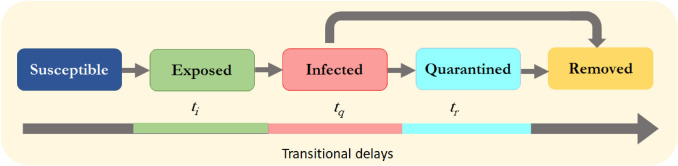
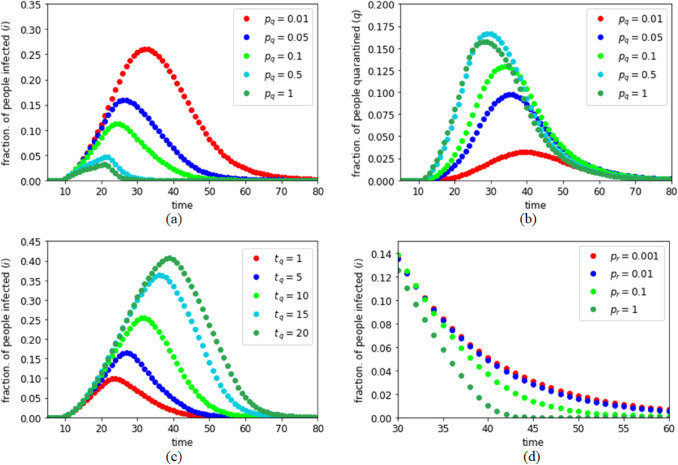
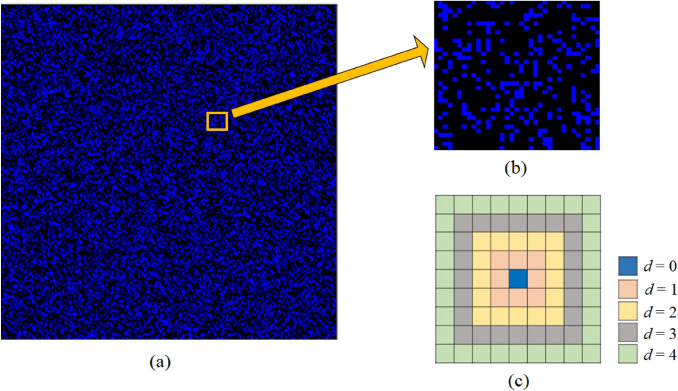
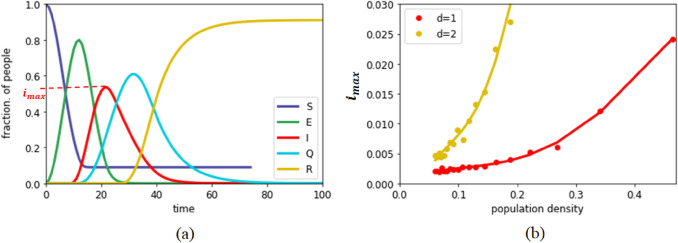
Since March, 2020, Coronavirus disease (COVID-19) has been designated as a pandemic by World Health Organization. This disease is highly infectious and potentially fatal, causing a global public health concern. To contain the spread of COVID-19, governments are adopting nationwide interventions, like lockdown, containment and quarantine, restrictions on travel, cancelling social events and extensive testing. To understand the effects of these measures on the control of the epidemic in a data-driven manner, we propose a probabilistic cellular automata (PCA) based epidemiological model. The transitions associated with the model is driven by data available on chronology, symptoms, pathogenesis and transmissivity of the virus. By arguing that the lattice-based model captures the features of the dynamics along with the existing fluctuations, we perform rigorous computational analyses of the model to take into account of the spatial dynamics of social distancing measures imposed on the people. Considering the probabilistic behavioral aspects associated with mitigation strategies, we study the model considering factors like population density and testing efficiency. Using the model, we focus on the variability of epidemic dynamics data for different countries, and point out the reasons behind these contrasting observations. To the best of our knowledge, this is the first attempt to model COVID-19 spread using PCA that gives us both spatial and temporal variations of the infection spread with the insight about the contributions of different infection parameters.
自2020年3月以来,冠状病毒病(COVID-19)被世界卫生组织列为大流行病。这种疾病具有高度传染性且可能致命,引发了全球公共卫生关注。为遏制COVID-19的传播,各国政府正在采取全国性干预措施,如封锁、隔离和检疫、旅行限制、取消社交活动以及广泛检测。为以数据驱动的方式了解这些措施对疫情控制的影响,我们提出一种基于概率细胞自动机(PCA)的流行病学模型。与该模型相关的转变由关于病毒的时间顺序、症状、发病机制和传播率的现有数据驱动。通过论证基于格点的模型捕捉了动态特征以及现有的波动情况,我们对该模型进行了严格的计算分析,以考虑对人们实施的社会 distancing 措施的空间动态。考虑到与缓解策略相关的概率行为方面,我们在研究模型时考虑了人口密度和检测效率等因素。使用该模型,我们关注不同国家疫情动态数据的变异性,并指出这些不同观察结果背后的原因。据我们所知,这是首次尝试使用PCA对COVID-19传播进行建模,它为我们提供了感染传播的时空变化以及对不同感染参数贡献的洞察。 (注:原文中“social distancing”直译为“社会距离”,在疫情语境下可能是指社交疏离等措施,这里未找到更合适的意译词汇,故保留英文。)