Disease Molecular Biology and Epigenetics Laboratory, National Institute of Molecular Biology and Biotechnology, National Science Complex, University of the Philippines Diliman, Quezon City 1101, Philippines.
Int J Mol Med. 2021 Jun;47(6). doi: 10.3892/ijmm.2021.4945. Epub 2021 Apr 28.
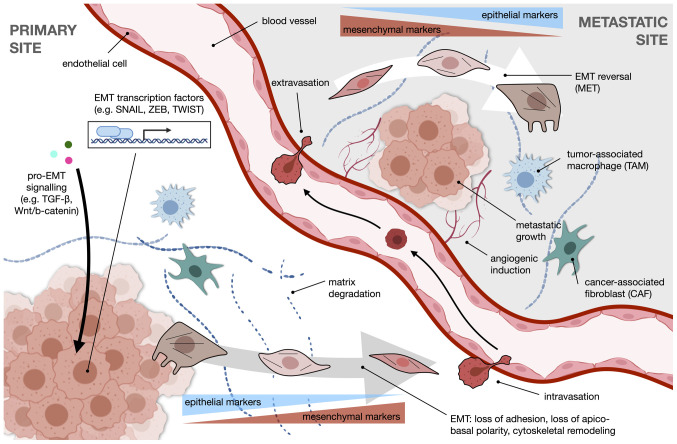
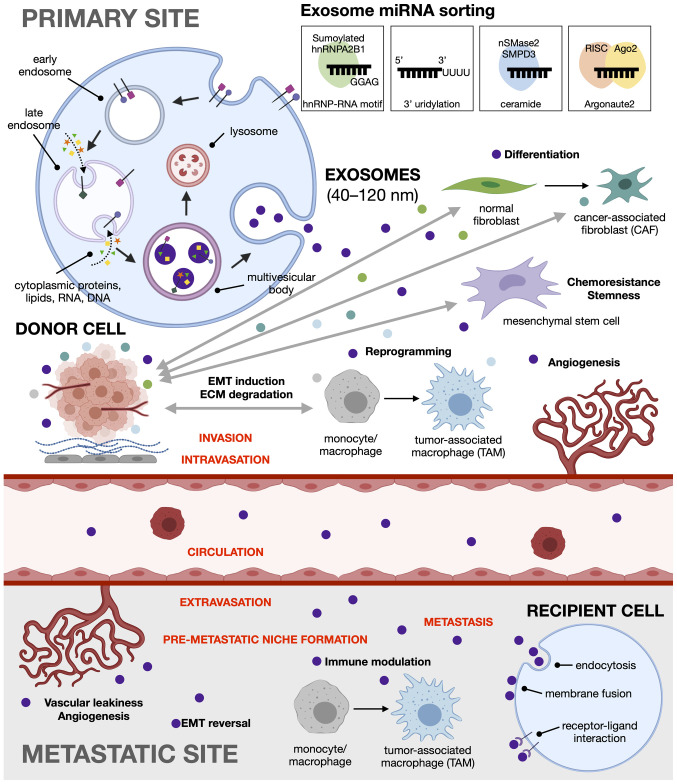
The journey of cancer cells from a primary tumor to distant sites is a multi‑step process that involves cellular reprogramming, the breaking or breaching of physical barriers and the preparation of a pre‑metastatic niche for colonization. The loss of adhesion between cells, cytoskeletal remodeling, the reduction in size and change in cell shape, the destruction of the extracellular matrix, and the modification of the tumor microenvironment facilitate migration and invasion into surrounding tissues. The promotion of vascular leakiness enables intra‑ and extravasation, while angiogenesis and immune suppression help metastasizing cells become established in the new site. Tumor‑derived exosomes have long been known to harbor microRNAs (miRNAs or miRs) that help prepare secondary sites for metastasis; however, their roles in the early and intermediate steps of the metastatic cascade are only beginning to be characterized. The present review article presents a summary and discussion of the miRNAs that form part of colorectal cancer (CRC)‑derived exosomal cargoes and which play distinct roles in epithelial to mesenchymal plasticity and metastatic organotropism. First, an overview of epithelial‑to‑mesenchymal transition (EMT), metastatic organotropism, as well as exosome biogenesis, cargo sorting and uptake by recipient cells is presented. Lastly, the potential of these exosomal miRNAs as prognostic biomarkers for metastatic CRC, and the blocking of these as a possible therapeutic intervention is discussed.
癌细胞从原发性肿瘤转移到远处部位是一个多步骤的过程,涉及细胞重编程、物理屏障的破坏或突破,以及为定植准备预先转移的生态位。细胞间黏附的丧失、细胞骨架重塑、细胞大小的减小和形状的改变、细胞外基质的破坏以及肿瘤微环境的改变促进了迁移和侵袭到周围组织。促进血管通透性使细胞内和细胞外渗,而血管生成和免疫抑制有助于转移细胞在新部位定植。肿瘤衍生的外泌体长期以来一直被认为含有有助于为转移准备次级部位的 microRNAs(miRNAs 或 miRs);然而,它们在转移级联的早期和中期步骤中的作用才刚刚开始被描述。本文综述了构成结直肠癌(CRC)衍生外泌体货物的部分 miRNAs,并讨论了它们在上皮-间充质可塑性和转移器官亲嗜性中发挥的独特作用。首先,介绍了上皮-间充质转化(EMT)、转移器官亲嗜性以及外泌体生物发生、货物分拣和被受体细胞摄取的概述。最后,讨论了这些外泌体 miRNAs 作为转移性 CRC 预后生物标志物的潜力,以及作为一种可能的治疗干预阻断这些 miRNA 的潜力。