• 文献检索
  • 文档翻译
  • 深度研究
  • 学术资讯
  • Suppr Zotero 插件Zotero 插件
  • 邀请有礼
  • 套餐&价格
  • 历史记录
应用&插件
Suppr Zotero 插件Zotero 插件浏览器插件Mac 客户端Windows 客户端微信小程序
定价
高级版会员购买积分包购买API积分包
服务
文献检索文档翻译深度研究API 文档MCP 服务
关于我们
关于 Suppr公司介绍联系我们用户协议隐私条款
关注我们

Suppr 超能文献

核心技术专利:CN118964589B侵权必究
粤ICP备2023148730 号-1Suppr @ 2026

文献检索

告别复杂PubMed语法,用中文像聊天一样搜索,搜遍4000万医学文献。AI智能推荐,让科研检索更轻松。

立即免费搜索

文件翻译

保留排版,准确专业,支持PDF/Word/PPT等文件格式,支持 12+语言互译。

免费翻译文档

深度研究

AI帮你快速写综述,25分钟生成高质量综述,智能提取关键信息,辅助科研写作。

立即免费体验

年龄、性别、健康状况和政党对 COVID-19 相关问题和预防行为的影响:一项大型、纵向横断面调查的结果。

Effects of Age, Gender, Health Status, and Political Party on COVID-19-Related Concerns and Prevention Behaviors: Results of a Large, Longitudinal Cross-sectional Survey.

机构信息

Center for SMART Health, Departments of Medicine and Bioengineering, David Geffen School of Medicine at UCLA and Samueli School of Engineering and Applied Science, Los Angeles, CA, United States.

Department of Political Science, College of Letters and Sciences, University of California, Los Angeles, Los Angeles, CA, United States.

出版信息

JMIR Public Health Surveill. 2021 Apr 28;7(4):e24277. doi: 10.2196/24277.

DOI:10.2196/24277
PMID:33908887
原文链接:https://pmc.ncbi.nlm.nih.gov/articles/PMC8080961/
Abstract

BACKGROUND

With conflicting information about COVID-19, the general public may be uncertain about how to proceed in terms of precautionary behavior and decisions about whether to return to activity.

OBJECTIVE

The aim of this study is to determine the factors associated with COVID-19-related concerns, precautionary behaviors, and willingness to return to activity.

METHODS

National survey data were obtained from the Democracy Fund + UCLA Nationscape Project, an ongoing cross-sectional weekly survey. The sample was provided by Lucid, a web-based market research platform. Three outcomes were evaluated: (1) COVID-19-related concerns, (2) precautionary behaviors, and (3) willingness to return to activity. Key independent variables included age, gender, race or ethnicity, education, household income, political party support, religion, news consumption, number of medication prescriptions, perceived COVID-19 status, and timing of peak COVID-19 infections by state.

RESULTS

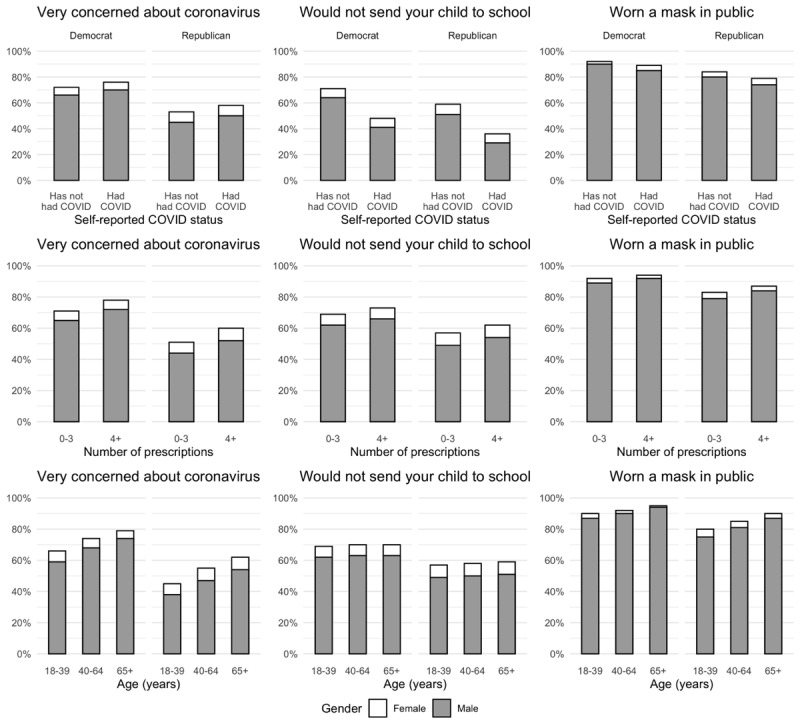
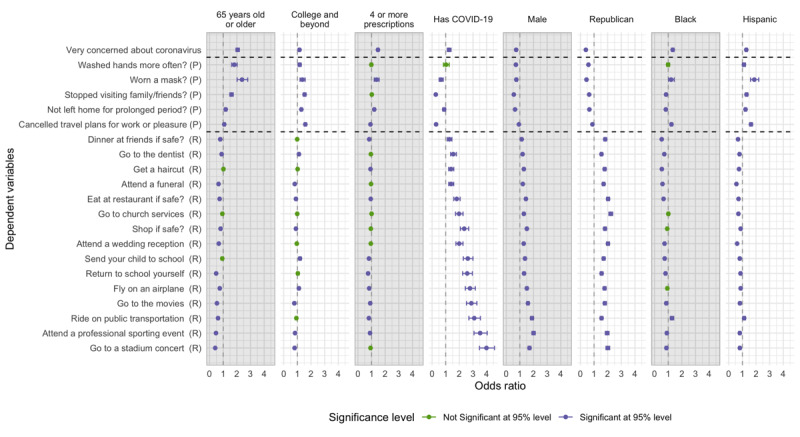
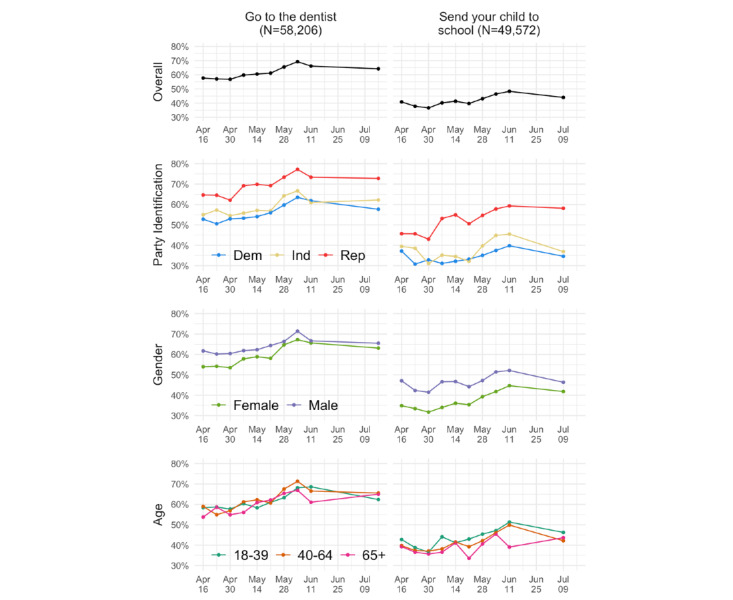
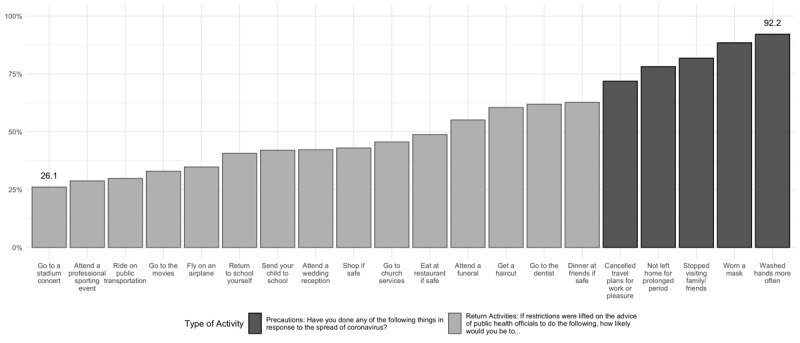
The data included 125,508 responses from web-based surveys conducted over 20 consecutive weeks during the COVID-19 pandemic (comprising approximately 6250 adults per week), between March 19 and August 5, 2020, approved by the University of California, Los Angeles (UCLA) Institutional Review Board for analysis. A substantial number of participants were not willing to return to activity even after the restrictions were lifted. Weighted multivariate logistic regressions indicated the following groups had different outcomes (all P<.001): individuals aged ≥65 years (COVID-19-related concerns: OR 2.05, 95% CI 1.93-2.18; precautionary behaviors: OR 2.38, 95% CI 2.02-2.80; return to activity: OR 0.41, 95% CI 0.37-0.46 vs 18-40 years); men (COVID-19-related concerns: OR 0.73, 95% CI 0.70-0.75; precautionary behaviors: OR 0.74, 95% CI 0.67-0.81; return to activity: OR 2.00, 95% CI 1.88-2.12 vs women); taking ≥4 medications (COVID-19-related concerns: OR 1.47, 95% CI 1.40-1.54; precautionary behaviors: OR 1.36, 95% CI 1.20-1.555; return to activity: OR 0.75, 95% CI 0.69-0.81 vs <3 medications); Republicans (COVID-19-related concerns: OR 0.40, 95% CI 0.38-0.42; precautionary behaviors: OR 0.45, 95% CI 0.40-0.50; return to activity: OR 2.22, 95% CI 2.09-2.36 vs Democrats); and adults who reported having COVID-19 (COVID-19-related concerns: OR 1.24, 95% CI 1.12-1.39; precautionary behaviors: OR 0.65, 95% CI 0.52-0.81; return to activity: OR 3.99, 95% CI 3.48-4.58 vs those who did not).

CONCLUSIONS

Participants' age, party affiliation, and perceived COVID-19 status were strongly associated with their COVID-19-related concerns, precautionary behaviors, and willingness to return to activity. Future studies need to develop and test targeted messaging approaches and consider political partisanship to encourage preventative behaviors and willingness to return to activities.

摘要

背景

由于关于 COVID-19 的信息相互矛盾,公众可能不确定在预防行为和是否恢复活动的决策方面该如何进行。

目的

本研究旨在确定与 COVID-19 相关的担忧、预防行为以及恢复活动意愿相关的因素。

方法

从 Democracy Fund + UCLA Nationscape Project 获取全国调查数据,这是一项正在进行的横断面每周调查。样本由 Lucid 提供,Lucid 是一个基于网络的市场研究平台。评估了三个结果:(1)COVID-19 相关的担忧,(2)预防行为,以及(3)恢复活动的意愿。主要的独立变量包括年龄、性别、种族或民族、教育程度、家庭收入、政党支持、宗教信仰、新闻消费、药物处方数量、感知 COVID-19 状况以及各州 COVID-19 感染高峰的时间。

结果

这些数据包括 2020 年 3 月 19 日至 8 月 5 日期间在 COVID-19 大流行期间进行的 20 周连续网络调查的 125508 份回复,每周约有 6250 名成年人参与,这些回复由加利福尼亚大学洛杉矶分校(UCLA)机构审查委员会批准进行分析。即使在限制解除后,仍有相当数量的参与者不愿意恢复活动。加权多元逻辑回归表明,以下群体有不同的结果(均 P<.001):年龄≥65 岁的个体(COVID-19 相关担忧:OR 2.05,95%CI 1.93-2.18;预防行为:OR 2.38,95%CI 2.02-2.80;恢复活动:OR 0.41,95%CI 0.37-0.46 与 18-40 岁);男性(COVID-19 相关担忧:OR 0.73,95%CI 0.70-0.75;预防行为:OR 0.74,95%CI 0.67-0.81;恢复活动:OR 2.00,95%CI 1.88-2.12 与女性);服用≥4 种药物(COVID-19 相关担忧:OR 1.47,95%CI 1.40-1.54;预防行为:OR 1.36,95%CI 1.20-1.555;恢复活动:OR 0.75,95%CI 0.69-0.81 与<3 种药物);共和党人(COVID-19 相关担忧:OR 0.40,95%CI 0.38-0.42;预防行为:OR 0.45,95%CI 0.40-0.50;恢复活动:OR 2.22,95%CI 2.09-2.36 与民主党人);以及报告有 COVID-19 的成年人(COVID-19 相关担忧:OR 1.24,95%CI 1.12-1.39;预防行为:OR 0.65,95%CI 0.52-0.81;恢复活动:OR 3.99,95%CI 3.48-4.58 与没有 COVID-19 的人)。

结论

参与者的年龄、党派和感知的 COVID-19 状况与他们的 COVID-19 相关担忧、预防行为以及恢复活动的意愿密切相关。未来的研究需要开发和测试有针对性的信息传递方法,并考虑政治党派关系,以鼓励预防行为和恢复活动的意愿。
https://cdn.ncbi.nlm.nih.gov/pmc/blobs/85b1/8080961/d40621eee7be/publichealth_v7i4e24277_fig4.jpg
https://cdn.ncbi.nlm.nih.gov/pmc/blobs/85b1/8080961/136183524dab/publichealth_v7i4e24277_fig1.jpg
https://cdn.ncbi.nlm.nih.gov/pmc/blobs/85b1/8080961/d35bb97b73a4/publichealth_v7i4e24277_fig2.jpg
https://cdn.ncbi.nlm.nih.gov/pmc/blobs/85b1/8080961/2aeb316f3ef7/publichealth_v7i4e24277_fig3.jpg
https://cdn.ncbi.nlm.nih.gov/pmc/blobs/85b1/8080961/d40621eee7be/publichealth_v7i4e24277_fig4.jpg
https://cdn.ncbi.nlm.nih.gov/pmc/blobs/85b1/8080961/136183524dab/publichealth_v7i4e24277_fig1.jpg
https://cdn.ncbi.nlm.nih.gov/pmc/blobs/85b1/8080961/d35bb97b73a4/publichealth_v7i4e24277_fig2.jpg
https://cdn.ncbi.nlm.nih.gov/pmc/blobs/85b1/8080961/2aeb316f3ef7/publichealth_v7i4e24277_fig3.jpg
https://cdn.ncbi.nlm.nih.gov/pmc/blobs/85b1/8080961/d40621eee7be/publichealth_v7i4e24277_fig4.jpg

相似文献

1
Effects of Age, Gender, Health Status, and Political Party on COVID-19-Related Concerns and Prevention Behaviors: Results of a Large, Longitudinal Cross-sectional Survey.年龄、性别、健康状况和政党对 COVID-19 相关问题和预防行为的影响:一项大型、纵向横断面调查的结果。
JMIR Public Health Surveill. 2021 Apr 28;7(4):e24277. doi: 10.2196/24277.
2
Novel Predictors of COVID-19 Protective Behaviors Among US Adults: Cross-sectional Survey.新冠病毒保护行为的新型预测因子:美国成年人的横断面调查。
J Med Internet Res. 2021 Apr 20;23(4):e23488. doi: 10.2196/23488.
3
Effects of COVID-19 Emergency Alert Text Messages on Practicing Preventive Behaviors: Cross-sectional Web-Based Survey in South Korea.新冠疫情紧急警报短信对践行预防行为的影响:韩国基于网络的横断面调查
J Med Internet Res. 2021 Feb 25;23(2):e24165. doi: 10.2196/24165.
4
COVID-19 precautionary behavior among Israeli breast cancer patients.以色列乳腺癌患者的 COVID-19 预防行为。
Support Care Cancer. 2021 Jul;29(7):4075-4080. doi: 10.1007/s00520-020-05948-2. Epub 2021 Jan 6.
5
The North American Layman's Understanding of COVID-19: Are We Doing Enough?北美民众对 COVID-19 的理解:我们做得够吗?
Front Public Health. 2020 Jul 3;8:358. doi: 10.3389/fpubh.2020.00358. eCollection 2020.
6
Predicting attitudes towards easing COVID-19 restrictions in the United States of America: The role of health concerns, demographic, political, and individual difference factors.预测美国民众对放宽 COVID-19 限制措施的态度:健康担忧、人口统计学、政治和个体差异因素的作用。
PLoS One. 2022 Feb 23;17(2):e0263128. doi: 10.1371/journal.pone.0263128. eCollection 2022.
7
Knowledge and Behaviors Toward COVID-19 Among US Residents During the Early Days of the Pandemic: Cross-Sectional Online Questionnaire.美国居民在大流行早期对 COVID-19 的认知和行为:横断面在线问卷调查。
JMIR Public Health Surveill. 2020 May 8;6(2):e19161. doi: 10.2196/19161.
8
Use of Rapid Online Surveys to Assess People's Perceptions During Infectious Disease Outbreaks: A Cross-sectional Survey on COVID-19.利用快速在线调查评估传染病暴发期间人们的认知:一项关于新冠肺炎的横断面调查
J Med Internet Res. 2020 Apr 2;22(4):e18790. doi: 10.2196/18790.
9
Association of Depression With Precautionary Behavior Compliance, COVID-19 Fear, and Health Behaviors in South Korea: National Cross-sectional Study.韩国全国性横断面研究:抑郁与预防行为遵守、对新冠病毒的恐惧和健康行为的关联。
JMIR Public Health Surveill. 2023 Feb 22;9:e42677. doi: 10.2196/42677.
10
Concerns About Information Regarding COVID-19 on the Internet: Cross-Sectional Study.关于互联网上新冠病毒疾病信息的担忧:横断面研究
J Med Internet Res. 2020 Nov 9;22(11):e20487. doi: 10.2196/20487.

引用本文的文献

1
Preventive health behaviour differences across racial groups during the early stages of COVID-19.新冠疫情早期不同种族群体的预防性健康行为差异
J Infect Prev. 2024 Sep;25(5):166-181. doi: 10.1177/17571774241238659. Epub 2024 Mar 14.
2
Self-Reported COVID-19 Vaccine and Booster Acceptance and Hesitancy Among Autistic Adults in Pennsylvania: Cross-Sectional Analysis of Survey Data.宾夕法尼亚州自闭症成年人自我报告的新冠疫苗及加强针接种接受度与犹豫情况:调查数据的横断面分析
JMIR Public Health Surveill. 2024 Aug 28;10:e51054. doi: 10.2196/51054.
3
Using Mobile Phone Data to Assess Socio-Economic Disparities in Unhealthy Food Reliance during the COVID-19 Pandemic.

本文引用的文献

1
Partisanship, health behavior, and policy attitudes in the early stages of the COVID-19 pandemic. partisanship, health behavior, and policy attitudes in the early stages of the COVID-19 pandemic
PLoS One. 2021 Apr 7;16(4):e0249596. doi: 10.1371/journal.pone.0249596. eCollection 2021.
2
Infection fatality rate of COVID-19 inferred from seroprevalence data.基于血清流行率数据推断的 COVID-19 感染病死率。
Bull World Health Organ. 2021 Jan 1;99(1):19-33F. doi: 10.2471/BLT.20.265892. Epub 2020 Oct 14.
3
Covid-19: Do many people have pre-existing immunity?
利用手机数据评估新冠疫情期间不健康食品依赖方面的社会经济差异。
Health Data Sci. 2023 Dec 15;3:0101. doi: 10.34133/hds.0101. eCollection 2023.
4
Online Health Information Seeking and Preventative Health Actions: Cross-Generational Online Survey Study.在线健康信息搜索与预防性健康行动:跨代在线调查研究
J Med Internet Res. 2024 Mar 11;26:e48977. doi: 10.2196/48977.
5
The sound of safety: exploring the determinants of prevention intention in noisy industrial workplaces.安全的声音:探索嘈杂工业工作场所预防意图的决定因素。
BMC Public Health. 2024 Jan 4;24(1):90. doi: 10.1186/s12889-023-17618-z.
6
Communicating scientific uncertainty in the early stages of the COVID-19 pandemic: A message experiment.新冠疫情早期的科学不确定性交流:一项信息实验。
Risk Anal. 2024 Jul;44(7):1700-1715. doi: 10.1111/risa.14256. Epub 2023 Nov 14.
7
A Scoping Review on Gender/Sex Differences in COVID-19 Vaccine Intentions and Uptake in the United States.美国 COVID-19 疫苗接种意愿和接种情况的性别/性别差异范围综述
Am J Health Promot. 2024 Feb;38(2):242-274. doi: 10.1177/08901171231200778. Epub 2023 Oct 17.
8
Correlates of COVID-19 Preventative Behaviors before and after Vaccination Availability.疫苗可用前后新冠病毒预防行为的相关因素
Behav Sci (Basel). 2023 Jun 14;13(6):501. doi: 10.3390/bs13060501.
9
Observed face mask use outside retail chain stores during the COVID-19 pandemic in two cities in the state of Idaho, USA.观察到在 COVID-19 大流行期间,美国爱达荷州两个城市的零售连锁店外有人戴口罩。
J Community Health. 2024 Feb;49(1):26-33. doi: 10.1007/s10900-023-01241-5. Epub 2023 Jun 14.
10
Mask images on Twitter increase during COVID-19 mandates, especially in Republican counties.在 COVID-19 强制令期间,Twitter 上的口罩相关图像增加,尤其是在共和党县。
Sci Rep. 2022 Dec 9;12(1):21331. doi: 10.1038/s41598-022-23368-6.
新冠病毒:很多人有既往免疫力吗?
BMJ. 2020 Sep 17;370:m3563. doi: 10.1136/bmj.m3563.
4
Association Between Public Knowledge About COVID-19, Trust in Information Sources, and Adherence to Social Distancing: Cross-Sectional Survey.公众对 COVID-19 的了解、对信息源的信任与遵守社交距离措施之间的关联:横断面调查。
JMIR Public Health Surveill. 2020 Sep 15;6(3):e22060. doi: 10.2196/22060.
5
Does gender influence clinical expression and disease outcomes in COVID-19? A systematic review and meta-analysis.性别是否会影响 COVID-19 的临床表型和疾病结局?一项系统回顾和荟萃分析。
Int J Infect Dis. 2020 Oct;99:496-504. doi: 10.1016/j.ijid.2020.07.076. Epub 2020 Aug 12.
6
Does the Prosperity of a Country Play a Role in COVID-19 Outcomes?一个国家的繁荣程度对新冠疫情结果有影响吗?
Disaster Med Public Health Prep. 2022 Feb;16(1):177-186. doi: 10.1017/dmp.2020.304. Epub 2020 Aug 12.
7
Author Correction: Temporal dynamics in viral shedding and transmissibility of COVID-19.作者更正:新型冠状病毒肺炎病毒脱落及传播的时间动态
Nat Med. 2020 Sep;26(9):1491-1493. doi: 10.1038/s41591-020-1016-z.
8
Serology testing in the COVID-19 pandemic response.新冠疫情应对中的血清学检测。
Lancet Infect Dis. 2020 Sep;20(9):e245-e249. doi: 10.1016/S1473-3099(20)30517-X. Epub 2020 Jul 17.
9
Men and COVID-19: A Biopsychosocial Approach to Understanding Sex Differences in Mortality and Recommendations for Practice and Policy Interventions.男性与 COVID-19:理解死亡率性别差异的生物心理社会方法及对实践和政策干预的建议。
Prev Chronic Dis. 2020 Jul 16;17:E63. doi: 10.5888/pcd17.200247.
10
Mask use during COVID-19: A risk adjusted strategy.新冠期间的口罩使用:风险调整策略。
Environ Pollut. 2020 Nov;266(Pt 1):115099. doi: 10.1016/j.envpol.2020.115099. Epub 2020 Jun 25.