Health Research Institute of the Balearic Islands, Palma de Mallorca, Spain.
Primary Care Research Unit of Mallorca, Balearic Islands Health Services, Palma de Mallorca, Spain.
JMIR Mhealth Uhealth. 2021 May 18;9(5):e27039. doi: 10.2196/27039.
The global health emergency generated by the COVID-19 pandemic is posing an unprecedented challenge to health care workers, who are facing heavy workloads under psychologically difficult situations. Mental mobile Health (mHealth) interventions are now being widely deployed due to their attractive implementation features, despite the lack of evidence about their efficacy in this specific population and context.
The aim of this trial is to evaluate the effectiveness of a psychoeducational, mindfulness-based mHealth intervention to reduce mental health problems in health care workers during the COVID-19 pandemic.
We conducted a blinded, parallel-group, controlled trial in Spain. Health care workers providing face-to-face health care to patients with COVID-19 were randomly assigned (1:1) to receive the PsyCovidApp intervention (an app targeting emotional skills, healthy lifestyle behavior, burnout, and social support) or a control app (general recommendations about mental health care) for 2 weeks. The participants were blinded to their group allocation. Data were collected telephonically at baseline and after 2 weeks by trained health psychologists. The primary outcome was a composite of depression, anxiety, and stress (overall score on the Depression Anxiety Stress Scale-21 [DASS-21]). Secondary outcomes were insomnia (Insomnia Severity Index), burnout (Maslach Burnout Inventory Human Services Survey), posttraumatic stress (Davidson Trauma Scale), self-efficacy (General Self-Efficacy Scale), and DASS-21 individual scale scores. Differences between groups were analyzed using general linear modeling according to an intention-to-treat protocol. Additionally, we measured the usability of the PsyCovidApp (System Usability Scale). The outcome data collectors and trial statisticians were unaware of the treatment allocation.
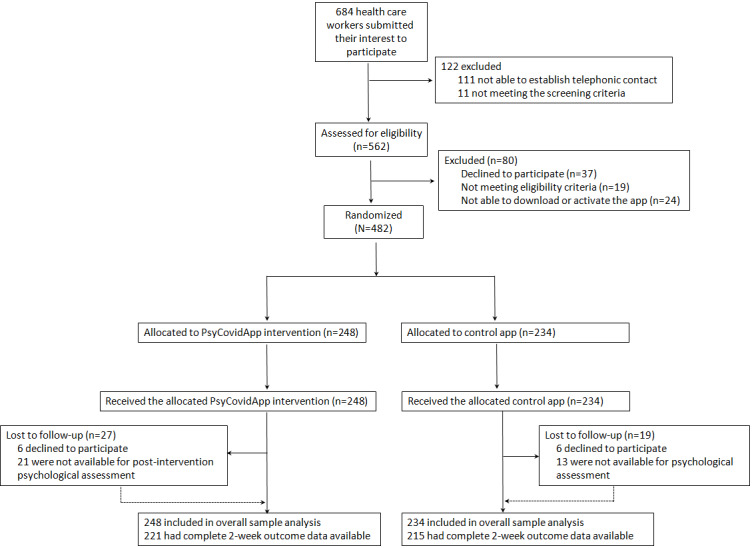
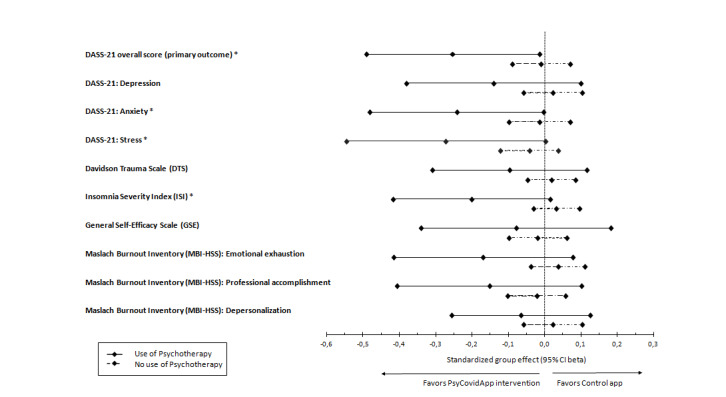
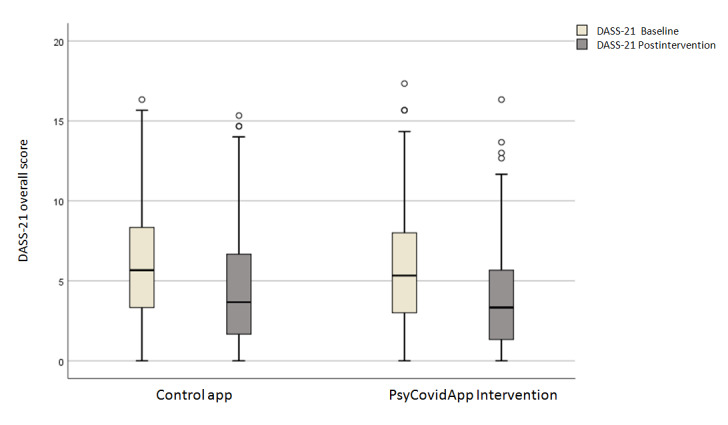
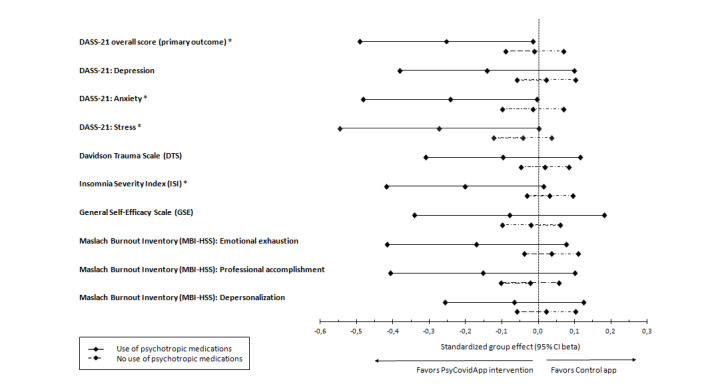
Between May 14 and July 25, 2020, 482 health care workers were recruited and randomly assigned to PsyCovidApp (n=248) or the control app (n=234). At 2 weeks, complete outcome data were available for 436/482 participants (90.5%). No significant differences were observed between the groups at 2 weeks in the primary outcome (standardized mean difference -0.04; 95% CI -0.11 to 0.04; P=.15) or in the other outcomes. In our prespecified subgroup analyses, we observed significant improvements among health care workers consuming psychotropic medications (n=79) in the primary outcome (-0.29; 95% CI -0.48 to -0.09; P=.004), and in posttraumatic stress, insomnia, anxiety, and stress. Similarly, among health care workers receiving psychotherapy (n=43), we observed improvements in the primary outcome (-0.25; 95% CI -0.49 to -0.02; P=.02), and in insomnia, anxiety, and stress. The mean usability score of PsyCovidApp was high (87.21/100, SD 12.65). After the trial, 208/221 participants in the intervention group (94.1%) asked to regain access to PsyCovidApp, indicating high acceptability.
In health care workers assisting patients with COVID-19 in Spain, PsyCovidApp, compared with a control app, reduced mental health problems at 2 weeks only among health care workers receiving psychotherapy or psychotropic medications.
ClinicalTrials.gov NCT04393818; https://clinicaltrials.gov/ct2/show/NCT04393818.
由 COVID-19 大流行引发的全球卫生紧急情况,正对医疗保健工作者造成前所未有的挑战,他们在心理困难的情况下面临着繁重的工作量。尽管在这一特定人群和背景下,精神移动健康(mHealth)干预措施的疗效缺乏证据,但由于其吸引人的实施特点,它们现在正在被广泛应用。
本试验旨在评估一种心理教育、基于正念的 mHealth 干预措施,以减少 COVID-19 大流行期间医疗保健工作者的心理健康问题。
我们在西班牙进行了一项盲法、平行组、对照试验。为面对面为 COVID-19 患者提供医疗服务的医疗保健工作者被随机分配(1:1)接受 PsyCovidApp 干预(针对情绪技能、健康生活方式行为、倦怠和社会支持的应用程序)或对照应用程序(关于精神保健的一般建议),为期 2 周。参与者对他们的分组分配是盲目的。数据通过训练有素的心理健康心理学家在基线和 2 周后通过电话收集。主要结果是抑郁、焦虑和压力(抑郁焦虑应激量表-21 [DASS-21] 的综合得分)的复合指标。次要结果是失眠(失眠严重程度指数)、倦怠(马斯拉奇倦怠量表-人类服务调查)、创伤后应激(戴维森创伤量表)、自我效能感(一般自我效能感量表)和 DASS-21 个体量表得分。根据意向治疗方案,使用一般线性建模分析组间差异。此外,我们还测量了 PsyCovidApp 的可用性(系统可用性量表)。结局数据收集者和试验统计学家对治疗分配不知情。
2020 年 5 月 14 日至 7 月 25 日,招募了 482 名医疗保健工作者,并随机分配至 PsyCovidApp(n=248)或对照应用程序(n=234)。在 2 周时,482 名参与者中有 436 名(90.5%)完成了完整的结局数据。在 2 周时,两组在主要结局(标准化均数差值-0.04;95%置信区间-0.11 至 0.04;P=.15)或其他结局方面均无显著差异。在我们预先指定的亚组分析中,我们观察到在使用精神药物(n=79)的医疗保健工作者中,主要结局(-0.29;95%置信区间-0.48 至-0.09;P=.004)和创伤后应激、失眠、焦虑和压力均有显著改善。同样,在接受心理治疗的医疗保健工作者(n=43)中,我们观察到主要结局(-0.25;95%置信区间-0.49 至-0.02;P=.02)和失眠、焦虑和压力均有改善。 PsyCovidApp 的平均可用性得分很高(87.21/100,标准差 12.65)。试验结束后,干预组的 208/221 名参与者(94.1%)要求重新访问 PsyCovidApp,表明接受度很高。
在为 COVID-19 患者提供医疗服务的西班牙医疗保健工作者中,与对照应用程序相比, PsyCovidApp 仅在接受心理治疗或精神药物的医疗保健工作者中,在 2 周时降低了心理健康问题。
ClinicalTrials.gov NCT04393818;https://clinicaltrials.gov/ct2/show/NCT04393818。