Cheng Weiren, Zhang Huabin, Luan Deyan, Lou Xiong Wen David
School of Chemical and Biomedical Engineering, Nanyang Technological University, 62 Nanyang Drive, Singapore 637459, Singapore.
Sci Adv. 2021 Apr 28;7(18). doi: 10.1126/sciadv.abg2580. Print 2021 Apr.
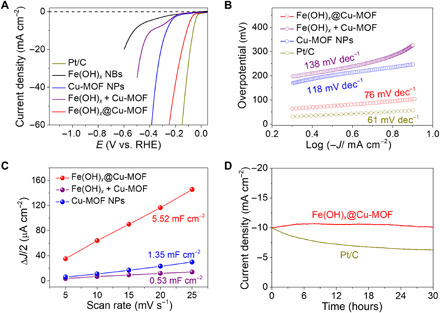
Conductive metal-organic framework (MOF) materials have been recently considered as effective electrocatalysts. However, they usually suffer from two major drawbacks, poor electrochemical stability and low electrocatalytic activity in bulk form. Here, we have developed a rational strategy to fabricate a promising electrocatalyst composed of a nanoscale conductive copper-based MOF (Cu-MOF) layer fully supported over synergetic iron hydr(oxy)oxide [Fe(OH) ] nanoboxes. Owing to the highly exposed active centers, enhanced charge transfer, and robust hollow nanostructure, the obtained Fe(OH) @Cu-MOF nanoboxes exhibit superior activity and stability for the electrocatalytic hydrogen evolution reaction (HER). Specifically, it needs an overpotential of 112 mV to reach a current density of 10 mA cm with a small Tafel slope of 76 mV dec X-ray absorption fine structure spectroscopy combined with density functional theory calculations unravels that the highly exposed coordinatively unsaturated Cu-O centers could effectively accelerate the formation of key *H intermediates toward fast HER kinetics.
导电金属有机框架(MOF)材料最近被认为是有效的电催化剂。然而,它们通常存在两个主要缺点,即电化学稳定性差和块状形式的电催化活性低。在此,我们开发了一种合理的策略来制备一种有前景的电催化剂,该催化剂由完全负载在协同铁氢氧化物[Fe(OH)]纳米盒上的纳米级导电铜基金属有机框架(Cu-MOF)层组成。由于高度暴露的活性中心、增强的电荷转移和坚固的中空纳米结构,所获得的Fe(OH)@Cu-MOF纳米盒在电催化析氢反应(HER)中表现出优异的活性和稳定性。具体而言,达到10 mA cm的电流密度需要112 mV的过电位,塔菲尔斜率小,为76 mV dec。X射线吸收精细结构光谱结合密度泛函理论计算表明,高度暴露的配位不饱和Cu-O中心可以有效地加速关键*H中间体的形成,从而实现快速的HER动力学。