Furukawa Yoshihiro, Iwasa Yoshinari, Chikaraishi Yoshito
Department of Earth Science, Tohoku University, 6-3 Aza-aoba, Aramaki, Aoba-ku, Sendai 980-8578, Japan.
Institute of Low-temperature Science, Hokkaido University, Kita-19, Nishi-8, Kita-ku, Sapporo 060-0819, Japan.
Sci Adv. 2021 Apr 28;7(18). doi: 10.1126/sciadv.abd3575. Print 2021 Apr.
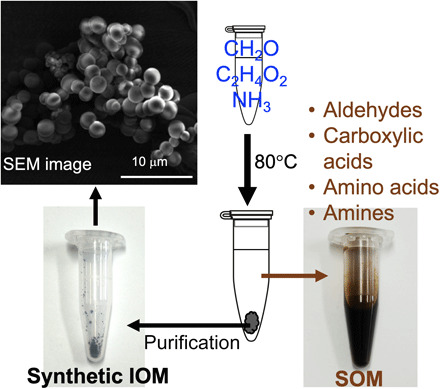
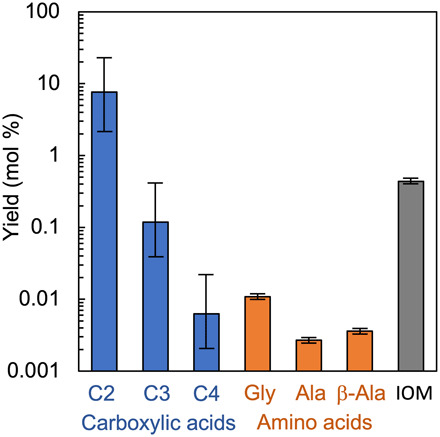
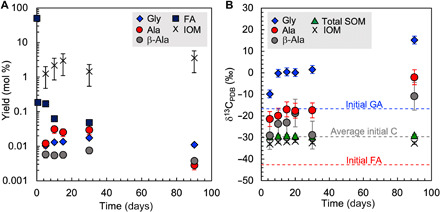
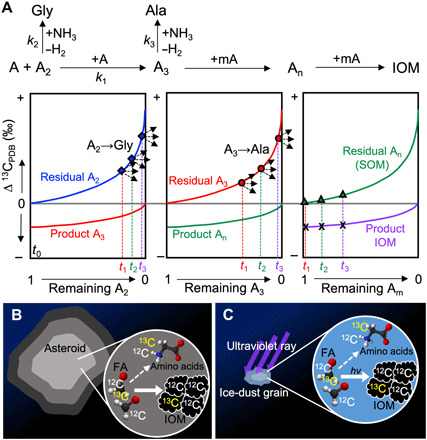
Solvent-soluble organic matter (SOM) in meteorites, which includes life's building molecules, is suspected to originate from the cold region of the early solar system, on the basis of C enrichment in the molecules. Here, we demonstrate that the isotopic characteristics are reproducible in amino acid synthesis associated with a formose-type reaction in a heated aqueous solution. Both thermochemically driven formose-type reaction and photochemically driven formose-type reaction likely occurred in asteroids and ice-dust grains in the early solar system. Thus, the present results suggest that the formation of C-enriched SOM was not specific to the cold outer protosolar disk or the molecular cloud but occurred more widely in the early solar system.
陨石中的溶剂可溶性有机物(SOM),包括构成生命的分子,基于分子中的碳富集,被怀疑起源于早期太阳系的寒冷区域。在此,我们证明了在加热水溶液中与福莫司型反应相关的氨基酸合成中,同位素特征是可重现的。热化学驱动的福莫司型反应和光化学驱动的福莫司型反应可能都发生在早期太阳系的小行星和冰尘颗粒中。因此,目前的结果表明,富含碳的SOM的形成并非早期原太阳盘外部寒冷区域或分子云所特有,而是在早期太阳系中更广泛地发生。