Abraham Kavitha, Abraham Anuja, Regi Annie, Lionel Jessie, Thomas Elsy, Vijayaselvi Reeta, Jeyaseelan L, Abraham Asha Mary, Santhanam Sridhar, Kuruvilla Kurian Anil, Steinhoff Mark C
Department of Obstetrics and Gynaecology, Christian Medical College Hospital, Vellore, Tamil Nadu, India.
Department of Biostatistics, Christian Medical College Hospital, Vellore, Tamil Nadu, India.
J Glob Infect Dis. 2021 Jan 29;13(1):20-26. doi: 10.4103/jgid.jgid_157_20. eCollection 2021 Jan-Mar.
Influenza infection in pregnancy causes 4%-8% case fatality and five times more perinatal mortality. Influenza is a major contributor to mortality in developing countries; however, the morbidity has largely been underestimated. Public health interventions for prevention are also lacking.
This study aimed to determine the seasonality of influenza in pregnant Indian women and to estimate the maternal and perinatal morbidity after treatment with oseltamivir.
This was a prospective observational cohort study, conducted in a tertiary hospital.
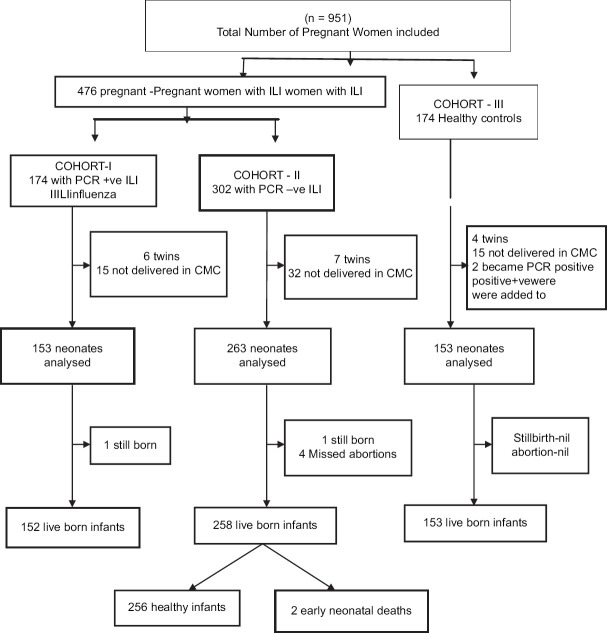
Pregnant women with ILI (influenza-like illness) were recruited into Cohort 1 (polymerase chain reaction [PCR] positive) and Cohort 2 (PCR negative). Gestational age-matched asymptomatic controls formed Cohort 3. Women in Cohort 1 received oseltamivir for 5 days. The incidence of small-for-gestational age (SGA) and preterm birth were the primary outcomes. Maternal and neonatal morbidity formed the secondary outcomes.
Unmatched (Cohort 1 and 2) and matched analysis (Cohort 1 and 3) were done. Student's -test and Chi-square test were used to compare between variables.
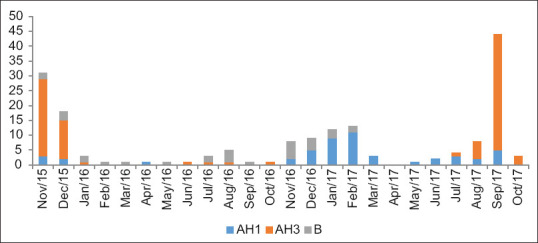
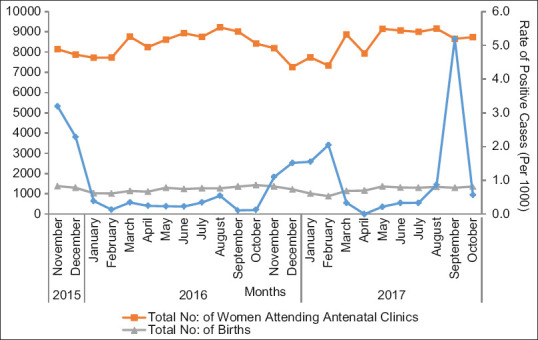
Year-round incidence of influenza was recorded. Severe illness was more in Cohort 1 compared to Cohort 2 (36.2% vs. 6.3%; < 0.001). SGA was comparable in all the cohorts (13%). Preterm birth (7.8% vs. 3.3%; < 0.08; relative risk-2.75) was considerably high in Cohort 1. Secondary maternal and neonatal outcomes were similar between the groups.
Influenza in pregnancy showed year-round incidence and increased maternal and neonatal morbidity despite treatment with oseltamivir. We suggest the need for newer interventions to curtail the illness in pregnancy.
妊娠期流感感染导致4%-8%的病死率以及高出五倍的围产期死亡率。流感是发展中国家死亡的主要原因;然而,其发病率在很大程度上被低估了。预防方面的公共卫生干预措施也很缺乏。
本研究旨在确定印度孕妇流感的季节性,并评估使用奥司他韦治疗后的孕产妇和围产期发病率。
这是一项在三级医院进行的前瞻性观察队列研究。
患有流感样疾病(ILI)的孕妇被纳入队列1(聚合酶链反应[PCR]阳性)和队列2(PCR阴性)。孕周匹配的无症状对照组组成队列3。队列1中的女性接受奥司他韦治疗5天。小于胎龄儿(SGA)和早产的发生率是主要结局。孕产妇和新生儿发病率是次要结局。
进行了非配对分析(队列1和2)和配对分析(队列1和3)。采用学生t检验和卡方检验比较变量。
记录到流感全年发病。与队列2相比,队列1中的重症病例更多(36.2%对6.3%;P<0.001)。所有队列中的SGA发生率相当(13%)。队列1中的早产发生率(7.8%对3.3%;P<0.08;相对风险-2.75)相当高。两组间的次要孕产妇和新生儿结局相似。
妊娠期流感全年发病,尽管使用了奥司他韦治疗,但孕产妇和新生儿发病率仍有所增加。我们建议需要更新的干预措施来减少妊娠期疾病。