Mertz Dominik, Geraci Johanna, Winkup Judi, Gessner Bradford D, Ortiz Justin R, Loeb Mark
Department of Medicine, McMaster University, Hamilton, ON, Canada; Department of Clinical Epidemiology and Biostatistics, McMaster University, Hamilton, ON, Canada; Department of Pathology and Molecular Medicine, McMaster University, Hamilton, ON, Canada; Michael G. DeGroote Institute for Infectious Diseases Research, McMaster University, Hamilton, ON, Canada.
Department of Family Medicine (Midwifery), McMaster University, Hamilton, ON, Canada.
Vaccine. 2017 Jan 23;35(4):521-528. doi: 10.1016/j.vaccine.2016.12.012. Epub 2016 Dec 23.
Pregnancy is considered to be an important risk factor for severe complications following influenza virus infection. As a consequence, WHO recommendations prioritize pregnant women over other risk groups for influenza vaccination. However, the risk associated with pregnancy has not been systematically quantified.
Systematic review and meta-analysis of observational studies that reported on pregnancy as a risk factor for severe outcomes from influenza virus infection.
MEDLINE, EMBASE, CINAHL, and CENTRAL up to April 2014.
Studies reporting on outcomes in pregnant women with influenza in comparison to non-pregnant patients with influenza. Outcomes included community-acquired pneumonia, hospitalization, admission to intensive care units (ICU), ventilatory support, and death.
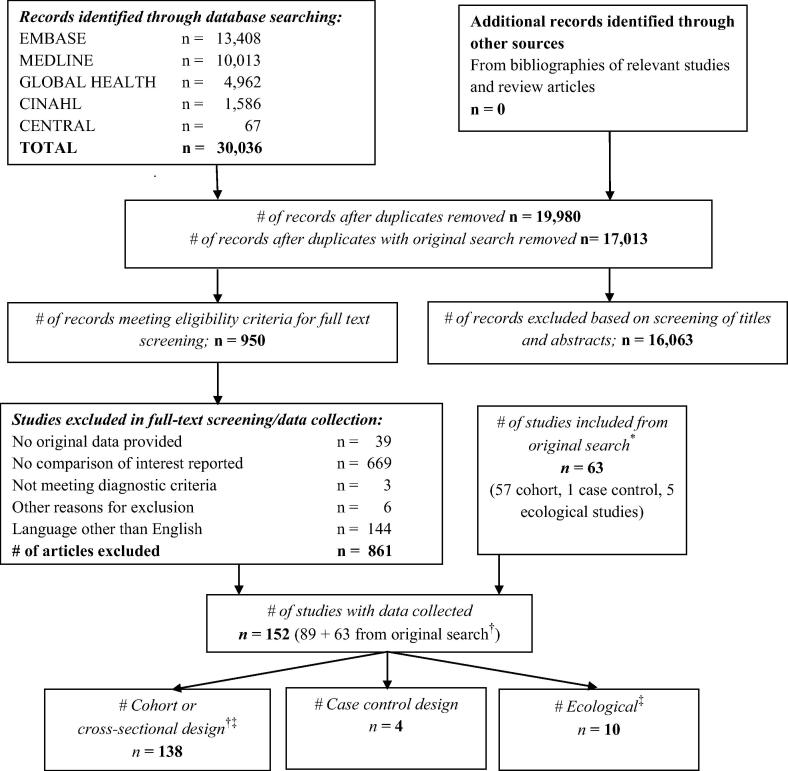
Two reviewers conducted independent screening and data extraction. A random effects model was used to obtain risk estimates. Ecological studies were summarized descriptively.
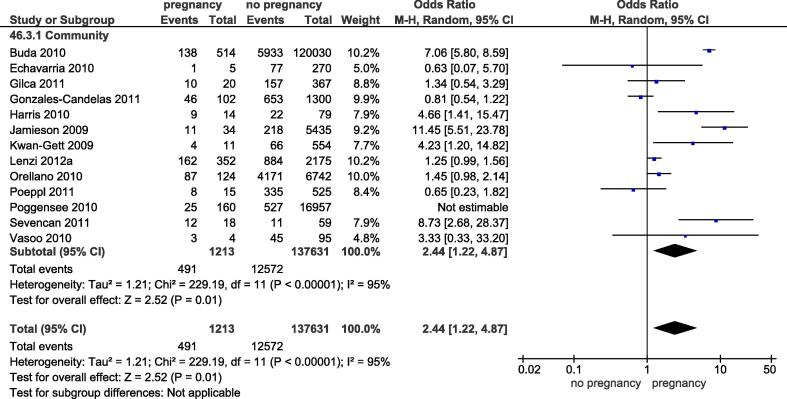
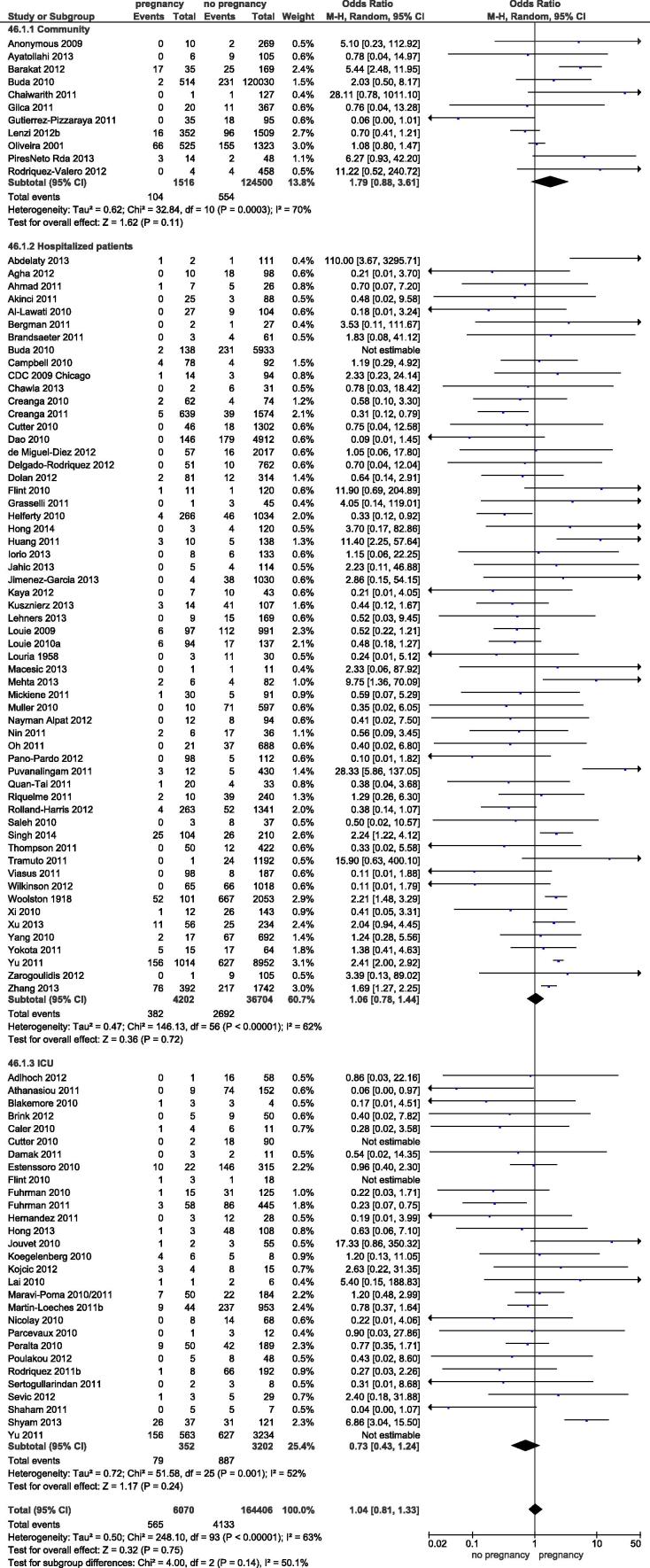
A total of 142 non-ecological and 10 ecological studies were included. The majority of studies (n=136, 95.8%) were conducted during the 2009 influenza A (pH1N1) pandemic. There was a higher risk for hospitalization in pregnant versus non-pregnant patients infected with influenza (odds ratio [OR] 2.44, 95% CI 1.22-4.87), but no significant difference in mortality (OR 1.04, 95% CI 0.81-1.33) or other outcomes. Ecologic studies confirmed the association between hospitalization risk and pregnancy and 4 of 7 studies reported higher mortality rates in pregnant women.
No studies were identified in which follow-up began prior to contact with the healthcare system and lack of adjustment for confounding factors.
We found that influenza during pregnancy resulted in a higher risk of hospital admission than influenza infection in non-pregnant individuals, but that the risk of mortality following influenza was similar in both pregnant and non-pregnant individuals.
妊娠被认为是流感病毒感染后出现严重并发症的重要危险因素。因此,世界卫生组织的建议将孕妇列为比其他风险群体更优先的流感疫苗接种对象。然而,与妊娠相关的风险尚未得到系统量化。
对报告妊娠作为流感病毒感染严重后果危险因素的观察性研究进行系统评价和荟萃分析。
截至2014年4月的MEDLINE、EMBASE、CINAHL和CENTRAL数据库。
报告流感孕妇与非流感孕妇结局的研究。结局包括社区获得性肺炎、住院、入住重症监护病房(ICU)、通气支持和死亡。
两名评价员进行独立筛选和数据提取。采用随机效应模型获得风险估计值。对生态学研究进行描述性总结。
共纳入142项非生态学研究和10项生态学研究。大多数研究(n = 136,95.8%)是在2009年甲型流感(pH1N1)大流行期间进行的。感染流感的孕妇与非孕妇相比,住院风险更高(优势比[OR]2.44,95%可信区间1.22 - 4.87),但在死亡率(OR 1.04,95%可信区间0.81 - 1.33)或其他结局方面无显著差异。生态学研究证实了住院风险与妊娠之间的关联,7项研究中有4项报告孕妇死亡率较高。
未发现随访在接触医疗系统之前开始的研究,且缺乏对混杂因素的调整。
我们发现,妊娠期间感染流感导致住院风险高于非妊娠个体感染流感,但流感后的死亡风险在妊娠和非妊娠个体中相似。