Department of Neurology College of Health Sciences Addis Ababa University.
Ethiop J Health Sci. 2020 Sep;30(5):843-846. doi: 10.4314/ejhs.v30i5.24.
Virchow-Robin Spaces (VRS) are perivascular spaces that surround small arteries and arterioles. These normal anatomical structures are thought to be involved in the drainage of interstitial fluid and also to play an immunomodulatory role by hosting macrophages. Rarely, it becomes giant and symptomatic resulting in mass effect on adjacent neuronal structures and ventricular system causing different neurological disorders.
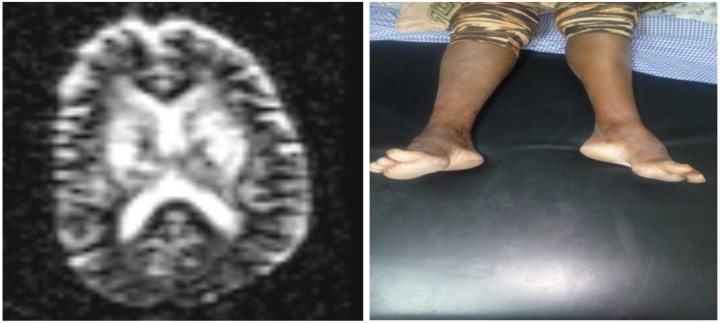
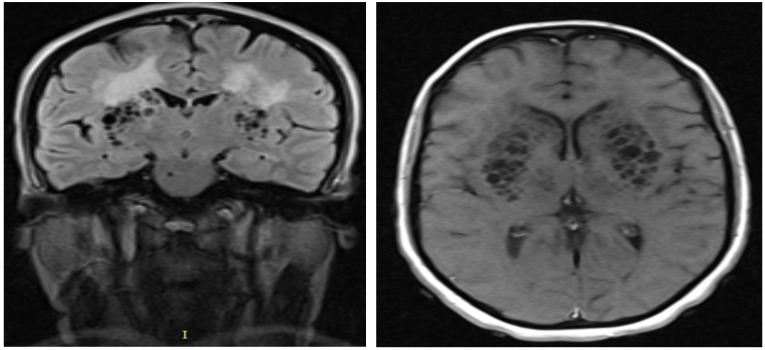
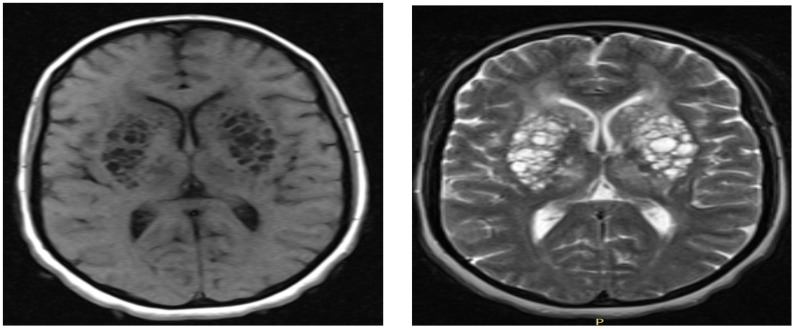
We report a 43-year-old, Ethiopian woman who presented with progressive weakness of all her extremity over the period of seven years. She had associated speech difficulty, visual blurring and pseudo-bulbar affect. Neurologic examination revealed spastic quadriparesis with increased deep tendon reflexes and up going plantar bilaterally. She had horizontal nystagmus, dysarthria and reduced bilateral visual acuity, otherwise normal cognition and cranial nerves examination. Brain MRI showed T1 hypointense, T2 hyperintense and non-enhancing multiple cystic lesions of different size, mainly in bilateral basal ganglia area with mass effect on adjacent internal capsule and lateral ventricles. Considering her clinical presentation and typical radiological features, diagnosis of symptomatic dilated Virchow-Robin spaces was made, and the patient was treated symptomatically.
Commonly, dilation of Virchow-Robin spaces are not symptomatic, but giant Virchow-Robin spaces, as in our patient may result in spastic quadriparesis, causing great disability on the patient. Thus, we recommend considering symptomatic Virchow-Robin spaces as a potential differential diagnosis of progressive quadriparesis, as early neurosurgical intervention may reduce the neurological complications, such as spastic quadriparesis.
血管周围间隙(VRS)是围绕小动脉和小动脉的血管周围间隙。这些正常的解剖结构被认为参与了间质液的引流,并且通过容纳巨噬细胞发挥免疫调节作用。很少见的是,它们会变得巨大并出现症状,对邻近的神经元结构和脑室系统产生占位效应,导致不同的神经障碍。
我们报告了一位 43 岁的埃塞俄比亚女性,她在过去七年中逐渐出现四肢无力。她伴有言语困难、视力模糊和假性延髓性影响。神经系统检查显示痉挛性四肢瘫痪,伴有深部腱反射亢进和双侧向上的跖反射。她有水平性眼球震颤、构音障碍和双侧视力下降,认知功能和颅神经检查正常。脑 MRI 显示 T1 低信号、T2 高信号和不同大小的非增强性多个囊性病变,主要位于双侧基底节区,对邻近内囊和侧脑室产生占位效应。鉴于她的临床表现和典型的影像学特征,诊断为症状性扩张性血管周围间隙,对患者进行了对症治疗。
通常情况下,血管周围间隙扩张不会出现症状,但像我们患者的巨大血管周围间隙可能导致痉挛性四肢瘫痪,给患者带来极大的残疾。因此,我们建议将症状性血管周围间隙视为进行性四肢瘫痪的潜在鉴别诊断之一,因为早期神经外科干预可能会减少痉挛性四肢瘫痪等神经并发症。