Wu Lei-Lei, Wang Jin-Long, Huang Wei, Liu Xuan, Huang Yang-Yu, Zeng Jing, Cui Chun-Yan, Lu Jia-Bin, Lin Peng, Long Hao, Zhang Lan-Jun, Wei Jun, Lu Yao, Ma Guo-Wei
Sun Yat-sen University Cancer Center, State Key Laboratory of Oncology in South China, Collaborative Innovation Center for Cancer Medicine, Sun Yat-sen University, Guangzhou, China.
School of Data and Computer Science, Sun Yat-sen University, Guangzhou, China.
Front Oncol. 2021 Apr 12;11:565755. doi: 10.3389/fonc.2021.565755. eCollection 2021.
To evaluate the effectiveness of a novel computerized quantitative analysis based on histopathological and computed tomography (CT) images for predicting the postoperative prognosis of esophageal squamous cell carcinoma (ESCC) patients.
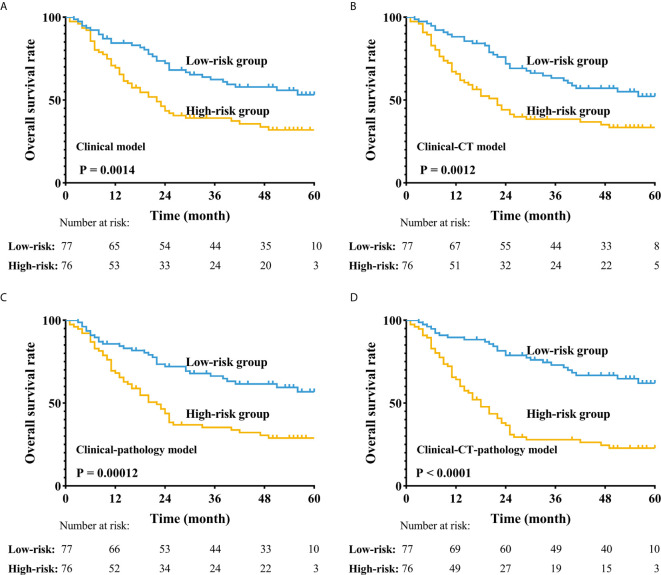
We retrospectively reviewed the medical records of 153 ESCC patients who underwent esophagectomy alone and quantitatively analyzed digital histological specimens and diagnostic CT images. We cut pathological images (6000 × 6000) into 50 × 50 patches; each patient had 14,400 patches. Cluster analysis was used to process these patches. We used the pathological clusters to all patches ratio (PCPR) of each case for pathological features and we obtained 20 PCPR quantitative features. Totally, 125 computerized quantitative (20 PCPR and 105 CT) features were extracted. We used a recursive feature elimination approach to select features. A Cox hazard model with L1 penalization was used for prognostic indexing. We compared the following prognostic models: Model A: clinical features; Model B: quantitative CT and clinical features; Model C: quantitative histopathological and clinical features; and Model D: combined information of clinical, CT, and histopathology. Indices of concordance (C-index) and leave-one-out cross-validation (LOOCV) were used to assess prognostic model accuracy.
Five PCPR and eight CT features were treated as significant indicators in ESCC prognosis. C-indices adjusted for LOOCV were comparable among four models, 0.596 (Model A) vs. 0.658 (Model B) vs. 0.651 (Model C), and improved to 0.711with Model D combining information of clinical, CT, and histopathology (all p<0.05). Using Model D, we stratified patients into low- and high-risk groups. The 3-year overall survival rates of low- and high-risk patients were 38.0% and 25.0%, respectively (p<0.001).
Quantitative prognostic modeling using a combination of clinical data, histopathological, and CT images can stratify ESCC patients with surgery alone into high-risk and low-risk groups.
评估一种基于组织病理学和计算机断层扫描(CT)图像的新型计算机定量分析方法对预测食管鳞状细胞癌(ESCC)患者术后预后的有效性。
我们回顾性分析了153例行单纯食管切除术的ESCC患者的病历,并对数字组织学标本和诊断性CT图像进行了定量分析。我们将病理图像(6000×6000)切成50×50的小块;每位患者有14400个小块。采用聚类分析处理这些小块。我们用每个病例的病理簇与所有小块的比例(PCPR)来表示病理特征,并获得了20个PCPR定量特征。总共提取了125个计算机定量(20个PCPR和105个CT)特征。我们采用递归特征消除方法来选择特征。使用带有L1惩罚的Cox风险模型进行预后指数分析。我们比较了以下预后模型:模型A:临床特征;模型B:定量CT和临床特征;模型C:定量组织病理学和临床特征;模型D:临床、CT和组织病理学的综合信息。使用一致性指数(C指数)和留一法交叉验证(LOOCV)来评估预后模型的准确性。
五个PCPR和八个CT特征被视为ESCC预后的显著指标。经LOOCV调整后的C指数在四个模型中具有可比性,模型A为0.596,模型B为0.658,模型C为0.651,而将临床、CT和组织病理学信息相结合的模型D提高到了0.711(所有p<0.05)。使用模型D,我们将患者分为低风险和高风险组。低风险和高风险患者的3年总生存率分别为38.0%和25.0%(p<0.001)。
结合临床数据、组织病理学和CT图像的定量预后模型可将单纯手术治疗的ESCC患者分为高风险和低风险组。