CAS Key Laboratory of Molecular Imaging, Institute of Automation, Chinese Academy of Sciences, Beijing, China.
University of Chinese Academy of Sciences, Beijing, China.
Eur Respir J. 2019 Mar 28;53(3). doi: 10.1183/13993003.00986-2018. Print 2019 Mar.
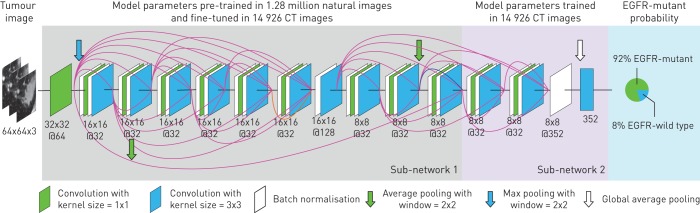
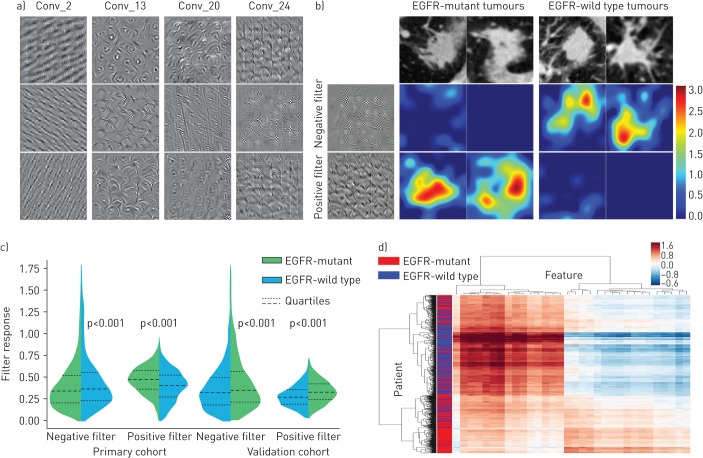
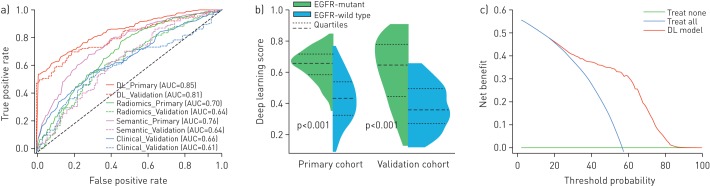
Epidermal growth factor receptor (EGFR) genotyping is critical for treatment guidelines such as the use of tyrosine kinase inhibitors in lung adenocarcinoma. Conventional identification of EGFR genotype requires biopsy and sequence testing which is invasive and may suffer from the difficulty of accessing tissue samples. Here, we propose a deep learning model to predict EGFR mutation status in lung adenocarcinoma using non-invasive computed tomography (CT).We retrospectively collected data from 844 lung adenocarcinoma patients with pre-operative CT images, EGFR mutation and clinical information from two hospitals. An end-to-end deep learning model was proposed to predict the EGFR mutation status by CT scanning.By training in 14 926 CT images, the deep learning model achieved encouraging predictive performance in both the primary cohort (n=603; AUC 0.85, 95% CI 0.83-0.88) and the independent validation cohort (n=241; AUC 0.81, 95% CI 0.79-0.83), which showed significant improvement over previous studies using hand-crafted CT features or clinical characteristics (p<0.001). The deep learning score demonstrated significant differences in EGFR-mutant and EGFR-wild type tumours (p<0.001).Since CT is routinely used in lung cancer diagnosis, the deep learning model provides a non-invasive and easy-to-use method for EGFR mutation status prediction.
表皮生长因子受体 (EGFR) 基因分型对于治疗指南至关重要,例如在肺腺癌中使用酪氨酸激酶抑制剂。传统的 EGFR 基因型鉴定需要活检和序列检测,这是一种有创的方法,可能会遇到获取组织样本的困难。在这里,我们提出了一种深度学习模型,通过非侵入性的计算机断层扫描 (CT) 来预测肺腺癌中的 EGFR 突变状态。我们回顾性地收集了来自两家医院的 844 例肺腺癌患者的术前 CT 图像、EGFR 突变和临床信息。提出了一种端到端的深度学习模型,通过 CT 扫描来预测 EGFR 突变状态。通过对 14926 张 CT 图像进行训练,深度学习模型在主要队列(n=603;AUC 0.85,95%CI 0.83-0.88)和独立验证队列(n=241;AUC 0.81,95%CI 0.79-0.83)中均取得了令人鼓舞的预测性能,与使用手工制作的 CT 特征或临床特征的先前研究相比,均有显著改善(p<0.001)。深度学习评分在 EGFR 突变型和 EGFR 野生型肿瘤之间存在显著差异(p<0.001)。由于 CT 常用于肺癌诊断,因此深度学习模型为 EGFR 突变状态预测提供了一种非侵入性且易于使用的方法。