Laboratory of Biochemistry, School of Veterinary Medicine, Azabu University, Sagamihara, Kanagawa 252-5201, Japan.
Laboratory of Radiation Biology, Department of Applied Veterinary Sciences, Graduate School of Veterinary Medicine, Hokkaido University, Sapporo, Hokkaido 060-0818, Japan.
J Radiat Res. 2021 Jul 10;62(4):564-573. doi: 10.1093/jrr/rrab032.
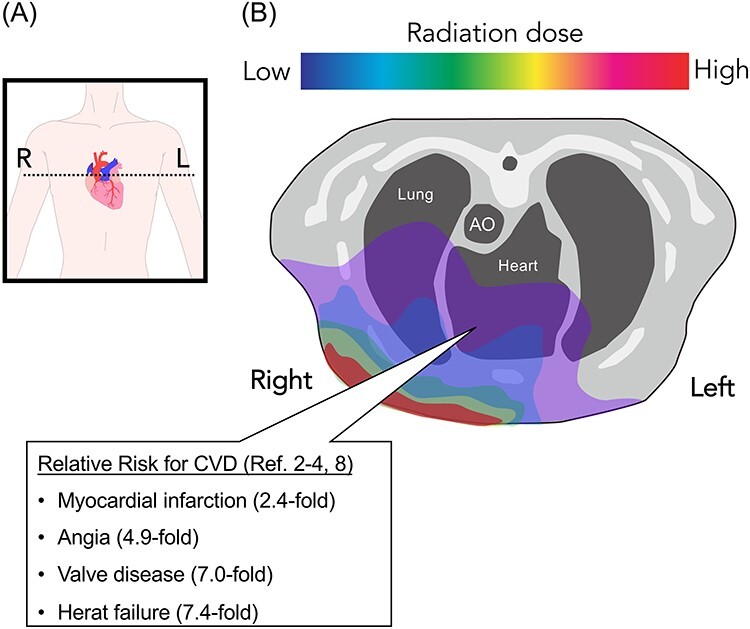
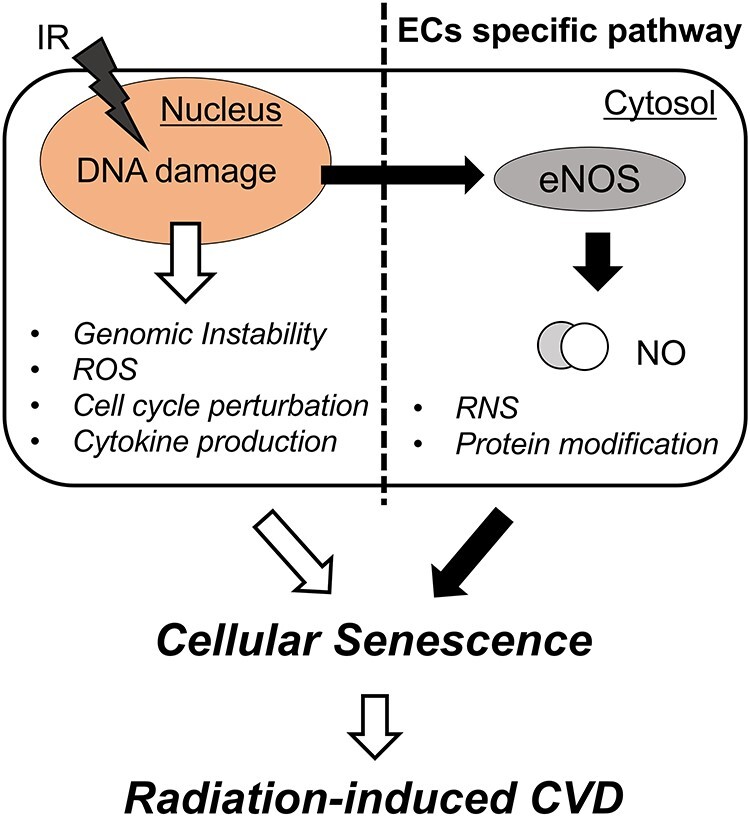
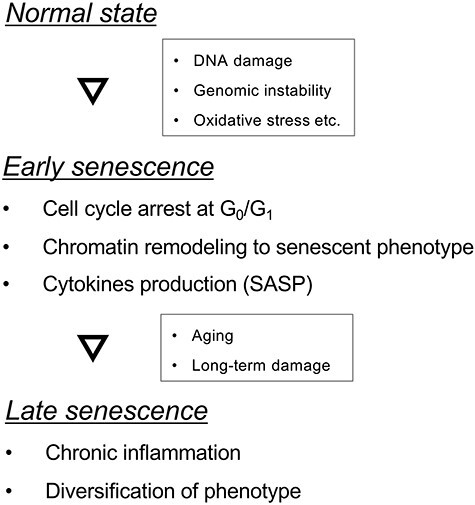
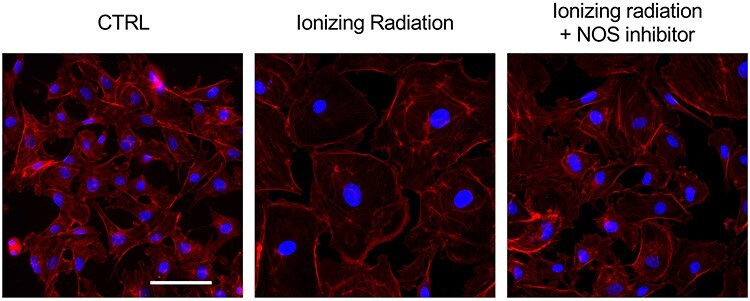
A post-exposure cohort study in Hiroshima and Nagasaki reported that low-dose exposure to radiation heightened the risk of cardiovascular diseases (CVD), such as stroke and myocardial infarction, by 14-18% per Gy. Moreover, the risk of atherosclerosis in the coronary arteries reportedly increases with radiation therapy of the chest, including breast and lung cancer treatment. Cellular senescence of vascular endothelial cells (ECs) is believed to play an important role in radiation-induced CVDs. The molecular mechanism of age-related cellular senescence is believed to involve genomic instability and DNA damage response (DDR); the chronic inflammation associated with senescence causes cardiovascular damage. Therefore, vascular endothelial cell senescence is believed to induce the pathogenesis of CVDs after radiation exposure. The findings of several prior studies have revealed that ionizing radiation (IR) induces cellular senescence as well as cell death in ECs. We have previously reported that DDR activates endothelial nitric oxide (NO) synthase, and NO production promotes endothelial senescence. Endothelial NO synthase (eNOS) is a major isoform expressed in ECs that maintains cardiovascular homeostasis. Therefore, radiation-induced NO production, a component of the DDR in ECs, may be involved in CVDs after radiation exposure. In this article, we describe the pathology of radiation-induced CVD and the unique radio-response to radiation exposure in ECs.
广岛和长崎的一项事后队列研究报告称,低剂量辐射使心血管疾病(CVD)的风险增加 14-18%每 Gy。此外,据报道,胸部放射治疗(包括乳腺癌和肺癌治疗)会增加冠状动脉粥样硬化的风险。血管内皮细胞(ECs)的细胞衰老被认为在放射性 CVDs 中起重要作用。与年龄相关的细胞衰老的分子机制被认为涉及基因组不稳定性和 DNA 损伤反应(DDR);与衰老相关的慢性炎症会导致心血管损伤。因此,血管内皮细胞衰老被认为会在辐射暴露后引发 CVD 的发病机制。几项先前的研究结果表明,电离辐射(IR)会诱导 ECs 中的细胞衰老和细胞死亡。我们之前曾报道过,DDR 会激活内皮型一氧化氮合酶(eNOS),而 NO 的产生会促进内皮细胞衰老。内皮型一氧化氮合酶(eNOS)是 ECs 中表达的主要同工酶,可维持心血管稳态。因此,辐射诱导的 NO 产生,即 ECs 中 DDR 的一个组成部分,可能与辐射暴露后的 CVD 有关。在本文中,我们描述了放射性 CVD 的病理学和 ECs 中对辐射暴露的独特反应。