GSI Helmholtzzentrum für Schwerionenforschung, 64291 Darmstadt, Germany.
Institut für Festkörperphysik, TU Darmstadt, 64289 Darmstadt, Germany.
J Radiat Res. 2021 Jul 10;62(4):645-655. doi: 10.1093/jrr/rrab034.
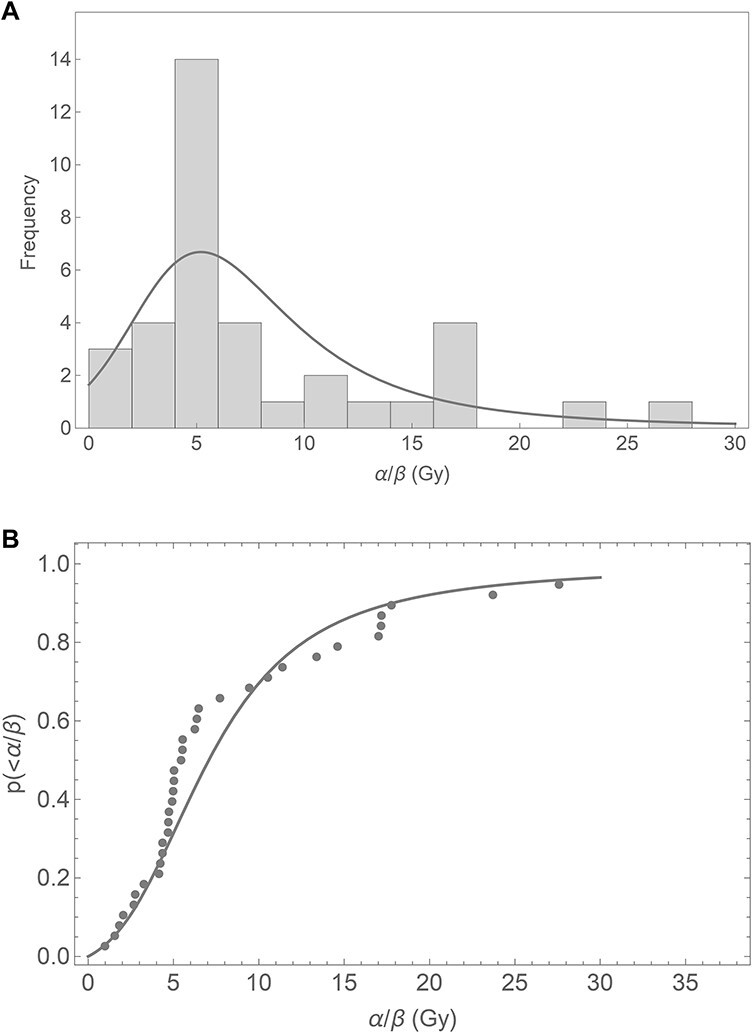
The particle irradiation data ensemble (PIDE) is the largest database of cell survival data measured after exposure to ion beams and photon reference radiation. We report here on the updated version of the PIDE database and demonstrate how to investigate generic properties of radiation dose response using these sets of raw data. The database now contains information of over 1100 pairs of photon and ion dose response curves. It provides the originally published raw data of cell survival in addition to given linear quadratic (LQ) model parameters. If available, the raw data were used to derive LQ model parameters in the same way for all experiments. To demonstrate the extent of the database and the variability among experiments we focus on the dose response curves after ion and photon radiation separately in a first step. Furthermore, we discuss the capability and the limitations of the database for analyzing properties of low and high linear energy transfer (LET) radiation response based on multiple experiments. PIDE is freely available to the research community under www.gsi.de/bio-pide.
粒子辐照数据集成(PIDE)是最大的细胞存活数据数据库,这些数据是在暴露于离子束和光子参考辐射后测量的。我们在此报告 PIDE 数据库的更新版本,并展示如何使用这些原始数据集研究辐射剂量响应的一般特性。该数据库现在包含超过 1100 对光子和离子剂量响应曲线的信息。它提供了细胞存活的原始发表数据,以及给定的线性二次(LQ)模型参数。如果可用,将使用原始数据以相同的方式为所有实验推导出 LQ 模型参数。为了展示数据库的范围和实验之间的可变性,我们首先分别关注离子和光子辐射后的剂量响应曲线。此外,我们还讨论了该数据库基于多个实验分析低和高线性能量转移(LET)辐射响应特性的能力和局限性。PIDE 在 www.gsi.de/bio-pide 下免费提供给研究界。