Nuffield Department of Surgical Sciences, University of Oxford, Oxford, United Kingdom.
Department of Vascular Surgery, Oxford University, Hospitals, NHS Foundation Trust, United Kingdom.
Ann Surg. 2023 Feb 1;277(2):e449-e459. doi: 10.1097/SLA.0000000000004835. Epub 2023 Jan 10.
Intravenous contrast agents are routinely used in CT imaging to enable the visualization of intravascular pathology, such as with abdominal aortic aneurysms. However, the injection is contraindicated in patients with iodine allergy and is associated with renal complications.
In this study, we investigate if the raw data acquired from a noncontrast CT image contains sufficient information to differentiate blood and other soft tissue components. A deep learning pipeline underpinned by generative adversarial networks was developed to simulate contrast enhanced CTA images using noncontrast CTs.
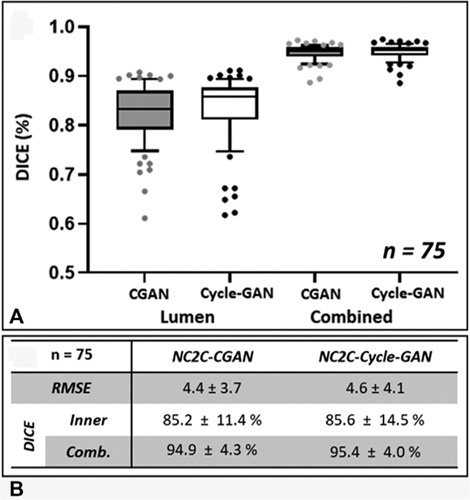
Two generative models (cycle- and conditional) are trained with paired noncontrast and contrast enhanced CTs from seventy-five patients (total of 11,243 pairs of images) with abdominal aortic aneurysms in a 3-fold cross-validation approach with a training/testing split of 50:25 patients. Subsequently, models were evaluated on an independent validation cohort of 200 patients (total of 29,468 pairs of images). Both deep learning generative models are able to perform this image transformation task with the Cycle-generative adversarial network (GAN) model outperforming the Conditional-GAN model as measured by aneurysm lumen segmentation accuracy (Cycle-GAN: 86.1% ± 12.2% vs Con-GAN: 85.7% ± 10.4%) and thrombus spatial morphology classification accuracy (Cycle-GAN: 93.5% vs Con-GAN: 85.7%).
This pipeline implements deep learning methods to generate CTAs from noncontrast images, without the need of contrast injection, that bear strong concordance to the ground truth and enable the assessment ofimportant clinical metrics. Our pipeline is poised to disrupt clinical pathways requiring intravenous contrast.
静脉内造影剂在 CT 成像中常规用于使血管内病理学可视化,例如腹主动脉瘤。然而,在碘过敏患者中注射是禁忌的,并且与肾并发症有关。
在这项研究中,我们研究了从非对比 CT 图像获得的原始数据是否包含足以区分血液和其他软组织成分的信息。基于生成对抗网络的深度学习管道被开发用于使用非对比 CT 模拟对比增强 CTA 图像。
两种生成模型(循环和条件)使用来自 75 例腹主动脉瘤患者的配对非对比和对比增强 CT 进行训练(总共 11243 对图像),采用 3 折交叉验证方法,训练/测试比例为 50:25 名患者。随后,在 200 例患者的独立验证队列上评估模型(总共 29468 对图像)。两种深度学习生成模型都能够执行此图像转换任务,循环生成对抗网络(Cycle-GAN)模型的表现优于条件生成对抗网络(Con-GAN)模型,如动脉瘤管腔分割准确性(Cycle-GAN:86.1%±12.2%vs Con-GAN:85.7%±10.4%)和血栓空间形态分类准确性(Cycle-GAN:93.5%vs Con-GAN:85.7%)。
该管道实现了深度学习方法,从非对比图像生成 CTA,无需静脉内注射,与真实情况具有很强的一致性,并能够评估重要的临床指标。我们的管道有望破坏需要静脉内对比的临床途径。