Young David J, Nguyen Bao, Zhu Ruiqi, Seo Jaesung, Li Li, Levis Mark J, Pratz Keith W, Duffield Amy S, Small Donald
Department of Oncology.
Department of Pediatrics, and.
Blood Adv. 2021 May 11;5(9):2285-2293. doi: 10.1182/bloodadvances.2020002876.
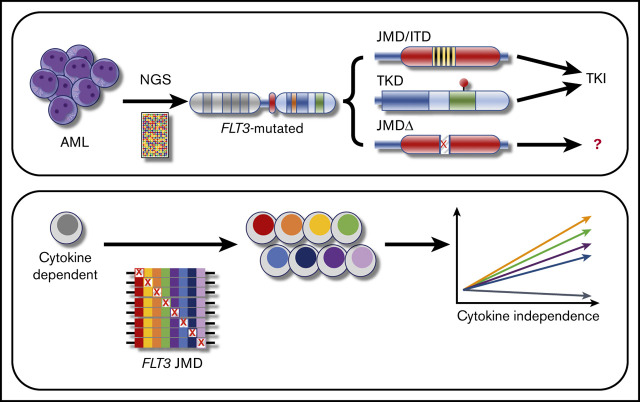
The FMS-like tyrosine kinase 3 (FLT-3) is the most frequently mutated gene in acute myeloid leukemia (AML), a high-risk feature, and now the target of tyrosine kinase inhibitors (TKIs), which are approved and in development. The most common mutation is the internal tandem duplication (ITD). We present a novel mutation, FLT-3/Q575Δ, identified in a patient with AML through next-generation sequencing (NGS). This mutation is activating, drives downstream signaling comparable to FLT-3/ITD, and can be targeted using available FLT-3 TKIs. We present the results of a systematic analysis that identified Y572Δ, E573Δ, and S574Δ as similarly activating and targetable deletions located in the FLT-3 juxtamembrane domain (JMD). These mutations target key residues in the JMD involved in the interactions within FLT-3 that regulate its activation. Our results suggest a new class of FLT-3 mutations that may have an impact on patient care and highlight the increasing importance of a systematic understanding of FLT-3 mutations other than ITD. It is likely that, as NGS becomes more commonly used in the diagnosis of patients with AML, these and other activating mutations will be discovered with increasing frequency.
FMS样酪氨酸激酶3(FLT-3)是急性髓系白血病(AML)中最常发生突变的基因,这是一种高危特征,目前是已获批准及正在研发的酪氨酸激酶抑制剂(TKIs)的作用靶点。最常见的突变是内部串联重复(ITD)。我们报告了通过下一代测序(NGS)在一名AML患者中鉴定出的一种新型突变FLT-3/Q575Δ。这种突变具有激活作用,可驱动与FLT-3/ITD相当的下游信号传导,并且可以使用现有的FLT-3 TKIs进行靶向治疗。我们展示了一项系统分析的结果,该分析确定Y572Δ、E573Δ和S574Δ是位于FLT-3近膜结构域(JMD)的具有类似激活作用且可靶向的缺失突变。这些突变靶向JMD中参与FLT-3内相互作用以调节其激活的关键残基。我们的结果提示了一类可能影响患者治疗的新型FLT-3突变,并突出了系统了解除ITD之外的FLT-3突变的重要性日益增加。随着NGS在AML患者诊断中越来越普遍地使用,很可能会越来越频繁地发现这些及其他激活突变。