Charpentier Marine, Gutierrez Charly, Guillaudeux Thierry, Verhoest Grégory, Pedeux Rémy
COSS (Chemistry Oncogenesis Stress Signaling)-UMR_S 1242, University of Rennes, INSERM, CLCC Eugène Marquis, F-35000 Rennes, France.
Department of Urology, CHU RENNES, Rue Henri le Guilloux, 35033 Rennes, France.
Cancers (Basel). 2021 Apr 1;13(7):1650. doi: 10.3390/cancers13071650.
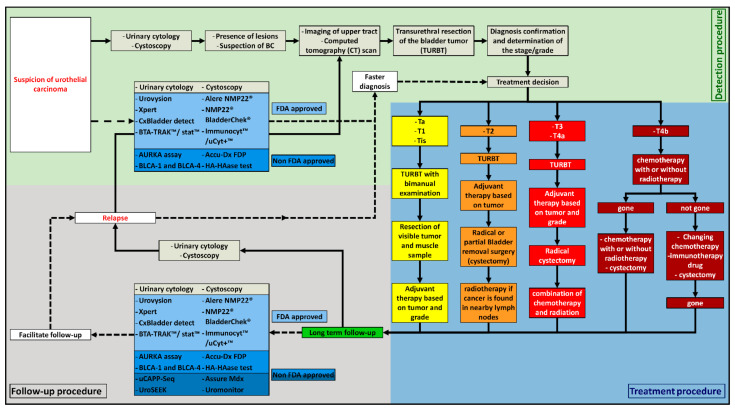
Liquid biopsies are increasingly used for the diagnosis and follow-up of cancer patients. Urine is a body fluid that can be used to detect cancers and others diseases. It is noninvasive and easy to collect. To detect Bladder Cancer (BC), cytology is the first assay used. It is an effective way to detect high grade BC but has a high rate of equivocal results, especially for low grade BC. Furthermore, cystoscopy is used to confirm cytology results and to determine cancer status. Cystoscopy is also effective but highly invasive, and not well accepted by patients, especially for BC follow-up. In this review we survey the numerous assays recently developed in order to diagnose BC at an early stage, and to facilitate the follow-up of patients. We discuss their effectiveness, ease of use, and applications. Finally, we discuss assays that, in the future, could improve the diagnosis and management of BC patients.
液体活检越来越多地用于癌症患者的诊断和随访。尿液是一种可用于检测癌症和其他疾病的体液。它是非侵入性的,易于收集。为了检测膀胱癌(BC),细胞学检查是首先使用的检测方法。这是检测高级别膀胱癌的有效方法,但存在较高的结果不明确率,尤其是对于低级别膀胱癌。此外,膀胱镜检查用于确认细胞学检查结果并确定癌症状态。膀胱镜检查也很有效,但具有高度侵入性,患者接受度不高,尤其是用于膀胱癌随访时。在本综述中,我们调查了最近开发的众多检测方法,以便早期诊断膀胱癌,并促进患者的随访。我们讨论了它们的有效性、易用性和应用。最后,我们讨论了未来可能改善膀胱癌患者诊断和管理的检测方法。