Systems Engineering Program, Universidad de Lima, Lima 15023, Peru.
Department of Management and Marketing, Universidad Pablo de Olavide, 41013 Seville, Spain.
Int J Environ Res Public Health. 2021 Apr 1;18(7):3687. doi: 10.3390/ijerph18073687.
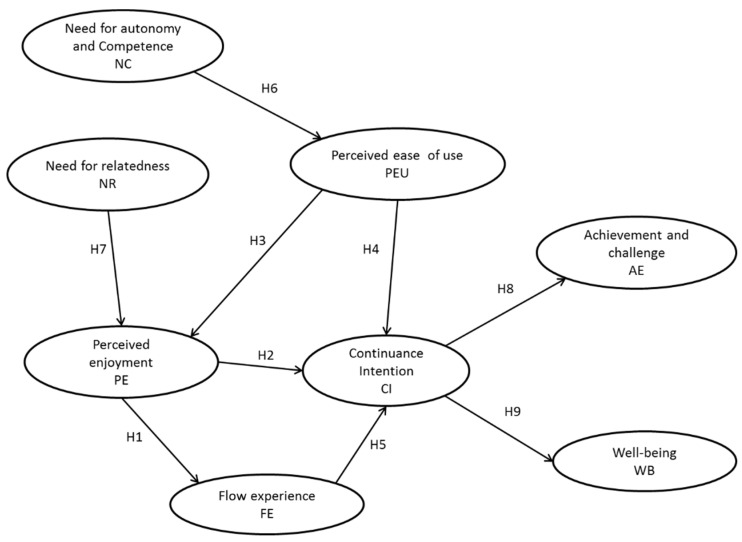
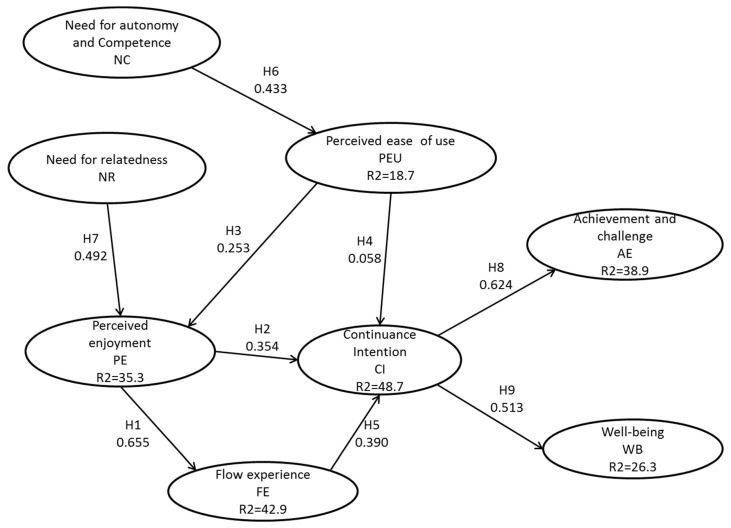
This study is focused on the massively multiplayer online games' acceptance. In general, while specialized literature reveals that the online gaming industry has grown strongly in recent years, little evidence is identified on its user acceptance. In this manner, the present study is an attempt to fill this gap. Concretely, two aims are defined: (1) proposing an acceptance model to predict the continuance usage of massively multiplayer online games, and (2) knowing how this continuance usage encourages social well-being. The model proposed employing the structural equation modeling with partial least squares (PLS-SEM) methodology. This PLS-SEM model has been defined using a combination of the technology acceptance model (TAM) and the self-determination theory (SDT), comprising eight constructs: (1) autonomy and competence, (2) relatedness, (3) achievement and challenge, (4) flow experience, (5) perceived enjoyment, (6) social well-being, (7) perceived ease of use, and (8) continuance intention. The findings reveal that continuance intention impacts on social well-being. Moreover, the pivotal role of flow experience for continuance intention has been demonstrated. Additionally, continuance intention has been impacted by the perceived enjoyment, showing that it is a key construct for the acceptance of massively multiplayer online games. Thus, two contributions are highlighted. First, these results provide the gaming industry and software developer companies with considerations on gamers' motivations in the online game design, in order to stimulate and incentivize its use. Second, the present study can be useful for academicians and practitioners to understand the online gamers' emotions and well-being, showing some light over their psychology and mental health. Finally, limitations and future directions are exposed.
这项研究关注的是大型多人在线游戏的接受度。总的来说,虽然专业文献表明,近年来在线游戏行业发展强劲,但关于其用户接受度的证据却很少。因此,本研究试图填补这一空白。具体来说,定义了两个目标:(1)提出一个接受模型来预测大型多人在线游戏的持续使用,(2)了解这种持续使用如何促进社会福祉。该模型采用结构方程建模与偏最小二乘法(PLS-SEM)方法进行定义。该 PLS-SEM 模型结合了技术接受模型(TAM)和自我决定理论(SDT),包含八个构念:(1)自主性和能力,(2)关联性,(3)成就和挑战,(4)流畅体验,(5)感知乐趣,(6)社会福祉,(7)感知易用性和(8)持续意图。研究结果表明,持续意图对社会福祉有影响。此外,还证明了流畅体验对持续意图的关键作用。此外,持续意图受到感知乐趣的影响,表明它是大型多人在线游戏接受度的关键构念。因此,突出了两个贡献。首先,这些结果为游戏行业和软件开发商提供了关于玩家在在线游戏设计中的动机的考虑因素,以便激励和激励其使用。其次,本研究可以帮助学者和从业者了解在线游戏玩家的情绪和幸福感,揭示他们的心理和心理健康的一些方面。最后,暴露了局限性和未来的方向。