CNRS, Architecture et Réactivité de l'ARN, UPR 9002, IBMC-2 Allée Konrad Roentgen, Université de Strasbourg, F-67000 Strasbourg, France.
Sorbonne Paris Cité, INSERM U1016, CNRS UMR8104, Institut Cochin-27 rue du Faubourg Saint-Jacques, Université Paris Descartes, F-75014 Paris, France.
Viruses. 2021 Apr 3;13(4):617. doi: 10.3390/v13040617.
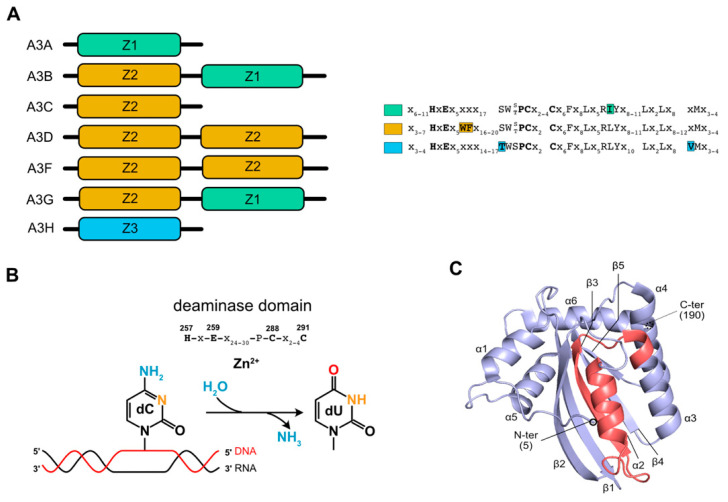
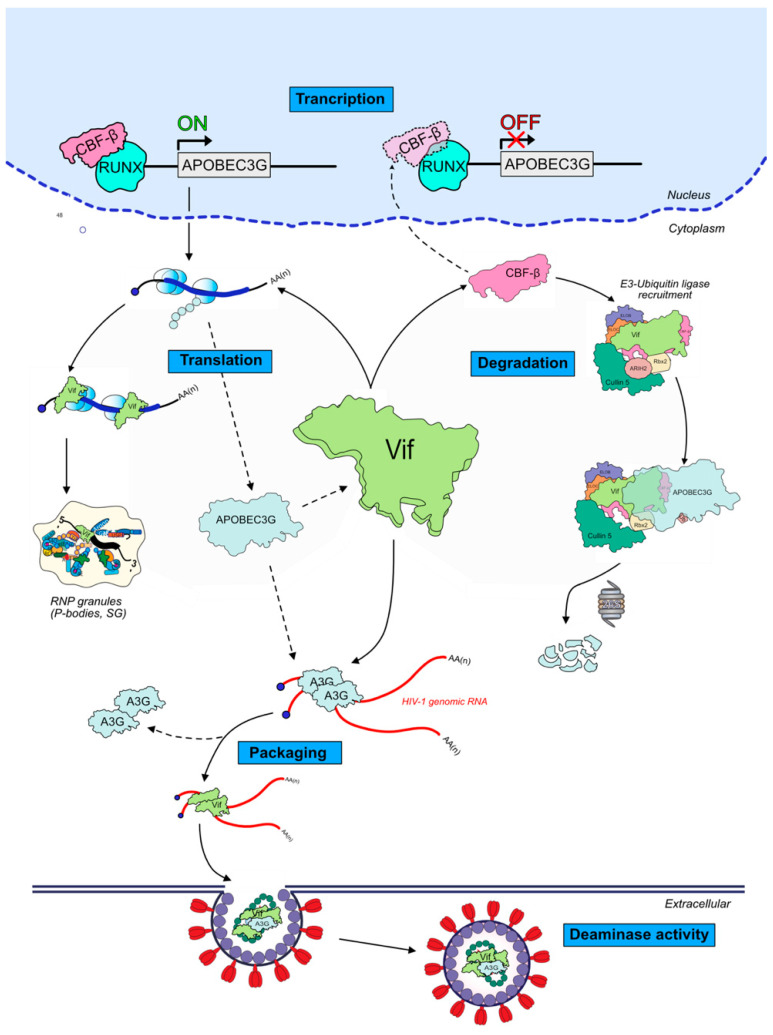
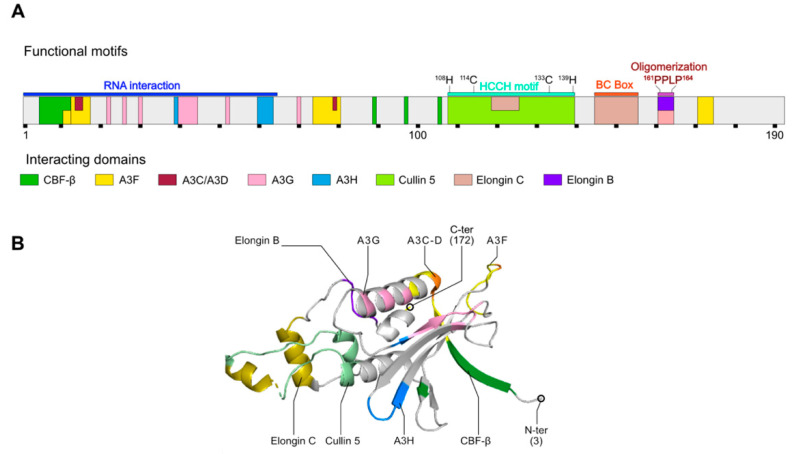
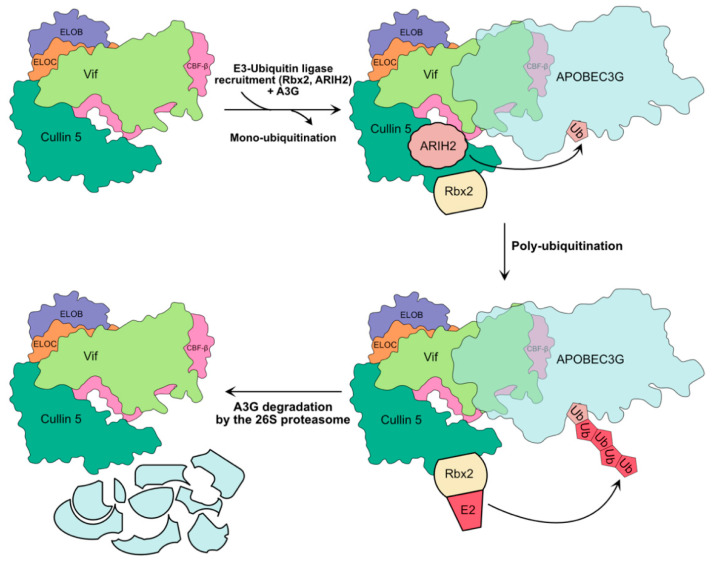
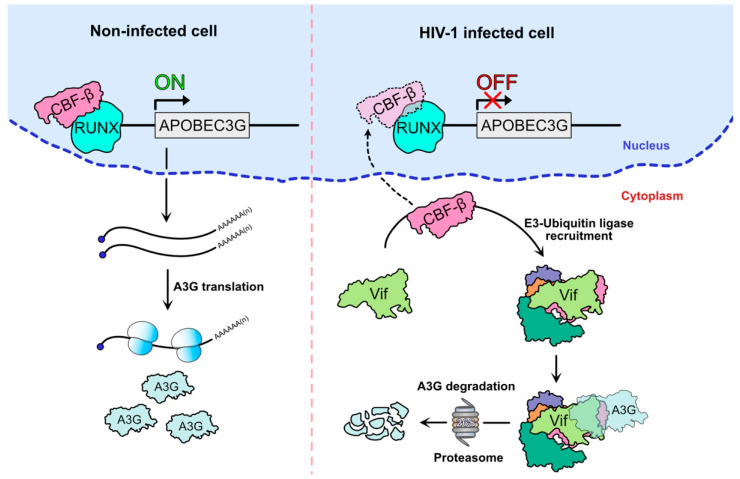
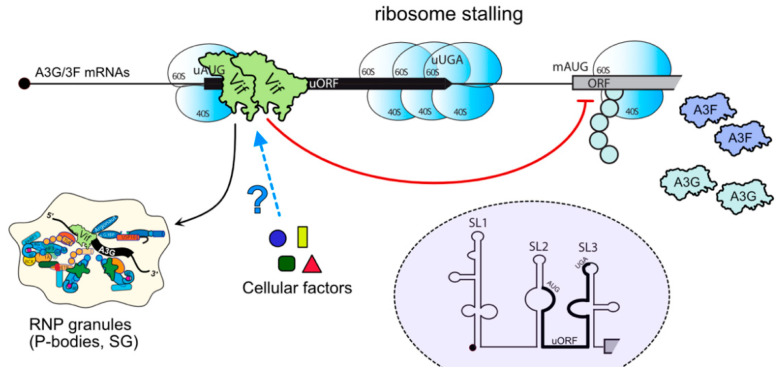
The ubiquitin-proteasome system plays an important role in the cell under normal physiological conditions but also during viral infections. Indeed, many auxiliary proteins from the (HIV-1) divert this system to its own advantage, notably to induce the degradation of cellular restriction factors. For instance, the HIV-1 viral infectivity factor (Vif) has been shown to specifically counteract several cellular deaminases belonging to the apolipoprotein B mRNA-editing enzyme catalytic polypeptide-like (APOBEC3 or A3) family (A3A to A3H) by recruiting an E3-ubiquitin ligase complex and inducing their polyubiquitination and degradation through the proteasome. Although this pathway has been extensively characterized so far, Vif has also been shown to impede A3s through degradation-independent processes, but research on this matter remains limited. In this review, we describe our current knowledge regarding the degradation-independent inhibition of A3s, and A3G in particular, by the HIV-1 Vif protein, the molecular mechanisms involved, and highlight important properties of this small viral protein.
泛素-蛋白酶体系统在正常生理条件下以及病毒感染期间在细胞中发挥重要作用。事实上,许多来自(HIV-1)的辅助蛋白将该系统转移到自己的优势,特别是诱导细胞限制因子的降解。例如,HIV-1 病毒感染性因子 (Vif) 已被证明通过募集 E3-泛素连接酶复合物并通过蛋白酶体诱导它们的多泛素化和降解,特异性地拮抗属于载脂蛋白 B mRNA 编辑酶催化多肽样 (APOBEC3 或 A3) 家族 (A3A 至 A3H) 的几种细胞脱氨酶。尽管到目前为止已经广泛描述了该途径,但 Vif 也已被证明通过非降解依赖的过程来阻碍 A3s,但对此事的研究仍然有限。在这篇综述中,我们描述了我们目前对 HIV-1 Vif 蛋白对 A3s,特别是 A3G 的非降解依赖性抑制的了解,涉及的分子机制,并强调了这种小病毒蛋白的重要特性。