Cao Chun-Feng, Ma Kun-Long, Li Qian-Lu, Luan Fu-Jun, Wang Qun-Bo, Zhang Ming-Hua, Viswanath Omar, Myrcik Dariusz, Varrassi Giustino, Wang Hai-Qiang
Department of Orthopedics, The Yongchuan Hospital of Chongqing Medical University, 439# Xuanhua Road, Yongchuan, Chongqing 402160, China.
Department of Neurology, The Yongchuan Hospital of Chongqing Medical University, 439# Xuanhua Road, Yongchuan, Chongqing 402160, China.
J Clin Med. 2021 Apr 3;10(7):1493. doi: 10.3390/jcm10071493.
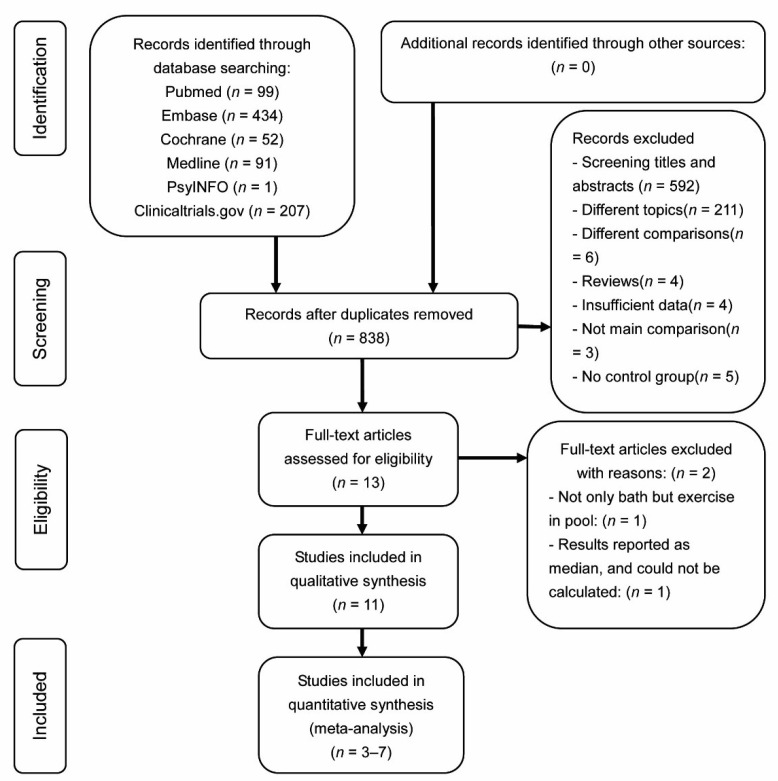
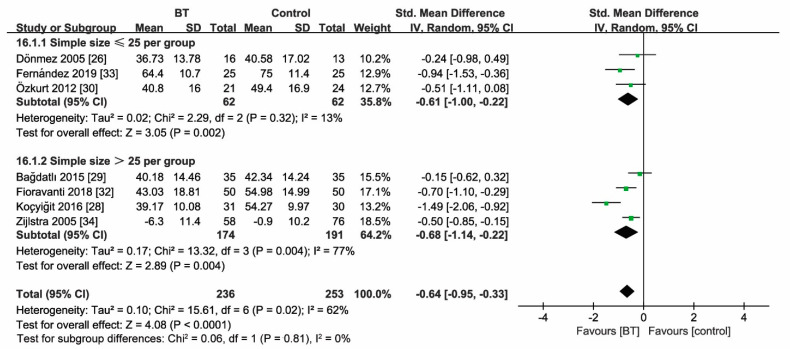
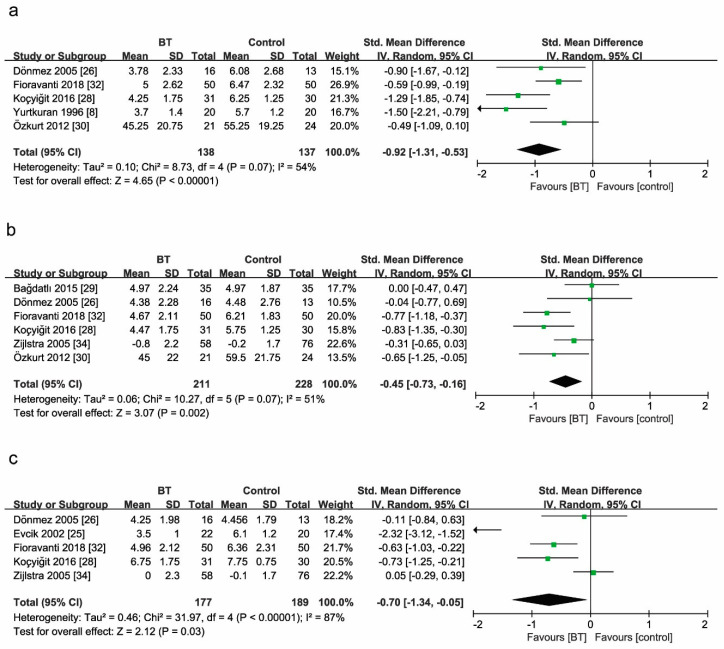
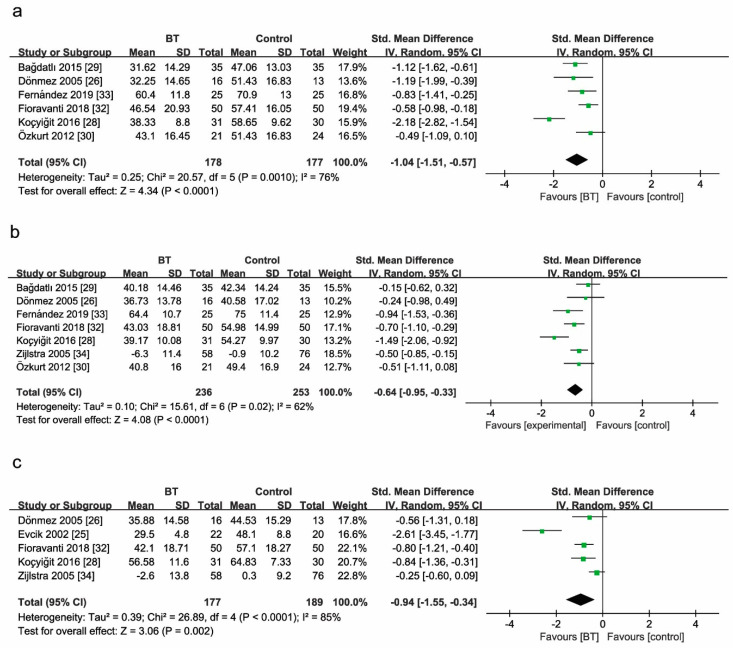
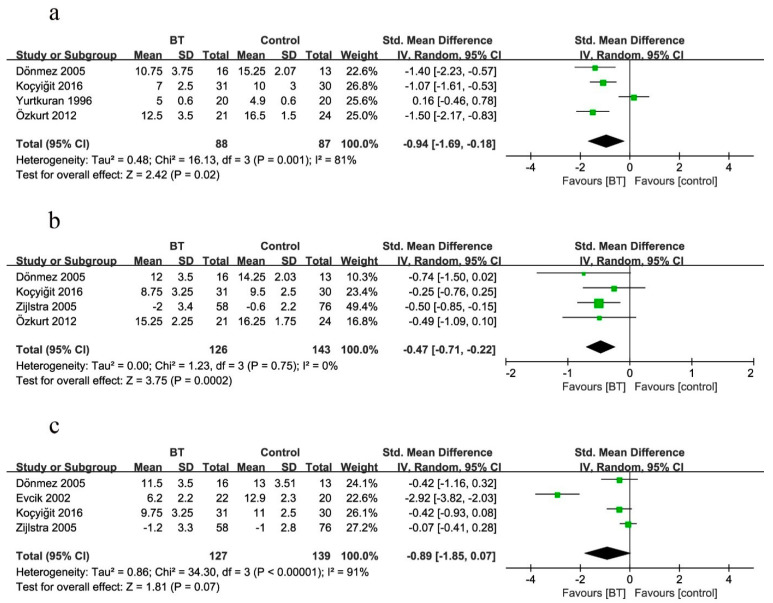
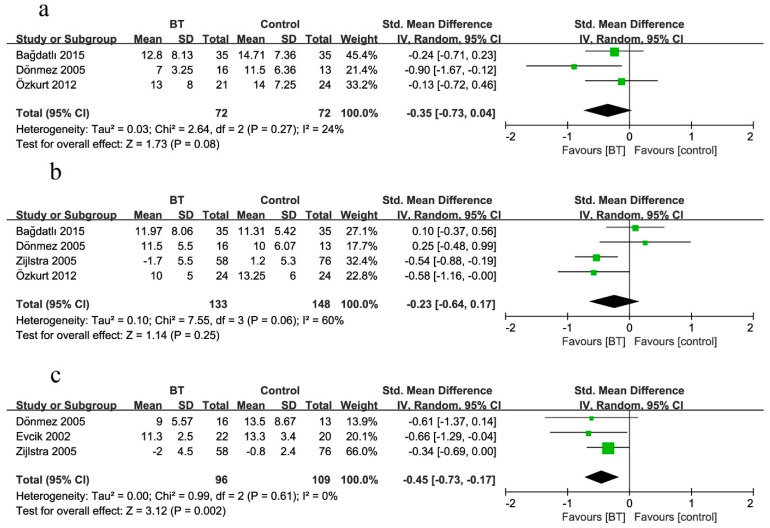
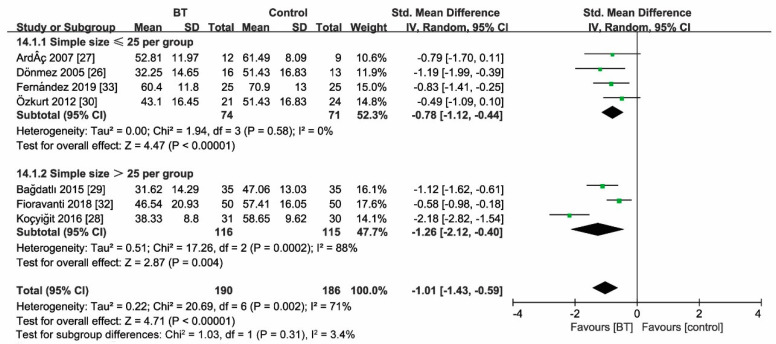
(1) Background: The efficiency of balneotherapy (BT) for fibromyalgia syndrome (FMS) remains elusive. (2) Methods: Cochrane Library, EMBASE, MEDLINE, PubMed, Clinicaltrials.gov, and PsycINFO were searched from inception to 31 May 2020. Randomized controlled trials (RCTs) with at least one indicator were included, i.e., pain, Fibromyalgia Impact Questionnaire (FIQ), Tender Points Count (TPC), and Beck's Depression Index (BDI). The outcome was reported as a standardized mean difference (SMD), 95% confidence intervals (CIs), and for heterogeneity at three observational time points. GRADE was used to evaluate the strength of evidence. (3) Results: Amongst 884 citations, 11 RCTs were included ( = 672). Various BT regimens were reported (water types, duration, temperature, and ingredients). BT can benefit FMS with statistically significant improvement at different time points (pain of two weeks, three and six months: SMD = -0.92, -0.45, -0.70; 95% CI (-1.31 to -0.53, -0.73 to -0.16, -1.34 to -0.05); = 54%, 51%, 87%; GRADE: very low, moderate, low; FIQ: SMD = -1.04, -0.64, -0.94; 95% CI (-1.51 to -0.57, -0.95 to -0.33, -1.55 to -0.34); = 76%, 62%, 85%; GRADE: low, low, very low; TPC at two weeks and three months: SMD = -0.94, -0.47; 95% CI (-1.69 to -0.18, -0.71 to -0.22); = 81%, 0; GRADE: very low, moderate; BDI at six months: SMD = -0.45; 95% CI (-0.73 to -0.17); = 0; GRADE: moderate). There was no statistically significant effect for the TPC and BDI at the remaining time points (TPC at six months: SMD = -0.89; 95% CI (-1.85 to 0.07); = 91%; GRADE: very low; BDI at two weeks and three months: SMD = -0.35, -0.23; 95% CI (-0.73 to 0.04, -0.64 to 0.17); = 24%, 60%; GRADE: moderate, low). (4) Conclusions: Very low to moderate evidence indicates that BT can benefit FMS in pain and quality-of-life improvement, whereas tenderness and depression improvement varies at time phases. Established BT regimens with a large sample size and longer observation are needed.
(1)背景:温泉浴疗法(BT)对纤维肌痛综合征(FMS)的疗效尚不明确。(2)方法:检索Cochrane图书馆、EMBASE、MEDLINE、PubMed、Clinicaltrials.gov和PsycINFO数据库,检索时间从建库至2020年5月31日。纳入至少有一项指标的随机对照试验(RCT),即疼痛、纤维肌痛影响问卷(FIQ)、压痛点计数(TPC)和贝克抑郁量表(BDI)。结果以标准化均数差(SMD)、95%置信区间(CIs)以及三个观察时间点的异质性来报告。采用GRADE评估证据强度。(3)结果:在884篇文献中,纳入了11项RCT(n = 672)。报告了各种BT方案(水的类型、持续时间、温度和成分)。BT对FMS有益,在不同时间点有统计学显著改善(两周、三个月和六个月时的疼痛:SMD = -0.92,-0.45,-0.70;95% CI(-1.31至-0.53,-0.73至-0.16,-1.34至-0.05);I² = 54%,51%,87%;GRADE:极低、中等、低;FIQ:SMD = -1.04,-0.64,-0.94;95% CI(-1.51至-0.57,-0.95至-0.33,-1.55至-0.34);I² = 76%,62%,85%;GRADE:低、低、极低;两周和三个月时的TPC:SMD = -0.94,-0.47;95% CI(-1.69至-0.18,-0.71至-0.22);I² = 81%,0;GRADE:极低、中等;六个月时的BDI:SMD = -0.45;95% CI(-0.73至-0.17);I² = 0;GRADE:中等)。在其余时间点,TPC和BDI没有统计学显著效果(六个月时的TPC:SMD = -0.89;95% CI(-1.85至0.07);I² = 91%;GRADE:极低;两周和三个月时的BDI:SMD = -0.35,-0.23;95% CI(-0.73至0.04,-0.64至0.17);I² = 24%,60%;GRADE:中等、低)。(4)结论:极低至中等强度的证据表明,BT可改善FMS的疼痛和生活质量,而压痛和抑郁的改善在不同时间阶段有所不同。需要建立大样本量和更长观察期的BT方案。