Salminen Liina, Braicu Elena Ioana, Lääperi Mitja, Jylhä Antti, Oksa Sinikka, Hietanen Sakari, Sehouli Jalid, Kulbe Hagen, Bois Andreas du, Mahner Sven, Harter Philipp, Carpén Olli, Huhtinen Kaisa, Hynninen Johanna, Hilvo Mika
Department of Obstetrics and Gynecology, Turku University Hospital and University of Turku, 20521 Turku, Finland.
Department of Gynecology, Charité-Universitätsmedizin Berlin, Corporate Member of Freie Universität Berlin, Humboldt Universität zu Berlin, and Berlin Institute of Health, Campus Virchow Klinikum, 13353 Berlin, Germany.
Cancers (Basel). 2021 Apr 7;13(8):1764. doi: 10.3390/cancers13081764.
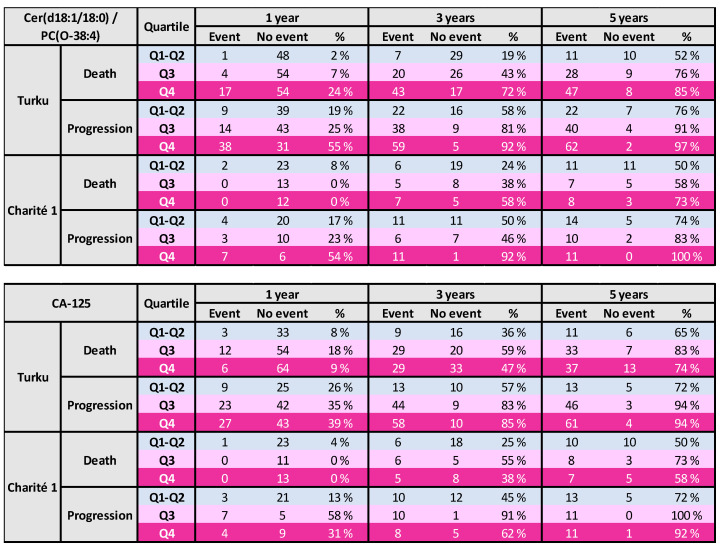
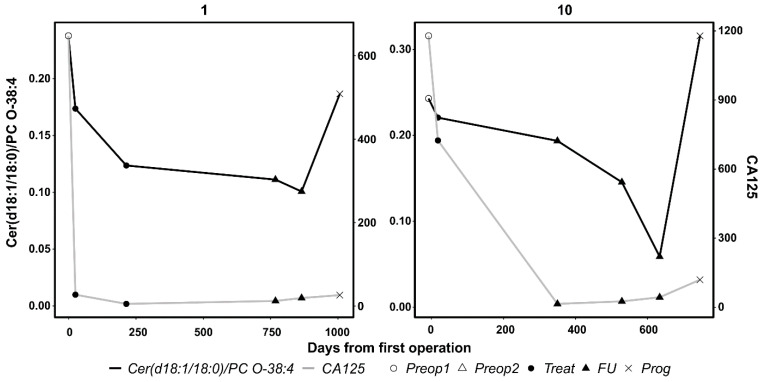
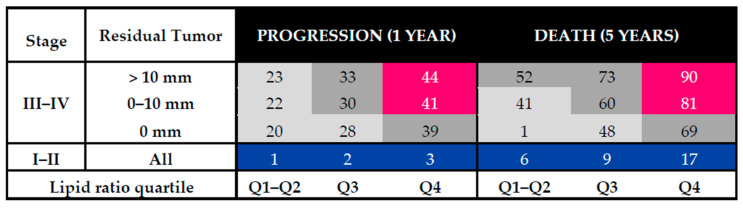
Epithelial ovarian cancer (EOC) generally responds well to oncological treatments, but the eventual development of a refractory disease is a major clinical problem. Presently, there are no prognostic blood-based biomarkers for the stratification of EOC patients at the time of diagnosis. We set out to assess and validate the prognostic utility of a novel two-lipid signature, as the lipidome is known to be markedly aberrant in EOC patients. The study consisted of 499 women with histologically confirmed EOC that were prospectively recruited at the university hospitals in Turku (Finland) and Charité (Berlin, Germany). Lipidomic screening by tandem liquid chromatography-mass spectrometry (LC-MS/MS) was performed for all baseline serum samples of these patients, and additionally for 20 patients of the Turku cohort at various timepoints. A two-lipid signature, based on the ratio of the ceramide Cer(d18:1/18:0) and phosphatidylcholine PC(O-38:4), showed consistent prognostic performance in all investigated study cohorts. In the Turku cohort, the unadjusted hazard ratios (HRs) per standard deviation (SD) (95% confidence interval) were 1.79 (1.40, 2.29) for overall and 1.40 (1.14, 1.71) for progression-free survival. In a Charité cohort incorporating only stage III completely resected patients, the corresponding HRs were 1.59 (1.08, 2.35) and 1.53 (1.02, 2.30). In linear-mixed models predicting progression of the disease, the two-lipid signature showed higher performance (beta per SD increase 1.99 (1.38, 2.97)) than cancer antigen 125 (CA-125, 1.78 (1.13, 2.87)). The two-lipid signature was able to identify EOC patients with an especially poor prognosis at the time of diagnosis, and also showed promise for the detection of disease relapse.
上皮性卵巢癌(EOC)通常对肿瘤治疗反应良好,但最终发展为难治性疾病是一个主要的临床问题。目前,在诊断时没有基于血液的预后生物标志物用于EOC患者的分层。我们着手评估并验证一种新型双脂质特征的预后效用,因为已知EOC患者的脂质组明显异常。该研究纳入了499名经组织学确诊为EOC的女性,她们是在芬兰图尔库和德国柏林的大学医院前瞻性招募的。对这些患者的所有基线血清样本进行了串联液相色谱 - 质谱(LC-MS/MS)脂质组学筛查,另外还对图尔库队列的20名患者在不同时间点进行了检测。基于神经酰胺Cer(d18:1/18:0)与磷脂酰胆碱PC(O-38:4)的比率的双脂质特征,在所有研究队列中均显示出一致的预后性能。在图尔库队列中,总体生存的每标准差(SD)未调整风险比(HRs)(95%置信区间)为1.79(1.40,2.29),无进展生存为1.40(1.14,1.71)。在仅纳入III期完全切除患者的柏林夏里特医院队列中,相应的HRs为1.59(1.08,2.35)和1.53(1.02,2.30)。在预测疾病进展的线性混合模型中,双脂质特征表现出比癌抗原125(CA-125,1.78(1.13,2.87))更高的性能(每SD增加的β值为1.99(1.38,2.97))。双脂质特征能够在诊断时识别出预后特别差的EOC患者,并且在疾病复发检测方面也显示出前景。