Valenti Fabio, Falcone Italia, Ungania Sara, Desiderio Flora, Giacomini Patrizio, Bazzichetto Chiara, Conciatori Fabiana, Gallo Enzo, Cognetti Francesco, Ciliberto Gennaro, Morrone Aldo, Guerrisi Antonino
Oncogenomics and Epigenetics, IRCCS-Regina Elena National Cancer Institute, 00144 Rome, Italy.
Medical Oncology 1, IRCCS-Regina Elena National Cancer Institute, 00144 Rome, Italy.
Int J Mol Sci. 2021 Apr 7;22(8):3837. doi: 10.3390/ijms22083837.
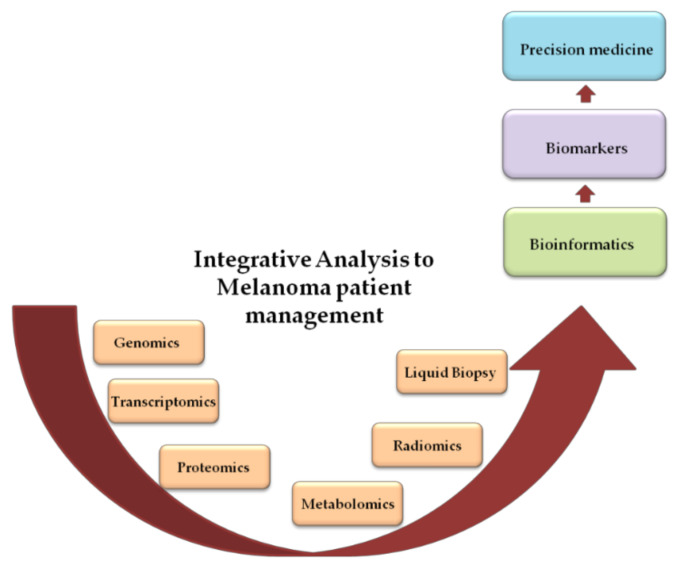
The treatment and management of patients with metastatic melanoma have evolved considerably in the "era" of personalized medicine. Melanoma was one of the first solid tumors to benefit from immunotherapy; life expectancy for patients in advanced stage of disease has improved. However, many progresses have yet to be made considering the (still) high number of patients who do not respond to therapies or who suffer adverse events. In this scenario, precision medicine appears fundamental to direct the most appropriate treatment to the single patient and to guide towards treatment decisions. The recent multi-omics analyses (genomics, transcriptomics, proteomics, metabolomics, radiomics, etc.) and the technological evolution of data interpretation have allowed to identify and understand several processes underlying the biology of cancer; therefore, improving the tumor clinical management. Specifically, these approaches have identified new pharmacological targets and potential biomarkers used to predict the response or adverse events to treatments. In this review, we will analyze and describe the most important omics approaches, by evaluating the methodological aspects and progress in melanoma precision medicine.
在个性化医疗的“时代”,转移性黑色素瘤患者的治疗与管理有了显著进展。黑色素瘤是最早受益于免疫疗法的实体瘤之一;疾病晚期患者的预期寿命有所提高。然而,鉴于仍有大量患者对治疗无反应或出现不良事件,仍有许多进展有待实现。在这种情况下,精准医疗对于为个体患者选择最合适的治疗方法并指导治疗决策显得至关重要。近期的多组学分析(基因组学、转录组学、蛋白质组学、代谢组学、放射组学等)以及数据解读的技术发展,使得人们能够识别和理解癌症生物学背后的多个过程;从而改善肿瘤的临床管理。具体而言,这些方法已经确定了新的药理学靶点以及用于预测治疗反应或不良事件的潜在生物标志物。在本综述中,我们将通过评估黑色素瘤精准医疗的方法学方面和进展,来分析和描述最重要的组学方法。