Li Guojing, Zheng Wangli, Yang Jinfang, Qi Tongsheng, He Yongcai, Chen Wangkai, Ma Hejia, Sun Yali, Li Ying, Kang Ming, Li Jixu
State Key Laboratory of Plateau Ecology and Agriculture, Qinghai University, Xining 810016, China.
College of Agriculture and Animal Husbandry, Qinghai University, Xining 810016, China.
Pathogens. 2021 Apr 6;10(4):432. doi: 10.3390/pathogens10040432.
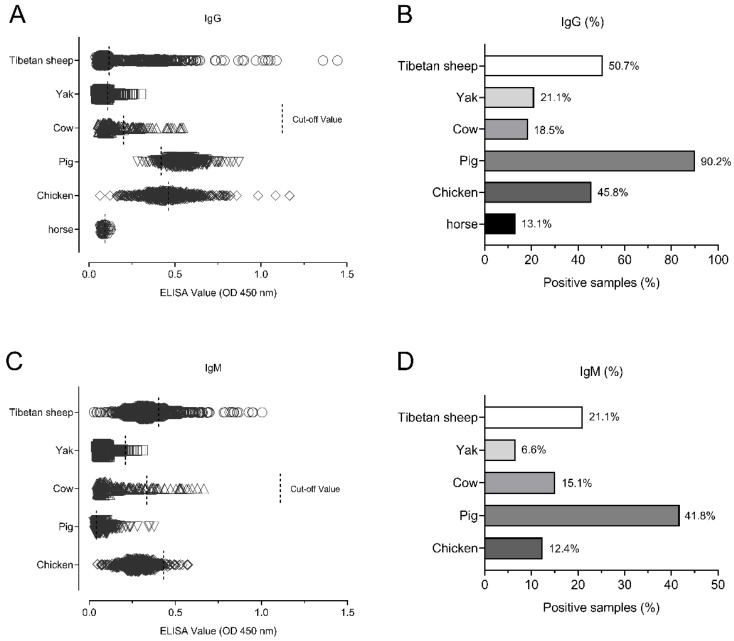
belongs to the Apicomplexan protozoa-an obligate intracellular parasite-causing toxoplasmosis that has a worldwide distribution and is very harmful to both human health and the livestock industry. However, the information on toxoplasmosis in the Qinghai-Tibetan Plateau Area (QTPA) and the seroprevalence of in the food-borne animals in that area has been limited. Therefore, this study focused to and toxoplasmosis to perform an indirect ELISA test based on recombinant SAG2 protein to establish a comprehensive record of the seroprevalence of infections in a wide range of animals, including Tibetan sheep (), yaks (), cows, chicken, pigs, and horses, in the QTPA. Overall, the seropositive rates of the specific- IgG and IgM antibodies in all investigated animals were 44.1% (1179/2673) and 18.0% (469/2612), respectively. The 14.9% (389/2612) sera were determined to be both IgG and IgM positive samples, 30.2% (789/2673) were single-IgG seropositive, and a total of 80 in 2612 animals (3.0%) were single-IgM seropositive. Moreover, for the animal species, the pig was the most prevalent animal (90.2%, 304/337) for IgG positivity, followed by Tibetan sheep (50.7%, 460/907), chickens (45.8%, 229/500), yaks (21.1%, 140/663), cows (18.5%, 38/205) and horses (13.1%, 8/61), respectively. For the IgM antibody positivity, the pig was also the most prevalent animal (41.8%, 141/337), followed by Tibetan sheep (21.2%, 191/907), cows (15.1%, 31/205), chickens (12.4%, 62/500) and yaks (6.6%, 44/663), respectively. The significant differences in the prevalent distribution of were found in the different altitudes. In conclusion, this study found the high seroprevalence for infections among these animal species in the QTPA, and provides new data to facilitate further research for development of control measures against infections in the surveyed locations.
属于顶复门原生动物——一种专性细胞内寄生虫——可引起弓形虫病,该病在全球范围内分布,对人类健康和畜牧业都非常有害。然而,关于青藏高原地区(QTPA)弓形虫病以及该地区食源动物中弓形虫血清流行率的信息一直有限。因此,本研究聚焦于QTPA地区的动物和弓形虫病,基于重组SAG2蛋白进行间接ELISA检测,以全面记录包括藏绵羊( )、牦牛( )、奶牛、鸡、猪和马等多种动物中弓形虫感染的血清流行率。总体而言,所有调查动物中特异性IgG和IgM抗体的血清阳性率分别为44.1%(1179/2673)和18.0%(469/2612)。14.9%(389/2612)的血清被确定为IgG和IgM均阳性样本,30.2%(789/2673)为单一IgG血清阳性,2612只动物中有80只(3.0%)为单一IgM血清阳性。此外,就动物种类而言,猪是IgG阳性率最高的动物(90.2%,304/337),其次是藏绵羊(50.7%,460/907)、鸡(45.8%,229/500)、牦牛(21.1%,140/663)、奶牛(18.5%,38/205)和马(13.1%,8/61)。对于IgM抗体阳性,猪也是最普遍的动物(41.8%,141/337),其次是藏绵羊(21.2%,191/907)、奶牛(15.1%,31/205)、鸡(12.4%,62/500)和牦牛(6.6%,44/663)。在不同海拔高度发现了弓形虫流行分布的显著差异。总之,本研究发现QTPA地区这些动物物种中弓形虫感染的血清流行率很高,并提供了新的数据,以促进在调查地点进一步开展针对弓形虫感染控制措施的研究。