Dentika Pauline, Ozier-Lafontaine Harry, Penet Laurent
UR ASTRO, INRAE, F-97170 Petit-Bourg, Guadeloupe, France.
J Fungi (Basel). 2021 Apr 9;7(4):283. doi: 10.3390/jof7040283.
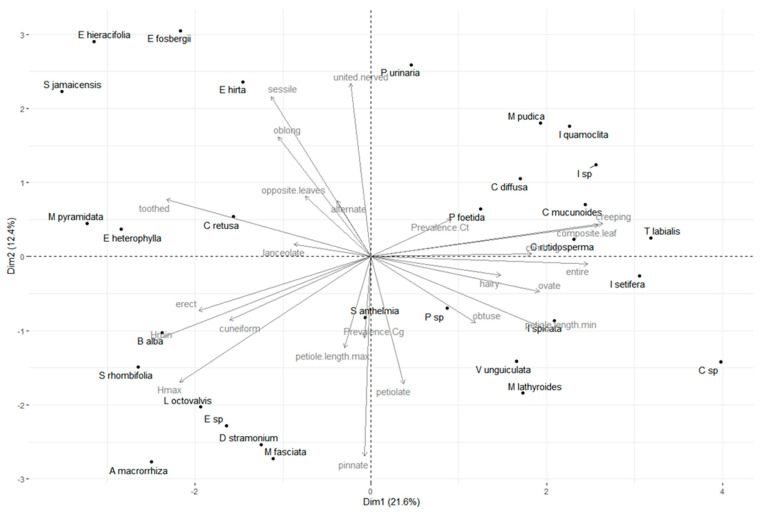
The transition toward sustainable agriculture requires rethinking cropping systems in the light of less intensive and chemically reliant practices. Weed management is one of the target practices to evolve cropping systems with decreased impact on the environment. While softened management will lead to increased weeds/crops coexistence, it is of importance to assess the relative benefits and drawbacks of new practices. Among the potential drawbacks of weeds/crops coexistence, disease risk may increase if weeds are hosting pathogens. In this study, we assessed the potential of weeds for hosting pathogenic generalist fungi known to translate into disease in crops. We first describe prevalence in fields after harvest and relate prevalence to species characteristics and communities. Then, we directly test the idea that weeds serve as inoculums sources during cropping with a natural experiment. This study highlights variation in host skill among feral weeds for species, including potential congeneric sub-specialization on different weeds within communities. Last, prevalence within fields was more correlated to focal crop inoculation rates compared to local weed load, but there was a significant correlation effect with prevalence on weeds in the vicinity of fields, suggesting that weeds are mediating disease levels at the local scale, too. Results pointed to the importance of weed host skill in disease risk yet open the door to the potential control of pathogens via targeted weed management.
向可持续农业转型需要根据集约化程度较低且依赖化学方法较少的做法重新思考种植系统。杂草管理是发展对环境影响较小的种植系统的目标做法之一。虽然较为宽松的管理会导致杂草与作物共存增加,但评估新做法的相对利弊很重要。在杂草与作物共存的潜在弊端中,如果杂草携带病原体,疾病风险可能会增加。在本研究中,我们评估了杂草携带已知会在作物中引发疾病的致病广布真菌的可能性。我们首先描述收获后田间的患病率,并将患病率与物种特征和群落联系起来。然后,我们通过一项自然实验直接检验杂草在种植期间作为接种源的观点。这项研究突出了野生杂草对不同物种的寄主能力差异,包括群落内不同杂草上潜在的同属亚专业化现象。最后,与当地杂草数量相比,田间患病率与主要作物的接种率相关性更强,但与田间附近杂草的患病率存在显著的相关效应,这表明杂草在局部尺度上也在介导疾病水平。结果表明杂草寄主能力在疾病风险中的重要性,但也为通过有针对性的杂草管理控制病原体开辟了可能性。