Penet Laurent, Guyader Sébastien, Pétro Dalila, Salles Michèle, Bussière François
INRA, UR1321, ASTRO Agrosystèmes tropicaux, F-97170, Petit-Bourg (Guadeloupe), France.
PLoS One. 2014 Dec 22;9(12):e115757. doi: 10.1371/journal.pone.0115757. eCollection 2014.
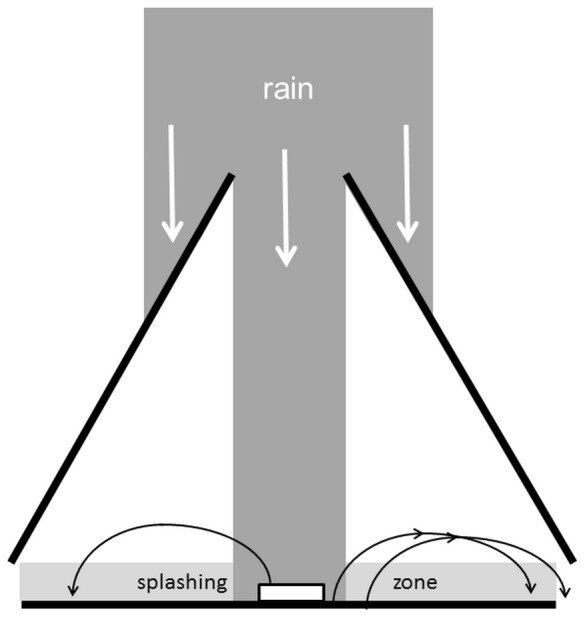
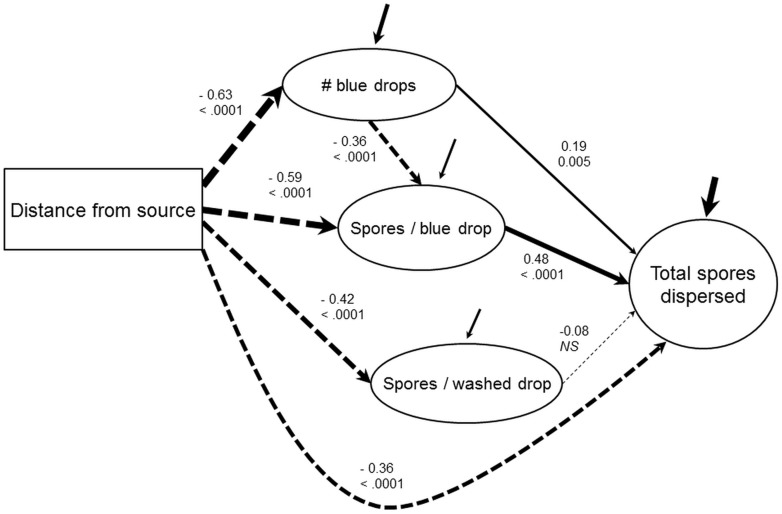
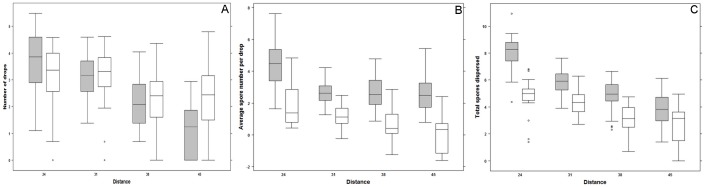
Plant pathogens have evolved many dispersal mechanisms, using biotic or abiotic vectors or a combination of the two. Rain splash dispersal is known from a variety of fungi, and can be an efficient driver of crop epidemics, with infectious strains propagating rapidly among often genetically homogenous neighboring plants. Splashing is nevertheless a local dispersal process and spores taking the droplet ride seldom move farther than a few decimeters. In this study, we assessed rain splash dispersal of conidia of the yam anthracnose agent, Colletotrichum gloeosporioides, in an experimental setting using a rain simulator, with emphasis on the impact of soil contamination (i.e., effect of re-splashing events). Spores dispersed up to 50 cm from yam leaf inoculum sources, though with an exponential decrease with increasing distance. While few spores were dispersed via re-splash from spore-contaminated soil, the proportion deposited via this mechanism increased with increasing distance from the initial source. We found no soil contamination carryover from previous rains, suggesting that contamination via re-splashing from contaminated soils mainly occurred within single rains. We conclude that most dispersal occurs from direct splashing, with a weaker contribution of indirect dispersal via re-splash.
植物病原体已经进化出许多传播机制,利用生物或非生物载体,或两者结合。多种真菌都存在雨滴飞溅传播的情况,并且它可能是作物病害流行的一个有效驱动因素,感染性菌株在通常基因同质的相邻植物间迅速传播。然而,飞溅是一种局部传播过程,搭乘水滴的孢子很少能移动到超过几分米的距离。在本研究中,我们在实验环境中使用降雨模拟器评估了山药炭疽病菌(胶孢炭疽菌)分生孢子的雨滴飞溅传播情况,重点关注土壤污染的影响(即再次飞溅事件的影响)。孢子从山药叶片接种源传播的距离可达50厘米,不过随着距离增加呈指数下降。虽然很少有孢子通过受孢子污染土壤的再次飞溅传播,但通过这种机制沉积的比例随着与初始源距离的增加而增加。我们没有发现前次降雨遗留的土壤污染情况,这表明受污染土壤的再次飞溅造成的污染主要发生在单次降雨期间。我们得出结论,大多数传播是由直接飞溅引起的,通过再次飞溅的间接传播作用较弱。