Sitarz Katarzyna, Czamara Krzysztof, Bialecka Joanna, Klimek Malgorzata, Szostek Slawa, Kaczor Agnieszka
Chair of Microbiology, Department of Molecular Medical Microbiology, Faculty of Medicine, Jagiellonian University Medical College, 18 Czysta Street, 31-121 Krakow, Poland.
Faculty of Chemistry, Jagiellonian University, 2 Gronostajowa Street, 30-387 Krakow, Poland.
Cancers (Basel). 2021 Apr 21;13(9):1997. doi: 10.3390/cancers13091997.
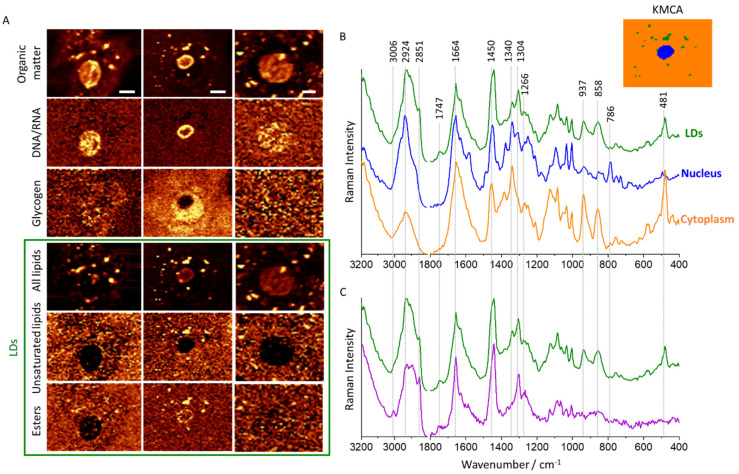
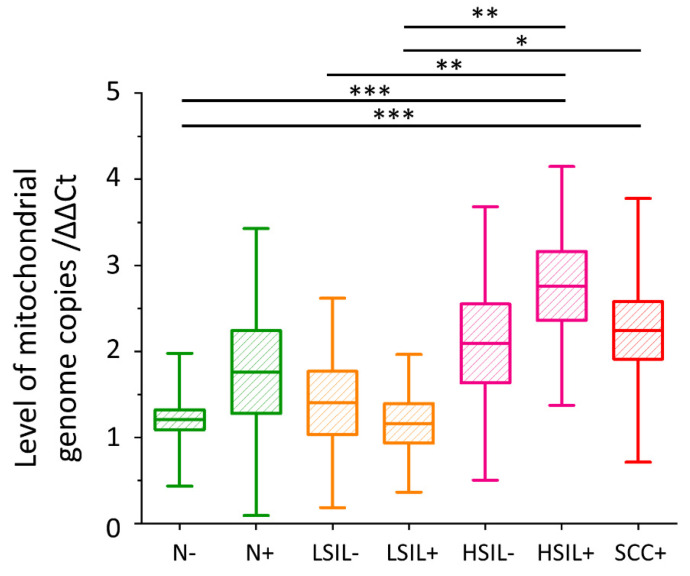
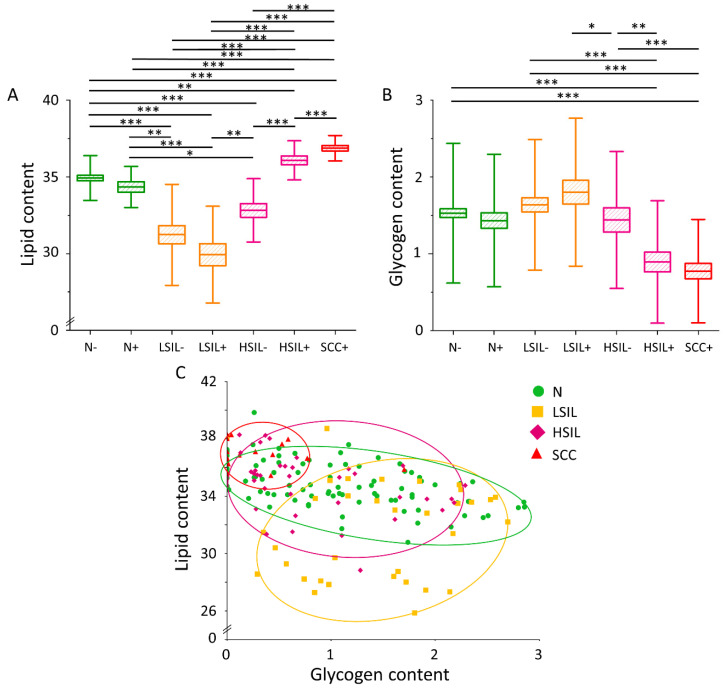
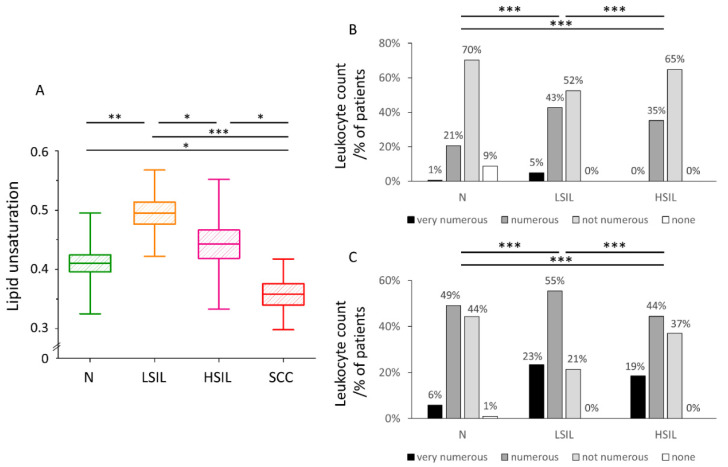
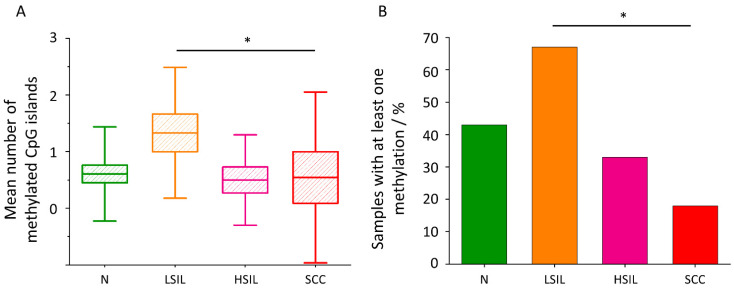
Cellular lipid metabolism is significantly transformed during oncogenesis. To assess how dysplasia development influences lipid cellular metabolisms and what is the molecular background behind it, cervical epithelial cells of 63 patients assigned to seven groups (based on the cytological examination and HPVhr test results) were studied using a multimethodological approach including Raman microscopy and molecular methods. The consistent picture obtained studying the lipid content, cell inflammation, gene methylation (hence SREBP1 inhibition) and level of mitochondrial DNA copies (indirectly the number of mitochondria) showed that changes in lipid metabolism were multidirectional. Cells from patients classified as mildly dysplastic (LSIL) exhibited a unique behavior (the highest level of inflammation and methylation, the lowest lipid content and mitochondrial DNA). On the contrary, cells from severe dysplastic (HSIL) and cancer (SCC) groups showed the opposite characteristics including the lowest gene methylation as well as the highest level of mitochondrial DNA and lipid cellular concentration (for HSIL/HPVhr+ and SCC groups). Following dysplastic progression, the lipid content decreases significantly (compared to the control) for mildly abnormal cells, but then increases for HSIL/HPVhr+ and SCC groups. This intriguing dual switch in lipid metabolism (reflected also in other studied parameters) on the way from normal to squamous carcinoma cells is of potential diagnostic interest.
细胞脂质代谢在肿瘤发生过程中会发生显著变化。为了评估发育异常如何影响脂质细胞代谢以及其背后的分子机制,我们采用了包括拉曼显微镜和分子方法在内的多方法学手段,对63例患者的宫颈上皮细胞进行了研究,这些患者根据细胞学检查和HPVhr检测结果被分为七组。研究脂质含量、细胞炎症、基因甲基化(从而抑制SREBP1)和线粒体DNA拷贝数水平(间接反映线粒体数量)所得到的一致结果表明,脂质代谢的变化是多方向的。被归类为轻度发育异常(LSIL)的患者的细胞表现出独特的行为(炎症和甲基化水平最高,脂质含量和线粒体DNA最低)。相反,重度发育异常(HSIL)和癌症(SCC)组的细胞表现出相反的特征,包括最低的基因甲基化以及最高水平的线粒体DNA和脂质细胞浓度(对于HSIL/HPVhr+和SCC组)。随着发育异常的进展,轻度异常细胞的脂质含量与对照组相比显著降低,但随后HSIL/HPVhr+和SCC组的脂质含量增加。从正常细胞到鳞状癌细胞的过程中,脂质代谢的这种有趣的双重转变(在其他研究参数中也有体现)具有潜在的诊断意义。