Department of Nursing, Chang Gung University of Science and Technology, Taoyuan 33303, Taiwan.
Neng-Chun Diabetes Clinic, Yilan County 265, Taiwan.
Int J Environ Res Public Health. 2021 Apr 21;18(9):4421. doi: 10.3390/ijerph18094421.
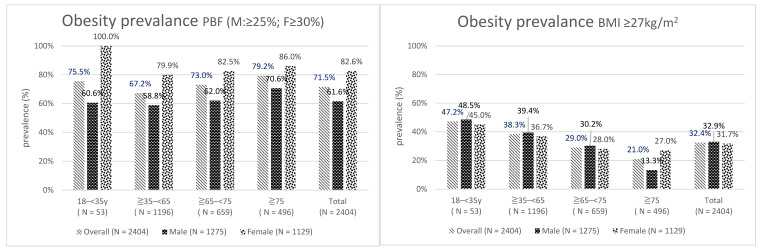
This study analyzed the body composition of individuals with type 2 diabetes (T2DM). In this retrospective chart review study, body composition was measured through multifrequency bioelectrical impedance analysis (InBody 770). Body composition assessments were conducted in individuals with T2DM, who were aged ≥18 years. The parameters included body mass index (BMI), body fat mass (BFM), fat-free mass (FFM), visceral fat area, percent body fat (PBF), appendicular skeletal muscle mass (ASM), and skeletal muscle index (SMI). One-way ANOVA and independent -tests were used to calculate differences in body composition distribution by age and sex. A total of 2404 participants were recruited. The prevalence of overall low muscle mass and sarcopenic obesity was 28.0% and 18.7%, respectively, which increased with age. The overall prevalence of obesity when PBF was used was 71.5%, which was higher than that when BMI was applied (32.4%). The normal BMI group exhibited a prevalence of low muscle mass of 55.6% and sarcopenic obesity of 34.8%. For both men and women, bodyweight, BFM, FFM, ASM, and SMI all decreased with age. The prevalence of low muscle mass and sarcopenic obesity was high in older adults and people with normal BMI. Using BMI to assess obesity and determine insufficient muscle mass underestimates the prevalence of obesity and neglects the problems of sarcopenia and high body fat in people with normal BMI.
本研究分析了 2 型糖尿病(T2DM)患者的身体成分。在这项回顾性图表研究中,通过多频生物电阻抗分析(InBody 770)测量身体成分。对年龄≥18 岁的 T2DM 患者进行身体成分评估。参数包括体重指数(BMI)、体脂肪量(BFM)、去脂体重(FFM)、内脏脂肪面积、体脂百分比(PBF)、四肢骨骼肌量(ASM)和骨骼肌指数(SMI)。使用单因素方差分析和独立 t 检验计算年龄和性别对身体成分分布的差异。共招募了 2404 名参与者。总的低肌肉量和肌少症性肥胖的患病率分别为 28.0%和 18.7%,且随年龄增长而增加。当使用 PBF 时,肥胖的总患病率为 71.5%,高于 BMI(32.4%)。BMI 正常组的低肌肉量患病率为 55.6%,肌少症性肥胖患病率为 34.8%。对于男性和女性,体重、BFM、FFM、ASM 和 SMI 均随年龄增长而降低。低肌肉量和肌少症性肥胖的患病率在老年人和 BMI 正常者中较高。使用 BMI 评估肥胖和确定肌肉量不足会低估肥胖的患病率,并且忽略了 BMI 正常者中肌少症和高体脂肪的问题。