Chargi Najiba, Wegner Inge, Markazi Navid, Smid Ernst, de Jong Pim, Devriese Lot, de Bree Remco
Department of Head and Neck Surgical Oncology, Division of Imaging and Oncology, University Medical Center Utrecht, Heidelberglaan 100, 3584 CX Utrecht, The Netherlands.
Department of Otorhinolaryngology and Head and Neck Surgery, University Medical Center Groningen, 9713 GZ Groningen, The Netherlands.
J Clin Med. 2021 Apr 18;10(8):1762. doi: 10.3390/jcm10081762.
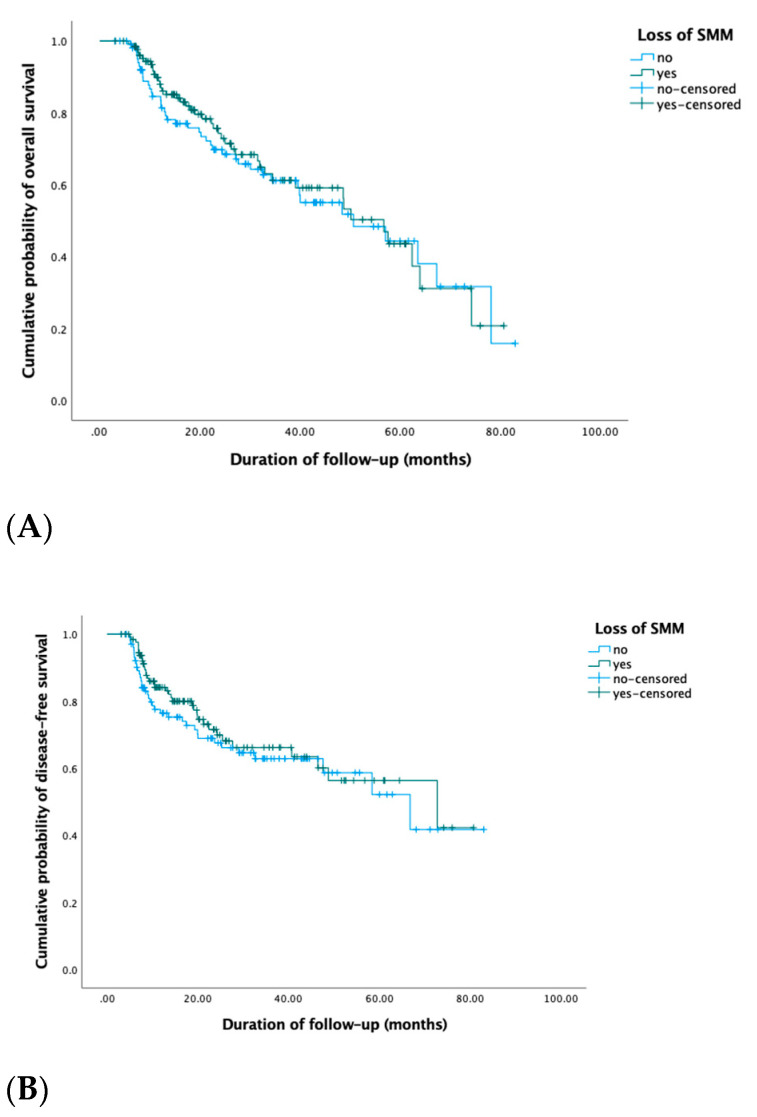
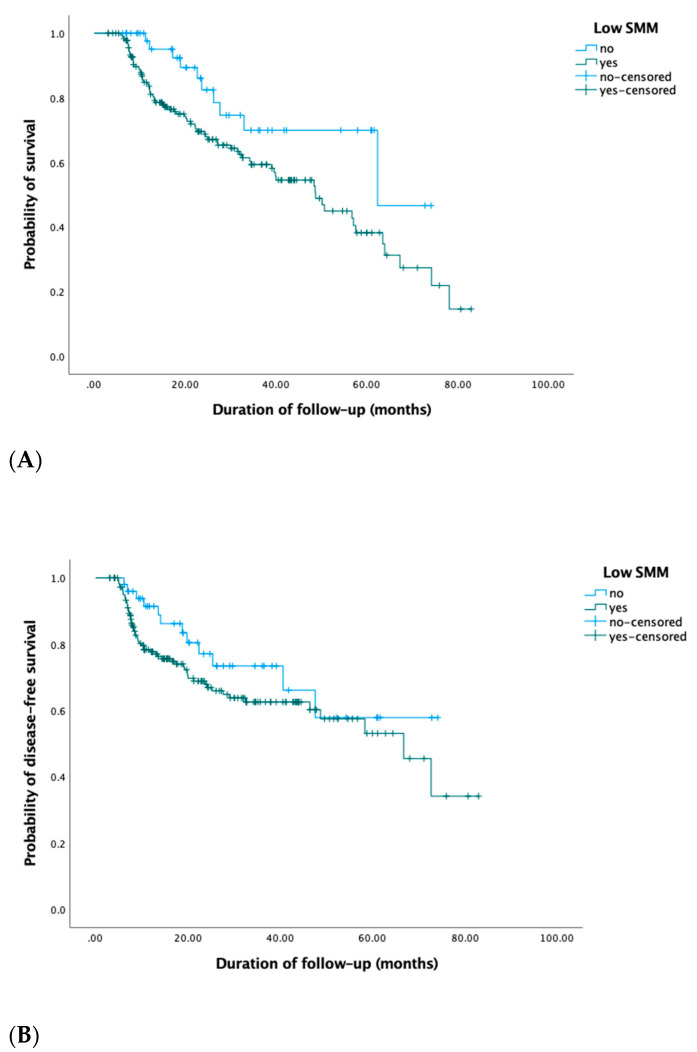
Low skeletal muscle mass (SMM) is associated with toxicities and decreased survival in head and neck cancer (HNC). Chemoradiotherapy (CRT) may exaggerate loss of SMM. We investigated the changes in SMM, their predictors, and prognostic impact of SMM in patients treated with CRT between 2012 and 2018. Skeletal muscle area (SMA) segmentation was performed on pre- and post-CRT imaging. Observed changes in SMM were categorized into: (I) Stable, (II) moderate gain (III), moderate loss, (IV) large gain, and (V) large loss. In total, 235 HNC patients were included, of which 39% had stable SMM, 55% moderate loss, 13% moderate gain, 0.4% large loss, and 0.4% large gain of SMM. After CRT, SMA decreased compared to pre-CRT (31.6 cm versus 33.3 cm, < 0.01). The key predictor was a body mass index (BMI) of ≥30 kg/m (OR 3.6, 95% CI 1.4-9.3, < 0.01). Low SMM at diagnosis (HR 2.1; 95% CI 1.1-4.1, = 0.03) and an HPV-positive oropharyngeal tumor (HR 0.1; 95% CI 0.01-0.9, = 0.04) were prognostic for overall survival. Changes in SMM were not prognostic for survival. Loss of SMM is highly prevalent after CRT and a high BMI before treatment may aid in identifying patients at risk.
低骨骼肌质量(SMM)与头颈癌(HNC)的毒性反应及生存率降低相关。放化疗(CRT)可能会加剧SMM的流失。我们调查了2012年至2018年间接受CRT治疗的患者SMM的变化、其预测因素以及SMM对预后的影响。在CRT前后的影像上进行骨骼肌面积(SMA)分割。观察到的SMM变化分为:(I)稳定,(II)中度增加,(III)中度减少,(IV)大幅增加,和(V)大幅减少。总共纳入了235例HNC患者,其中39%的患者SMM稳定,55%中度减少,13%中度增加,0.4%大幅减少,0.4%大幅增加。CRT后,SMA较CRT前降低(31.6平方厘米对33.3平方厘米,<0.01)。关键预测因素是体重指数(BMI)≥30kg/m²(比值比3.6,95%置信区间1.4 - 9.3,<0.01)。诊断时低SMM(风险比2.1;95%置信区间1.1 - 4.1,=0.03)和人乳头瘤病毒(HPV)阳性口咽肿瘤(风险比0.1;95%置信区间0.01 - 0.9,=0.04)对总生存期具有预后意义。SMM的变化对生存无预后意义。CRT后SMM流失非常普遍,治疗前高BMI可能有助于识别有风险的患者。