Lüttich Lina, Besso María José, Heiden Stephan, Koi Lydia, Baumann Michael, Krause Mechthild, Dubrovska Anna, Linge Annett, Kurth Ina, Peitzsch Claudia
OncoRay-National Center for Radiation Research in Oncology, Faculty of Medicine and University Hospital Carl Gustav Carus, Technische Universität Dresden, Helmholtz-Zentrum Dresden-Rossendorf, 01307 Dresden, Germany.
German Cancer Research Center (DKFZ), 69120 Heidelberg, Germany.
Cancers (Basel). 2021 Apr 14;13(8):1865. doi: 10.3390/cancers13081865.
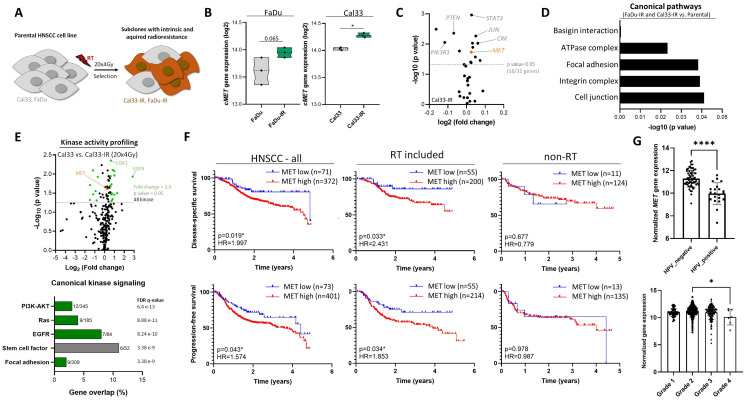
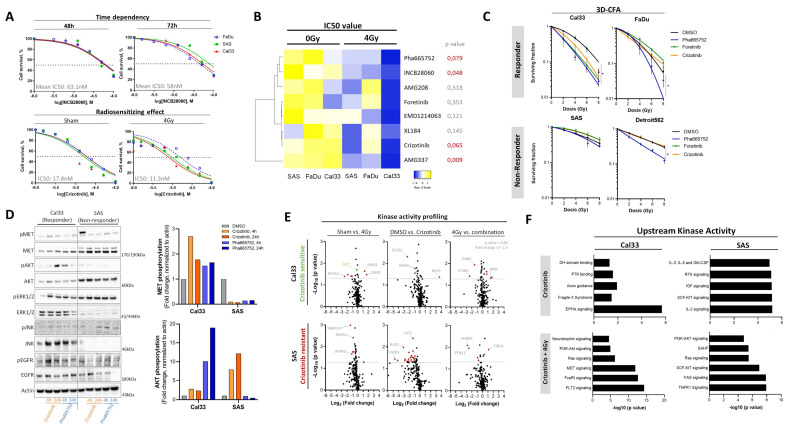
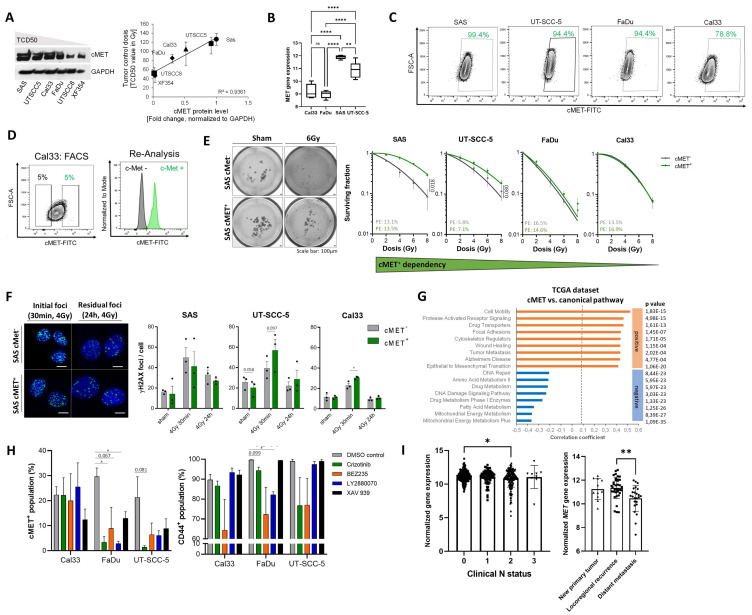
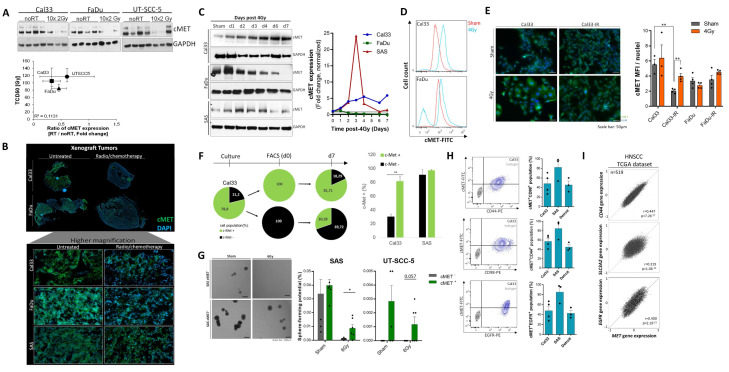
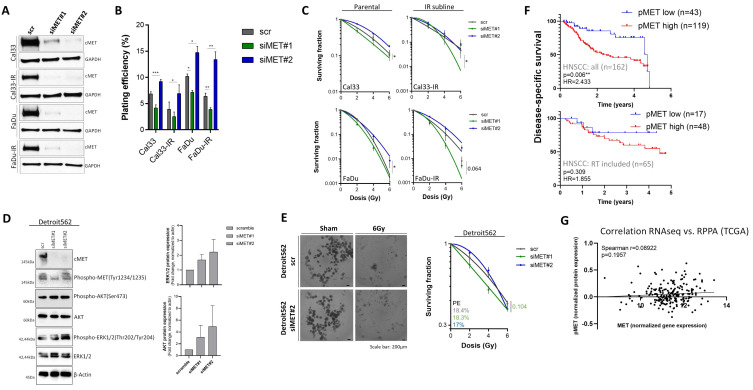
The receptor tyrosine kinase c-MET activates intracellular signaling and induces cell proliferation, epithelial-to-mesenchymal-transition and migration. Within the present study, we validated the prognostic value of c-MET in patients with head and neck squamous cell carcinoma (HNSCC) treated with radio(chemo)therapy using the Cancer Genome Atlas database and found an association of increased gene expression and protein phosphorylation with reduced disease-specific and progression-free survival. To investigate the role of c-MET-dependent radioresistance, c-MET-positive cells were purified from established HNSCC cell lines and a reduced radiosensitivity and enhanced sphere-forming potential, compared to the c-MET-depleted cell population, was found in two out of four analyzed cell lines pointing to regulatory heterogeneity. We showed that c-MET is dynamically regulated after irradiation in vitro and in vivo. Interestingly, no direct impact of c-MET on DNA damage repair was found. The therapeutic potential of eight c-MET targeting agents in combination with irradiation demonstrated variable response rates in six HNSCC cell lines. Amongst them, crizotinib, foretinib, and Pha665752 exhibited the strongest radiosensitizing effect. Kinase activity profiling showed an association of crizotinib resistance with compensatory PI3K/AKT and MAP kinase signaling. Overall, our results indicate that c-MET is conferring radioresistance in HNSCC through modulation of intracellular kinase signaling and stem-like features.
受体酪氨酸激酶c-MET激活细胞内信号传导并诱导细胞增殖、上皮-间质转化和迁移。在本研究中,我们使用癌症基因组图谱数据库验证了c-MET在接受放射(化学)治疗的头颈部鳞状细胞癌(HNSCC)患者中的预后价值,发现基因表达增加和蛋白磷酸化与疾病特异性生存率和无进展生存率降低相关。为了研究c-MET依赖性放射抗性的作用,从已建立的HNSCC细胞系中纯化出c-MET阳性细胞,在四个分析的细胞系中的两个中发现,与c-MET缺失的细胞群体相比,其放射敏感性降低且成球潜力增强,这表明存在调节异质性。我们表明,c-MET在体外和体内照射后受到动态调节。有趣的是,未发现c-MET对DNA损伤修复有直接影响。八种c-MET靶向药物与放疗联合使用的治疗潜力在六种HNSCC细胞系中显示出不同的反应率。其中,克唑替尼、福瑞替尼和Pha665752表现出最强的放射增敏作用。激酶活性分析表明克唑替尼耐药与PI3K/AKT和MAP激酶信号的代偿性激活有关。总体而言,我们的结果表明,c-MET通过调节细胞内激酶信号传导和干细胞样特征赋予HNSCC放射抗性。