Saini Ramesh Kumar, Assefa Awraris Derbie, Keum Young-Soo
Department of Crop Science, Konkuk University, Seoul 05029, Korea.
National Agrobiodiversity Center, National Institute of Agricultural Sciences, Rural Development Administration, Jeonju 54874, Korea.
Foods. 2021 Apr 14;10(4):854. doi: 10.3390/foods10040854.
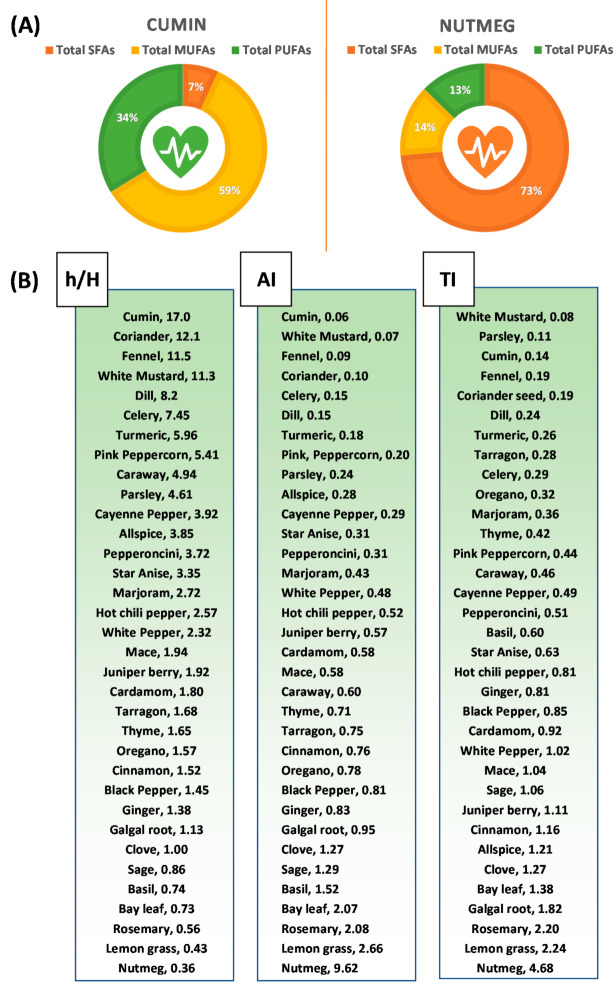
Spices and herbs are well-known for being rich in healthy bioactive metabolites. In recent years, interest in the fatty acid composition of different foods has greatly increased. Thus, the present study was designed to characterize the fatty acid composition of 34 widely used spices and herbs. Utilizing gas chromatography (GC) flame ionization detection (FID) and GC mass spectrometry (MS), we identified and quantified 18 fatty acids. This showed a significant variation among the studied spices and herbs. In general, oleic and linoleic acid dominate in seed spices, whereas palmitic, stearic, oleic, linoleic, and α-linolenic acids are the major constituents of herbs. Among the studied spices and herbs, the ratio of -6/-3 polyunsaturated fatty acids (PUFAs) was recorded to be in the range of 0.36 (oregano) to 85.99 (cumin), whereas the ratio of PUFAs/saturated fatty acids (SFAs) ranged from 0.17 (nutmeg) to 4.90 (cumin). Cumin, coriander, fennel, and dill seeds represent the healthiest fatty acid profile, based upon fat quality indices such as the ratio of hypocholesterolemic/hypercholesterolemic (h/H) fatty acids, the atherogenic index (AI), and the thrombogenic index (TI). All these seed spices belong to the Apiaceae family of plants, which are an exceptionally rich source of monounsaturated fatty acids (MUFAs) in the form of petroselinic acid (C18:1n12), with a very small amount of SFAs.
香料和药草以富含健康的生物活性代谢物而闻名。近年来,人们对不同食物的脂肪酸组成的关注度大幅提高。因此,本研究旨在对34种广泛使用的香料和药草的脂肪酸组成进行表征。利用气相色谱(GC)火焰离子化检测(FID)和GC质谱(MS),我们鉴定并定量了18种脂肪酸。这表明在所研究的香料和药草之间存在显著差异。一般来说,油酸和亚油酸在种子香料中占主导地位,而棕榈酸、硬脂酸、油酸、亚油酸和α-亚麻酸是药草的主要成分。在所研究的香料和药草中,-6/-3多不饱和脂肪酸(PUFA)的比例记录在0.36(牛至)至85.99(孜然)的范围内,而PUFA/饱和脂肪酸(SFA)的比例范围为0.17(肉豆蔻)至4.90(孜然)。根据降胆固醇/升胆固醇(h/H)脂肪酸比例、致动脉粥样硬化指数(AI)和血栓形成指数(TI)等脂肪质量指标,孜然、香菜、茴香和莳萝籽代表了最健康的脂肪酸谱。所有这些种子香料都属于伞形科植物,它们是岩芹酸(C18:1n12)形式的单不饱和脂肪酸(MUFA)的异常丰富来源,饱和脂肪酸含量非常少。