Department of Occupational Diseases and Environmental Health, Nofer Institute of Occupational Medicine, 91-348 Lodz, Poland.
Department of General Biochemistry, Faculty of Biology and Environmental Protection, University of Lodz, Pomorska 141/143, 90-236 Lodz, Poland.
Int J Mol Sci. 2021 Apr 11;22(8):3949. doi: 10.3390/ijms22083949.
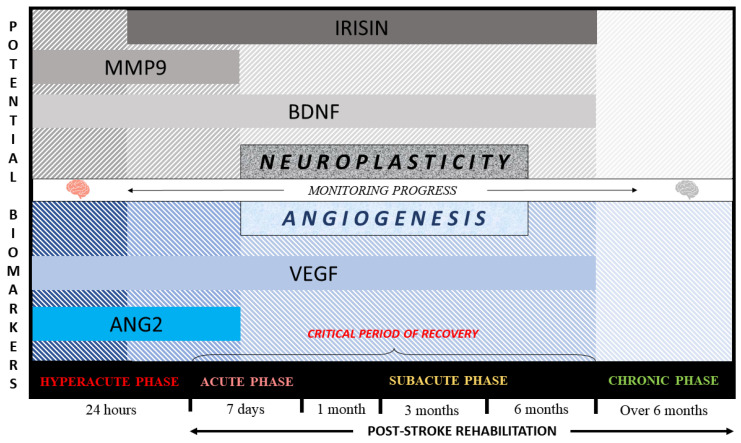
Several key issues impact the clinical practice of stroke rehabilitation including a patient's medical history, stroke experience, the potential for recovery, and the selection of the most effective type of therapy. Until clinicians have answers to these concerns, the treatment and rehabilitation are rather intuitive, with standard procedures carried out based on subjective estimations using clinical scales. Therefore, there is a need to find biomarkers that could predict brain recovery potential in stroke patients. This review aims to present the current state-of-the-art stroke recovery biomarkers that could be used in clinical practice. The revision of biochemical biomarkers has been developed based on stroke recovery processes: angiogenesis and neuroplasticity. This paper provides an overview of the biomarkers that are considered to be ready-to-use in clinical practice and others, considered as future tools. Furthermore, this review shows the utility of biomarkers in the development of the concept of personalized medicine. Enhancing brain neuroplasticity and rehabilitation facilitation are crucial concerns not only after stroke, but in all central nervous system diseases.
一些关键问题影响着中风康复的临床实践,包括患者的病史、中风经历、康复潜力以及最有效的治疗类型的选择。在临床医生找到这些问题的答案之前,治疗和康复主要是凭直觉进行的,根据临床量表的主观估计来进行标准的治疗程序。因此,需要找到能够预测中风患者大脑康复潜力的生物标志物。本篇综述旨在介绍可用于临床实践的最新中风康复生物标志物。基于中风恢复过程(血管生成和神经可塑性),对生化生物标志物进行了修订。本文概述了已考虑可用于临床实践的生物标志物,以及其他被认为是未来工具的生物标志物。此外,本综述还展示了生物标志物在个性化医疗概念发展中的应用。增强大脑神经可塑性和促进康复不仅是中风后的关键关注点,也是所有中枢神经系统疾病的关键关注点。