Darden Dijoia B, Kelly Lauren S, Fenner Brittany P, Moldawer Lyle L, Mohr Alicia M, Efron Philip A
Department of Surgery, College of Medicine, University of Florida, Gainesville, FL 32610, USA.
J Clin Med. 2021 Apr 17;10(8):1742. doi: 10.3390/jcm10081742.
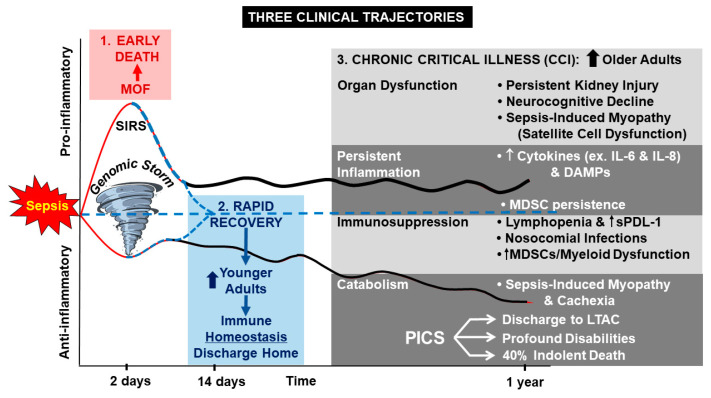
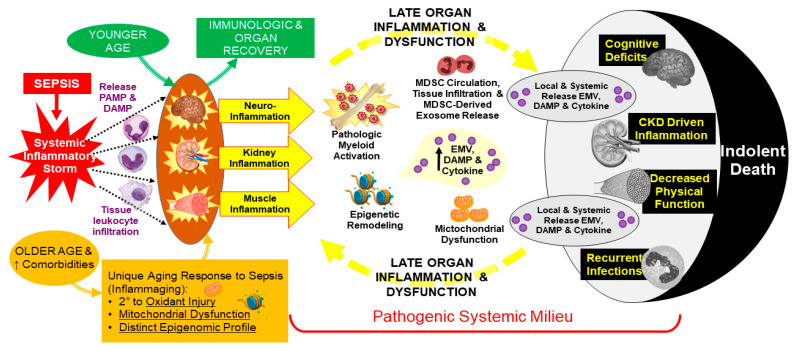
Implementation of protocolized surveillance, diagnosis, and management of septic patients, and of surgical sepsis patients in particular, is shown to result in significantly increased numbers of patients surviving their initial hospitalization. Currently, most surgical sepsis patients will rapidly recover from sepsis; however, many patients will not rapidly recover, but instead will go on to develop chronic critical illness (CCI) and experience dismal long-term outcomes. The elderly and comorbid patient is highly susceptible to death or CCI after sepsis. Here, we review aspects of the Persistent Inflammation, Immunosuppression, and Catabolism Syndrome (PICS) endotype to explain the underlying pathobiology of a dysregulated immune system in sepsis survivors who develop CCI; then, we explore targets for immunomodulatory therapy.
实施针对脓毒症患者,尤其是外科脓毒症患者的规范化监测、诊断和管理,已被证明可显著增加初次住院存活患者的数量。目前,大多数外科脓毒症患者会迅速从脓毒症中康复;然而,许多患者不会迅速康复,而是会发展为慢性危重病(CCI)并经历糟糕的长期预后。老年和合并症患者在脓毒症后极易死亡或发生CCI。在此,我们回顾持续性炎症、免疫抑制和分解代谢综合征(PICS)内型的相关方面,以解释发生CCI的脓毒症幸存者免疫系统失调的潜在病理生物学机制;然后,我们探索免疫调节治疗的靶点。