Department of Nuclear Medicine, Bern University Hospital, CH-3010 Bern, Switzerland.
School of Psychology and Counselling, Queensland University of Technology, Brisbane 4059, Australia.
Molecules. 2021 Apr 22;26(9):2451. doi: 10.3390/molecules26092451.
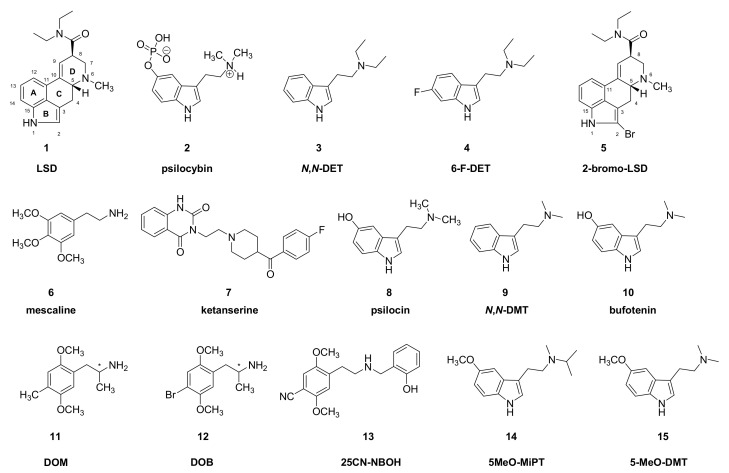
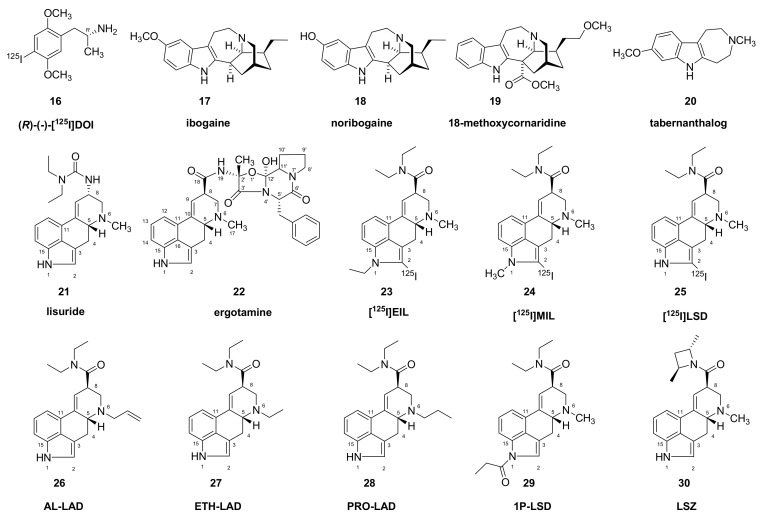
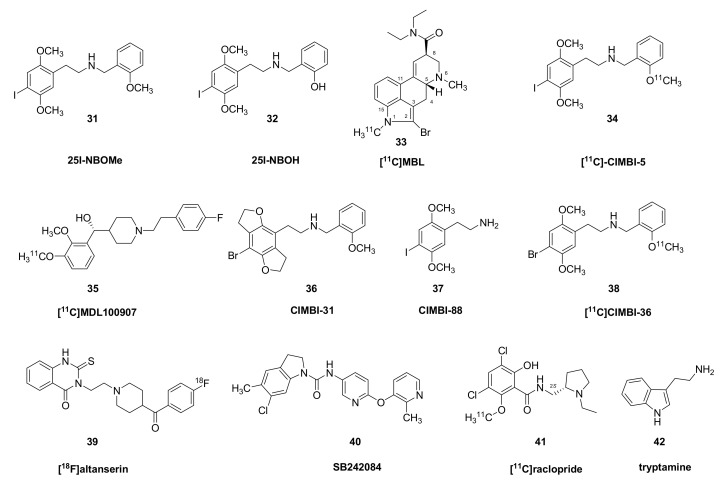
Hallucinogens are a loosely defined group of compounds including LSD, -dimethyltryptamines, mescaline, psilocybin/psilocin, and 2,5-dimethoxy-4-methamphetamine (DOM), which can evoke intense visual and emotional experiences. We are witnessing a renaissance of research interest in hallucinogens, driven by increasing awareness of their psychotherapeutic potential. As such, we now present a narrative review of the literature on hallucinogen binding in vitro and ex vivo, and the various molecular imaging studies with positron emission tomography (PET) or single photon emission computer tomography (SPECT). In general, molecular imaging can depict the uptake and binding distribution of labelled hallucinogenic compounds or their congeners in the brain, as was shown in an early PET study with -([C]-methyl)-2-bromo-LSD ([C]-MBL); displacement with the non-radioactive competitor ketanserin confirmed that the majority of [C]-MBL specific binding was to serotonin 5-HT receptors. However, interactions at serotonin 5HT and other classes of receptors and pleotropic effects on second messenger pathways may contribute to the particular experiential phenomenologies of LSD and other hallucinogenic compounds. Other salient aspects of hallucinogen action include permeability to the blood-brain barrier, the rates of metabolism and elimination, and the formation of active metabolites. Despite the maturation of radiochemistry and molecular imaging in recent years, there has been only a handful of PET or SPECT studies of radiolabeled hallucinogens, most recently using the 5-HT agonist -(2[CHO]-methoxybenzyl)-2,5-dimethoxy- 4-bromophenethylamine ([C]Cimbi-36). In addition to PET studies of target engagement at neuroreceptors and transporters, there is a small number of studies on the effects of hallucinogenic compounds on cerebral perfusion ([O]-water) or metabolism ([F]-fluorodeoxyglucose/FDG). There remains considerable scope for basic imaging research on the sites of interaction of hallucinogens and their cerebrometabolic effects; we expect that hybrid imaging with PET in conjunction with functional magnetic resonance imaging (fMRI) should provide especially useful for the next phase of this research.
致幻剂是一组定义不明确的化合物,包括 LSD、二甲色胺、麦斯卡林、裸盖菇素/赛洛西宾和 2,5-二甲氧基-4-甲基苯丙胺(DOM),它们可以引起强烈的视觉和情感体验。我们正见证着对致幻剂研究兴趣的复兴,这是由于人们越来越意识到它们的心理治疗潜力。因此,我们现在对致幻剂在体外和离体的结合文献以及使用正电子发射断层扫描(PET)或单光子发射计算机断层扫描(SPECT)的各种分子影像学研究进行了叙述性综述。一般来说,分子影像学可以描绘标记致幻化合物或其同系物在大脑中的摄取和结合分布,这在早期的使用 -([C]-甲基)-2-溴-LSD ([C]-MBL 的 PET 研究中得到了证明;用非放射性竞争物酮色林进行的置换证实,[C]-MBL 的大部分特异性结合是与 5-羟色胺 5-HT 受体。然而,5-HT 和其他类别的受体的相互作用以及对第二信使途径的多效性影响可能导致 LSD 和其他致幻化合物的特定体验现象学。致幻剂作用的其他显著方面包括对血脑屏障的通透性、代谢和消除的速度以及活性代谢物的形成。尽管近年来放射化学和分子影像学的成熟度有所提高,但仅有少数关于放射性标记致幻剂的 PET 或 SPECT 研究,最近使用的是 5-HT 激动剂 -(2[CHO]-甲氧基苄基)-2,5-二甲氧基-4-溴苯乙胺 ([C]Cimbi-36)。除了对神经受体和转运体靶标结合的 PET 研究外,还有少数关于致幻化合物对脑灌注 ([O]-水)或代谢 ([F]-氟脱氧葡萄糖/FDG)影响的研究。对致幻剂相互作用及其脑代谢效应的作用部位进行基础影像学研究仍有很大的空间;我们预计,与功能磁共振成像(fMRI)相结合的 PET 混合成像应特别有助于下一阶段的研究。