Cattaneo Luigi, Parmigiani Sara
Center for Mind/Brain Sciences (CIMeC), University of Trento, Via delle Regole 101, 38123 Trento, Italy.
Department of Neuroscience, Biomedicine and Movement, University of Verona, Piazzale L.A. Scuro 10, 37134 Verona, Italy.
Brain Sci. 2021 Apr 24;11(5):534. doi: 10.3390/brainsci11050534.
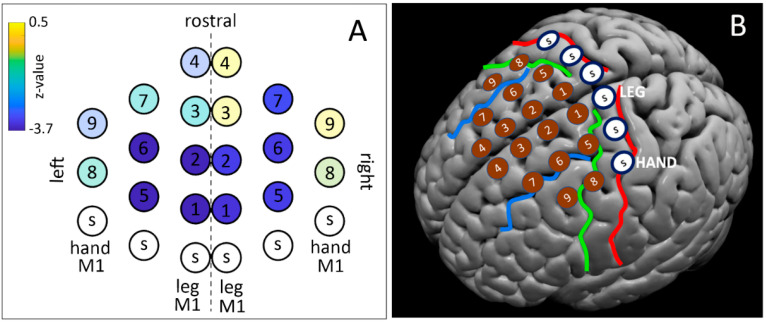
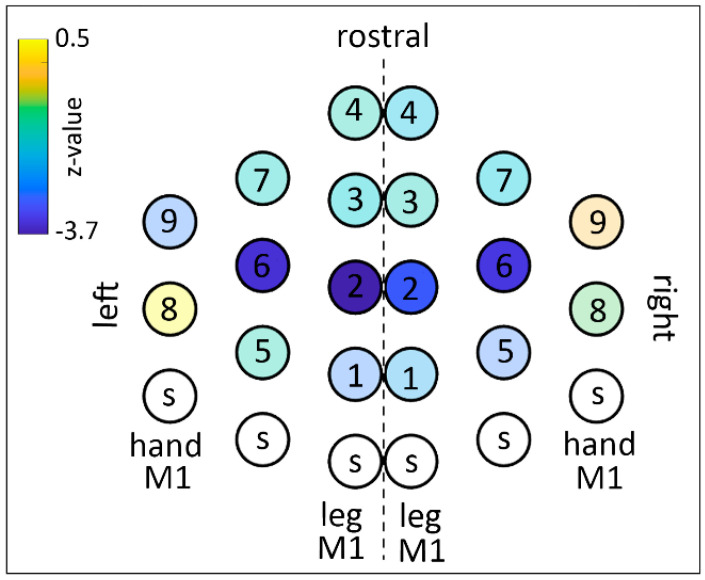
Delayed motor tasks require timely interaction between immobility and action. The neural substrates of these processes probably reside in the premotor and motor circuits; however, fine-grained anatomical/functional information is still lacking. Participants performed a delayed simple reaction task, structured as a ready-set-go sequence, with a fixed, predictable, SET-period. Responses were given with lip movements. During the SET-period, we performed a systematic dense-mapping of the bilateral dorsal premotor region (dPM) by means of single transcranial magnetic stimulation (TMS) pulses on an 18-spot mapping grid, interleaved with sham TMS which served as a baseline. Reaction times (RTs) in TMS trials over each grid spot were compared to RTs in sham trials to build a statistical parametric z-map. The results reveal a rostro-caudal functional gradient in the dPM. TMS of the rostral dPM induced a shift from reactive towards predictive response strategies. TMS of the caudal dPM interfered with the SET-period duration. By means of dense TMS mapping, we have drawn a putative functional map of the role of the dPM during the SET-period. A higher-order rostral component is involved in setting action strategies and a caudal, lower-order, part is probably involved in the inhibitory control of motor output.
延迟运动任务需要静止与行动之间的及时交互。这些过程的神经基础可能存在于运动前区和运动回路中;然而,仍缺乏精细的解剖学/功能信息。参与者执行了一项延迟简单反应任务,其结构为准备-就绪-开始序列,具有固定的、可预测的就绪期。通过唇部动作给出反应。在就绪期,我们通过在一个18点映射网格上施加单脉冲经颅磁刺激(TMS),对双侧背侧运动前区(dPM)进行了系统的密集映射,并穿插了作为基线的伪TMS。将每个网格点的TMS试验中的反应时间(RTs)与伪试验中的RTs进行比较,以构建统计参数z图。结果揭示了dPM中存在从嘴端到尾端的功能梯度。嘴端dPM的TMS诱导了从反应性向预测性反应策略的转变。尾端dPM的TMS干扰了就绪期的持续时间。通过密集的TMS映射,我们绘制了一幅dPM在就绪期作用的假定功能图。一个更高级的嘴端成分参与设定行动策略,而一个尾端的、较低级的部分可能参与运动输出的抑制控制。