Gómez-Villegas Patricia, Vigara Javier, Romero Luis, Gotor Cecilia, Raposo Sara, Gonçalves Brígida, Léon Rosa
Laboratory of Biochemistry, Department of Chemistry, Marine International Campus of Excellence (CEIMAR), University of Huelva, Avda. de las Fuerzas Armadas s/n, 21071 Huelva, Spain.
Instituto de Bioquímica Vegetal y Fotosíntesis, Consejo Superior de Investigaciones Científicas and Universidad de Sevilla, Avenida Américo Vespucio 49, 41092 Seville, Spain.
Biology (Basel). 2021 Apr 16;10(4):337. doi: 10.3390/biology10040337.
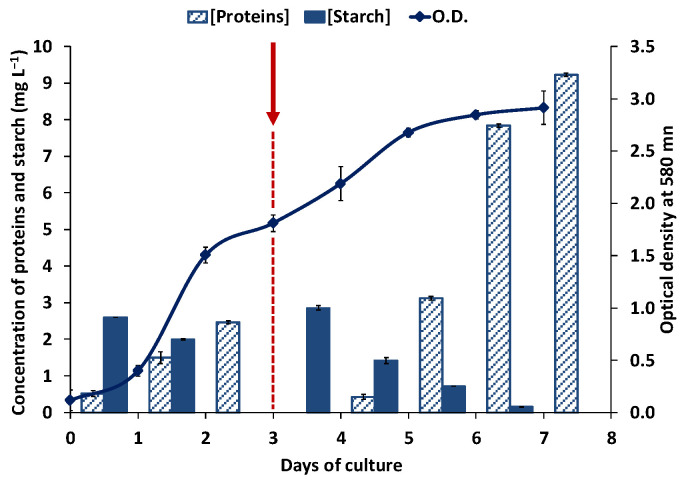
Alpha-amylases are a large family of α,1-4-endo-glycosyl hydrolases distributed in all kingdoms of life. The need for poly-extremotolerant amylases encouraged their search in extreme environments, where archaea become ideal candidates to provide new enzymes that are able to work in the harsh conditions demanded in many industrial applications. In this study, a collection of haloarchaea isolated from Odiel saltern ponds in the southwest of Spain was screened for their amylase activity. The strain that exhibited the highest activity was selected and identified as sp. HS. We demonstrated the existence in both, cellular and extracellular extracts of the new strain, of functional α-amylase activities, which showed to be moderately thermotolerant (optimum around 60 °C), extremely halotolerant (optimum over 25% NaCl), and calcium-dependent. The tryptic digestion followed by HPLC-MS/MS analysis of the partially purified cellular and extracellular extracts allowed to identify the sequence of three alpha-amylases, which despite sharing a low sequence identity, exhibited high three-dimensional structure homology, conserving the typical domains and most of the key consensus residues of α-amylases. Moreover, we proved the potential of the extracellular α-amylase from sp. HS to treat bakery wastes under high salinity conditions.
α-淀粉酶是一类分布于所有生命王国的α,1-4-内切糖苷水解酶大家族。对多极端耐受淀粉酶的需求促使人们在极端环境中寻找此类酶,在这些环境中,古菌成为提供能够在许多工业应用所需的苛刻条件下工作的新酶的理想候选者。在本研究中,对从西班牙西南部奥迪尔盐田池塘分离出的一批嗜盐古菌进行了淀粉酶活性筛选。选择了表现出最高活性的菌株,并将其鉴定为 sp. HS。我们证明了新菌株的细胞提取物和细胞外提取物中均存在功能性α-淀粉酶活性,这些活性表现出适度的耐热性(最适温度约为60°C)、极高的耐盐性(最适NaCl浓度超过25%)且依赖钙。对部分纯化的细胞提取物和细胞外提取物进行胰蛋白酶消化,随后进行HPLC-MS/MS分析,从而鉴定出三种α-淀粉酶的序列,尽管它们的序列同一性较低,但具有高度的三维结构同源性,保留了α-淀粉酶的典型结构域和大多数关键共有残基。此外,我们证明了来自 sp. HS的细胞外α-淀粉酶在高盐条件下处理烘焙废弃物的潜力。