Department of Social Work, Faculty of Social Sciences, Oslo Metropolitan University, 0167 Oslo, Norway.
School of Social Work, University of Michigan, Ann Arbor, MI 48109, USA.
Int J Environ Res Public Health. 2021 Apr 20;18(8):4345. doi: 10.3390/ijerph18084345.
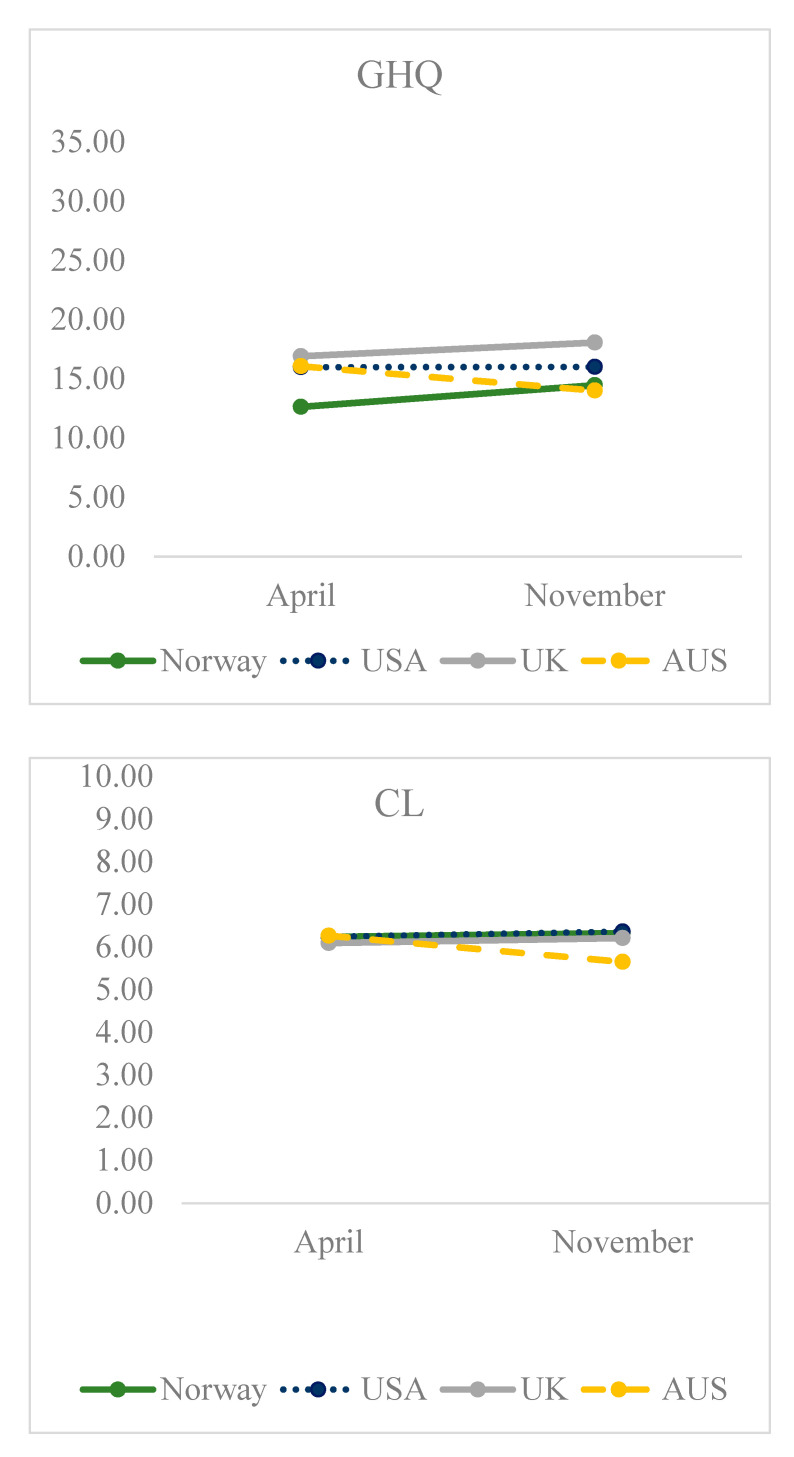
This cross-national study explored stability and change in mental health, quality of life, well-being and loneliness during the early stage and nine months after the implementation of COVID-19 pandemic social distancing measures and periodic lockdowns as adjusted by demographic variables. In the USA, the UK, Australia and Norway, 7284 individuals responded to the invitation to take part in two cross-sectional web-based surveys (April and November 2020), including questions about sociodemographic variables and psychosocial outcomes. Independent -tests and generalized linear models (GLM) and estimated marginal means were used to analyze differences between subgroups and countries, multiple linear regression analyses were conducted on the psychosocial outcome measures by demographic variables and time in each country and mean responses presented by time after adjusting for all demographic variables in the model. Age, gender, civil status, education, employment, place of work and living area were all significant factors for psychosocial health across the countries. Differences in mental health, quality of life, well-being and loneliness were found between the countries in both April and November 2020, while time did not contribute to reducing the toll in any of the four countries over the nine-month period.
本跨国研究旨在探讨在实施 COVID-19 大流行社交距离措施和定期封锁期间以及之后的 9 个月内,心理健康、生活质量、幸福感和孤独感的稳定性和变化,同时考虑到人口统计学变量的调整。在美国、英国、澳大利亚和挪威,共有 7284 人响应了参与两项横断面网络调查(2020 年 4 月和 11 月)的邀请,调查内容包括社会人口统计学变量和心理社会结果。独立样本 t 检验和广义线性模型(GLM)和估计边缘均值用于分析亚组和国家之间的差异,通过人口统计学变量和每个国家的时间对心理社会结果进行多线性回归分析,并在模型中调整所有人口统计学变量后呈现时间后的平均反应。年龄、性别、婚姻状况、教育、就业、工作地点和居住区域都是所有国家心理社会健康的重要因素。2020 年 4 月和 11 月,四个国家之间在心理健康、生活质量、幸福感和孤独感方面存在差异,而时间在 9 个月期间并没有减轻四个国家中任何一个国家的负担。