Bonsaksen Tore, Ruffolo Mary, Price Daicia, Leung Janni, Thygesen Hilde, Lamph Gary, Kabelenga Isaac, Geirdal Amy Østertun
Department of Health and Nursing Science, Faculty of Social and Health Science, Inland Norway University of Applied Sciences, Elverum, Norway.
Department of Health, Faculty of Health Studies, VID Specialized University, Stavanger, Norway.
Health Psychol Behav Med. 2023 Jan 1;11(1):2158089. doi: 10.1080/21642850.2022.2158089. eCollection 2023.
We aimed to examine the association between social media use and loneliness two years after the COVID-19 pandemic outbreak.
Participants were 1649 adults who completed a cross-sectional online survey disseminated openly in Norway, United Kingdom, USA, and Australia between November 2021 and January 2022. Linear regressions examined time spent on social media and participants' characteristics on loneliness, and interactions by motives for social media use.
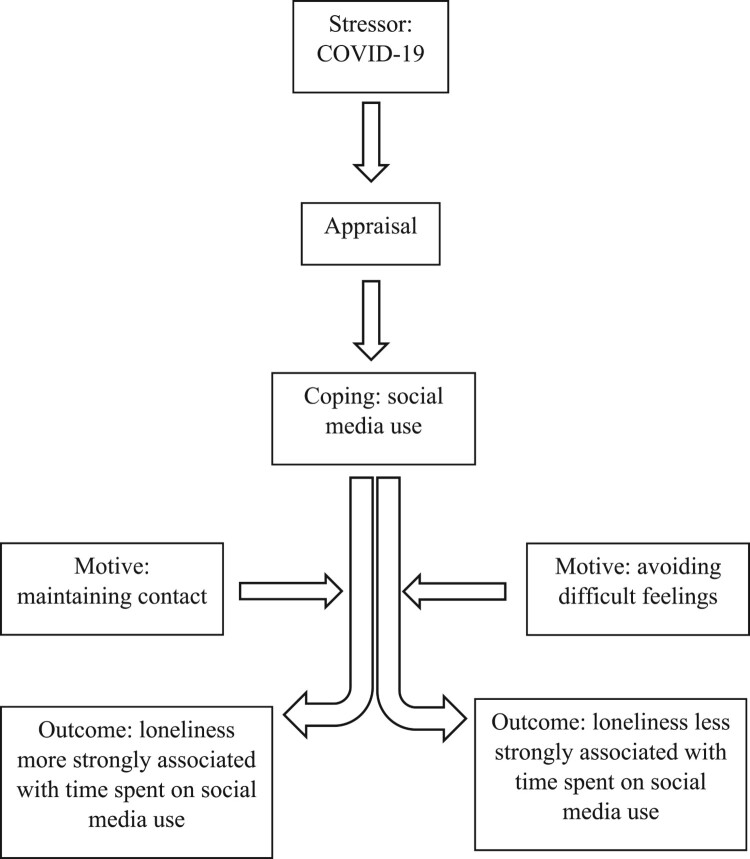
Participants who worried more about their health and were younger, not employed, and without a spouse or partner reported higher levels of loneliness compared to their counterparts. More time spent on social media was associated with more loneliness ( = 0.12, < 0.001). Three profile groups emerged for social media use motives: 1) social media use motive ratings on avoiding difficult feelings higher or the same as for maintaining contact; 2) slightly higher ratings for maintaining contact; and 3) substantially higher ratings for maintaining contact. Time spent on social media was significant only in motive profile groups 2 and 3 ( = 0.12 and = 0.14, both < 0.01).
Our findings suggest that people who use social media for the motive of maintaining their relationships feel lonelier than those who spend the same amount of time on social media for other reasons. While social media may facilitate social contact to a degree, they may not facilitate the type of contact sought by those who use social media primarily for this reason.
我们旨在研究新冠疫情爆发两年后社交媒体使用与孤独感之间的关联。
参与者为1649名成年人,他们于2021年11月至2022年1月期间在挪威、英国、美国和澳大利亚完成了一项公开传播的横断面在线调查。线性回归分析了花在社交媒体上的时间以及参与者的特征对孤独感的影响,以及社交媒体使用动机的相互作用。
与同龄人相比,那些更担心自己健康、年龄较小、未就业且没有配偶或伴侣的参与者报告的孤独感水平更高。花在社交媒体上的时间越多,孤独感越强(β = 0.12,P < 0.001)。社交媒体使用动机出现了三个特征组:1)避免困难情绪的社交媒体使用动机评分高于或等于维持联系的评分;2)维持联系的评分略高;3)维持联系的评分大幅更高。花在社交媒体上的时间仅在动机特征组2和3中具有统计学意义(β = 0.12和β = 0.14,均P < 0.01)。
我们的研究结果表明,出于维持人际关系的动机使用社交媒体的人比因其他原因在社交媒体上花费相同时间的人感到更孤独。虽然社交媒体在一定程度上可能促进社交联系,但它们可能无法促进那些主要出于这个原因使用社交媒体的人所寻求的那种联系。