Department of Global Health, School of Public Health, Peking University, 38 Xue Yuan Road, Haidian District, Beijing 100191, China.
Institute for Global Health, Peking University, Beijing 100191, China.
Int J Environ Res Public Health. 2021 Apr 13;18(8):4090. doi: 10.3390/ijerph18084090.
It is well-recognized that containing COVID-19 successfully is determined by people's prevention measures which are related to their knowledge, attitudes, and practices (KAP). This perception has attracted attention in low- and middle-income countries (LMIC) due to their fragile health systems and economies. The objective of this study was to understand how residents in Malawi perceived COVID-19, to determine the factors related to KAP.
A semi-structured questionnaire was used for the data collection. A field-based survey was conducted among adult residents in Lilongwe, Malawi. Descriptive statistic, linear regression, the Chi-square test, and Pearson's correlation statistics were used for data analysis.
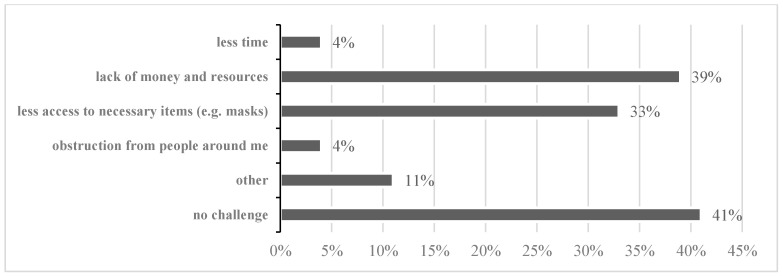
A total of 580 questionnaires were involved. The mean knowledge, attitude, and practice (KAP) scores were 10 (SD = ±3, range: 3-19), 16 (SD = ±4, range: 5-25), and 2 (SD = ±1, range: 0-5), respectively. Lack of money and resources (39%) was the biggest challenge for people who practice prevention measures. Among the participants, the radio (70%) and friends/family (56%) were the main sources of information. A higher economic status was associated with better KAP.
A low level of KAP was detected among the population. The people faced challenges regarding a lack of necessary preventive resources and formal information channels. The situation was worse considering vulnerable population who had low economic status. Further all-round health education is urgently needed along with providing adequate health supplies and ensuring proper information management.
众所周知,成功控制 COVID-19 取决于人们的预防措施,而这些措施与他们的知识、态度和行为(KAP)有关。由于中低收入国家(LMIC)的卫生系统和经济较为脆弱,这一观点引起了人们的关注。本研究旨在了解马拉维居民对 COVID-19 的看法,确定与 KAP 相关的因素。
采用半结构式问卷进行数据收集。在马拉维利隆圭市进行了一项基于现场的调查,调查对象为成年居民。采用描述性统计、线性回归、卡方检验和皮尔逊相关统计分析数据。
共涉及 580 份问卷。知识、态度和行为(KAP)得分的平均值分别为 10(SD=±3,范围:3-19)、16(SD=±4,范围:5-25)和 2(SD=±1,范围:0-5)。缺乏资金和资源(39%)是人们实施预防措施的最大挑战。在参与者中,广播(70%)和朋友/家人(56%)是主要的信息来源。较高的经济地位与较好的 KAP 相关。
在人群中发现 KAP 水平较低。人们在缺乏必要的预防资源和正规信息渠道方面面临挑战。考虑到经济地位较低的弱势群体,情况更为严重。迫切需要进行全面的健康教育,同时提供足够的卫生用品并确保适当的信息管理。