Jiao Kexin, Walsh Laurence J, Ivanovski Sašo, Han Pingping
Epigenetics Nanodiagnostic and Therapeutic Group, Center for Oral-Facial Regeneration, Rehabilitation and Reconstruction (COR3), School of Dentistry, Faculty of Health and Behavioural Sciences, The University of Queensland, Brisbane, QLD 4006, Australia.
School of Dentistry, Faculty of Health and Behavioural Sciences, The University of Queensland, Brisbane, QLD 4006, Australia.
Int J Mol Sci. 2021 Apr 28;22(9):4636. doi: 10.3390/ijms22094636.
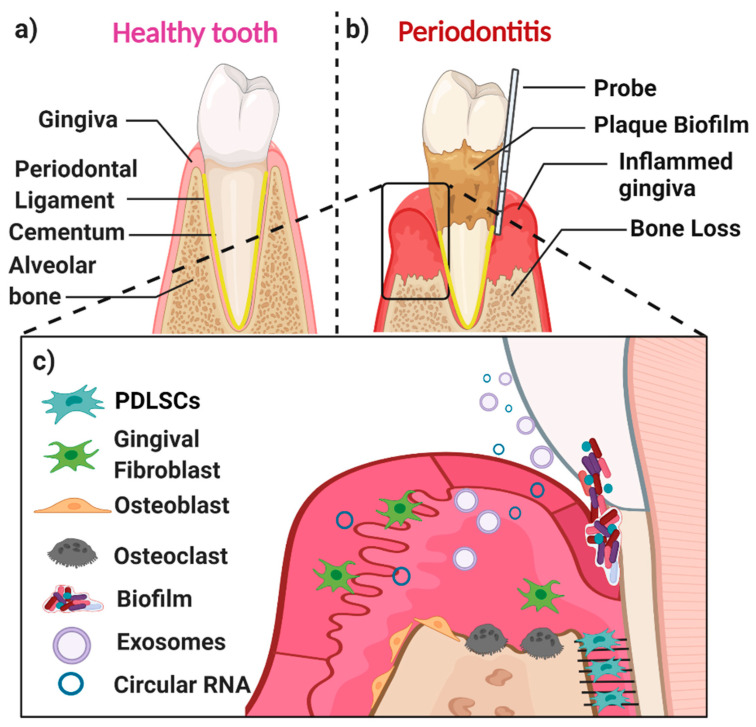
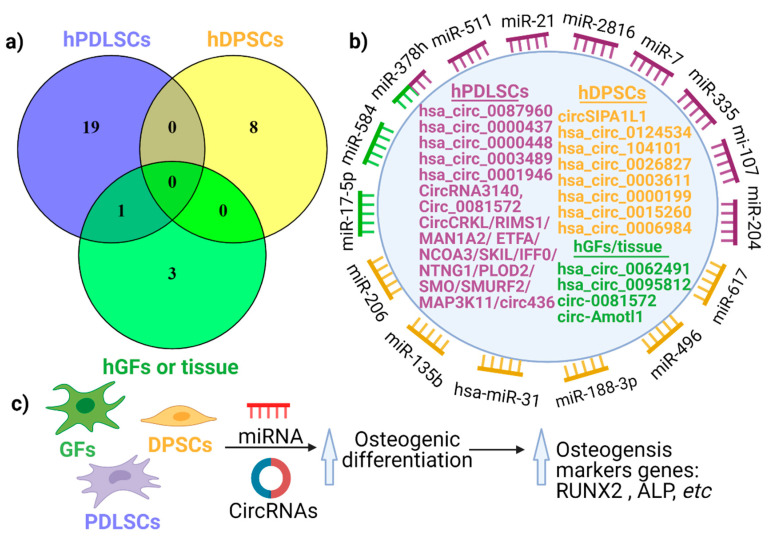
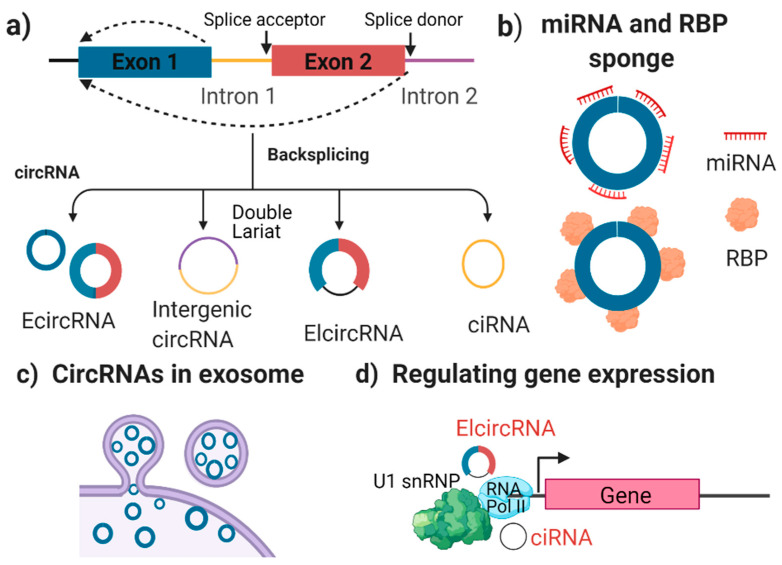
Periodontitis is a chronic complex inflammatory disease associated with a destructive host immune response to microbial dysbiosis, leading to irreversible loss of tooth-supporting tissues. Regeneration of functional periodontal soft (periodontal ligament and gingiva) and hard tissue components (cementum and alveolar bone) to replace lost tissues is the ultimate goal of periodontal treatment, but clinically predictable treatments are lacking. Similarly, the identification of biomarkers that can be used to accurately diagnose periodontitis activity is lacking. A relatively novel category of molecules found in oral tissue, circular RNAs (circRNAs) are single-stranded endogenous, long, non-coding RNA molecules, with covalently circular-closed structures without a 5' cap and a 3' tail via non-classic backsplicing. Emerging research indicates that circRNAs are tissue and disease-specific expressed and have crucial regulatory functions in various diseases. CircRNAs can function as microRNA or RNA binding sites or can regulate mRNA. In this review, we explore the biogenesis and function of circRNAs in the context of the emerging role of circRNAs in periodontitis pathogenesis and the differentiation of periodontal cells. CircMAP3K11, circCDK8, circCDR1as, circ_0062491, and circ_0095812 are associated with pathological periodontitis tissues. Furthermore, circRNAs are expressed in periodontal cells in a cell-specific manner. They can function as microRNA sponges and can form circRNA-miRNA-mRNA networks during osteogenic differentiation for periodontal-tissue (or dental pulp)-derived progenitor cells.
牙周炎是一种慢性复杂炎症性疾病,与宿主对微生物群落失调的破坏性免疫反应相关,会导致牙齿支持组织不可逆转的丧失。再生功能性牙周软组织(牙周韧带和牙龈)和硬组织成分(牙骨质和牙槽骨)以替代丧失的组织是牙周治疗的最终目标,但临床上缺乏可预测的治疗方法。同样,目前也缺乏能够用于准确诊断牙周炎活动的生物标志物。环状RNA(circRNAs)是在口腔组织中发现的一类相对新颖的分子,它们是单链内源性长链非编码RNA分子,通过非经典的反向剪接形成共价环状闭合结构,没有5'帽和3'尾。新出现的研究表明,circRNAs具有组织和疾病特异性表达,并且在各种疾病中具有关键的调节功能。CircRNAs可以作为微小RNA或RNA结合位点发挥作用,或者调节信使RNA。在本综述中,我们在circRNAs在牙周炎发病机制和牙周细胞分化中的新作用背景下,探讨了circRNAs的生物发生和功能。CircMAP3K11、circCDK8、circCDR1as、circ_0062491和circ_0095812与病理性牙周炎组织相关。此外,circRNAs在牙周细胞中以细胞特异性方式表达。它们可以作为微小RNA海绵发挥作用,并且在牙周组织(或牙髓)来源的祖细胞成骨分化过程中可以形成circRNA-微小RNA-信使RNA网络。