Jenkins Yasmin, Zabkiewicz Joanna, Ottmann Oliver, Jones Nicholas
Institute of Life Science, Swansea University Medical School, Swansea University, Swansea SA2 8PP, UK.
Department of Haematology, Cardiff University, Experimental Cancer Medicine Centre, Heath Hospital, Heath Park, Cardiff CF14 4XN, UK.
Antibodies (Basel). 2021 Apr 26;10(2):17. doi: 10.3390/antib10020017.
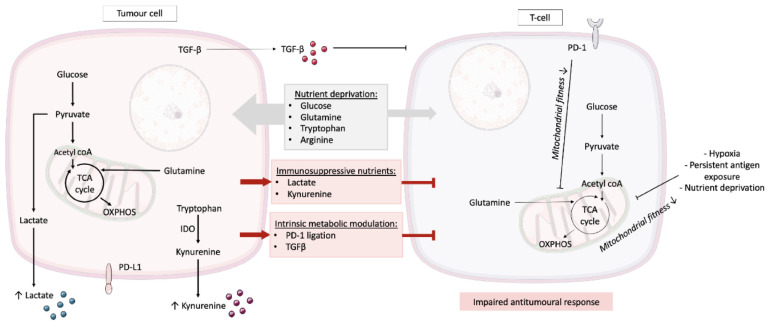
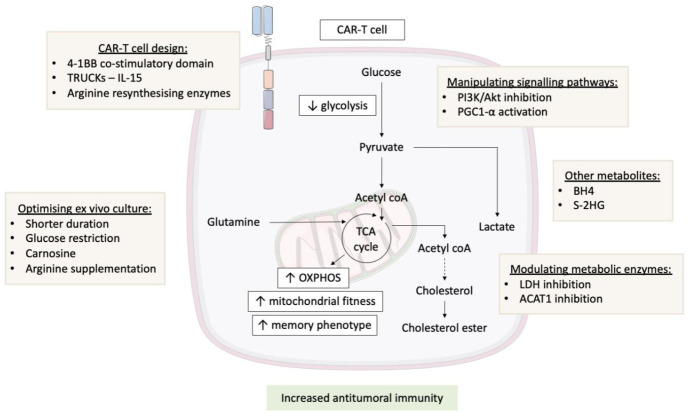
Chimeric antigen receptor (CAR)-T cells are one of the most exciting areas of immunotherapy to date. Clinically available CAR-T cells are used to treat advanced haematological B-cell malignancies with complete remission achieved at around 30-40%. Unfortunately, CAR-T cell success rates are even less impressive when considering a solid tumour. Reasons for this include the paucity of tumour specific targets and greater degree of co-expression on normal tissues. However, there is accumulating evidence that considerable competition for nutrients such as carbohydrates and amino acids within the tumour microenvironment (TME) coupled with immunosuppression result in mitochondrial dysfunction, exhaustion, and subsequent CAR-T cell depletion. In this review, we will examine research avenues being pursued to dissect the various mechanisms contributing to the immunosuppressive TME and outline in vitro strategies currently under investigation that focus on boosting the metabolic program of CAR-T cells as a mechanism to overcome the immunosuppressive TME. Various in vitro and in vivo techniques boost oxidative phosphorylation and mitochondrial fitness in CAR-T cells, resulting in an enhanced central memory T cell compartment and increased anti-tumoural immunity. These include intracellular metabolic enhancers and extracellular in vitro culture optimisation pre-infusion. It is likely that the next generation of CAR-T products will incorporate these elements of metabolic manipulation in CAR-T cell design and manufacture. Given the importance of immunometabolism and T cell function, it is critical that we identify ways to metabolically armour CAR-T cells to overcome the hostile TME and increase clinical efficacy.
嵌合抗原受体(CAR)-T细胞是迄今为止免疫治疗领域最令人兴奋的领域之一。临床上可用的CAR-T细胞用于治疗晚期血液系统B细胞恶性肿瘤,完全缓解率约为30%-40%。不幸的是,在考虑实体瘤时,CAR-T细胞的成功率甚至更低。其原因包括肿瘤特异性靶点的缺乏以及在正常组织上更高程度的共表达。然而,越来越多的证据表明,肿瘤微环境(TME)中对碳水化合物和氨基酸等营养物质的大量竞争,再加上免疫抑制,会导致线粒体功能障碍、耗竭以及随后的CAR-T细胞耗竭。在这篇综述中,我们将研究为剖析导致免疫抑制性TME的各种机制而探索的研究途径,并概述目前正在研究的体外策略,这些策略侧重于增强CAR-T细胞的代谢程序,以此作为克服免疫抑制性TME的一种机制。各种体外和体内技术可增强CAR-T细胞中的氧化磷酸化和线粒体适应性,从而导致中央记忆T细胞区室增强和抗肿瘤免疫力增加。这些技术包括细胞内代谢增强剂和输注前的细胞外体外培养优化。下一代CAR-T产品可能会在CAR-T细胞的设计和制造中纳入这些代谢调控元素。鉴于免疫代谢和T细胞功能的重要性,至关重要的是我们要找到方法,使CAR-T细胞在代谢上具备优势,以克服恶劣的TME并提高临床疗效。