Ma Ganggang, Yang Yang, Chen Yong, Wei Xin, Ding Jie, Zhou Ren-Peng, Hu Wei
Department of Clinical Pharmacology, The Second Hospital of Anhui Medical University, Hefei, China.
The Key Laboratory of Anti-inflammatory and Immune Medicine, Anhui Medical University, Ministry of Education, Hefei, China.
Front Pharmacol. 2021 Apr 13;12:655551. doi: 10.3389/fphar.2021.655551. eCollection 2021.
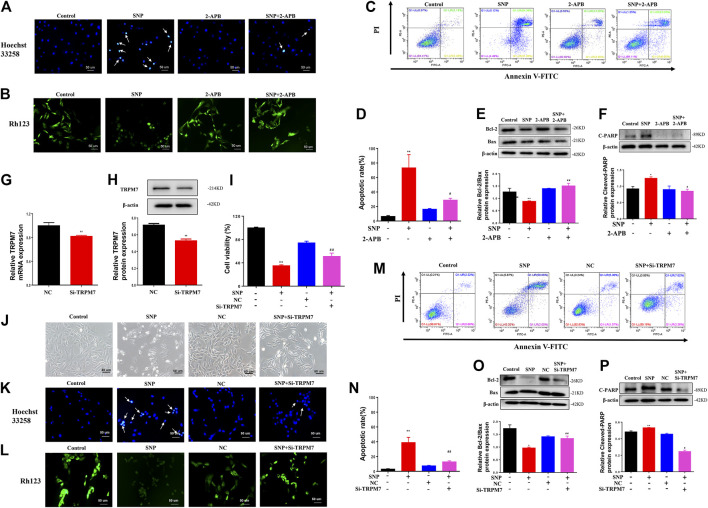
Articular cartilage damage with subsequent impairment of joint function is a common feature of articular diseases, in particular, rheumatoid arthritis and osteoarthritis. While articular cartilage injury mediated by chondrocyte apoptosis is a known major pathological feature of arthritis, the specific mechanisms remain unclear at present. Transient receptor potential melastatin-like seven channel (TRPM7) is reported to play an important regulatory role in apoptosis. This study focused on the effects of TRPM7 on arthritic chondrocyte injury and its underlying mechanisms of action. Sodium nitroprusside (SNP)-induced rat primary chondrocyte apoptosis and rat adjuvant arthritis (AA) were used as and models, respectively. Blockage of TRPM7 with 2-APB or specific siRNA resulted in increased chondrocyte viability and reduced toxicity of SNP. Moreover, treatment with 2-APB enhanced the Bcl-2/Bax ratio and reduced cleaved PARP and IL-6, MMP-13 and ADAMTS-5 expression in SNP-treated chondrocytes. Activation of Indian Hedgehog with purmorphamine reversed the protective effects of 2-APB on SNP-induced chondrocyte apoptosis. Blockage of TRPM7 with 2-APB relieved the clinical signs of AA in the rat model and reduced the arthritis score and paw swelling. Similar to findings in SNP-treated chondrocytes, 2-APB treatment increased the Bcl-2/Bax ratio and suppressed cleaved PARP, IL-6, MMP-13, ADAMTS-5, TRPM7, and Indian hedgehog expression in articular cartilage of AA rats. Our collective findings suggest that blockade of TRPM7 could effectively reduce chondrocyte apoptosis and articular cartilage damage in rats with adjuvant arthritis through regulation of the Indian Hedgehog signaling pathway.
关节软骨损伤及随后的关节功能障碍是关节疾病的常见特征,尤其是类风湿性关节炎和骨关节炎。虽然由软骨细胞凋亡介导的关节软骨损伤是关节炎已知的主要病理特征,但目前具体机制仍不清楚。据报道,瞬时受体电位褪黑素样7通道(TRPM7)在细胞凋亡中起重要调节作用。本研究聚焦于TRPM7对关节炎软骨细胞损伤的影响及其潜在作用机制。分别使用硝普钠(SNP)诱导的大鼠原代软骨细胞凋亡和大鼠佐剂性关节炎(AA)作为[具体未提及的]和[具体未提及的]模型。用2-氨基乙氧基二苯硼酸(2-APB)或特异性小干扰RNA(siRNA)阻断TRPM7可提高软骨细胞活力并降低SNP的毒性。此外,用2-APB处理可提高SNP处理的软骨细胞中Bcl-2/Bax比值,并降低裂解的聚(ADP-核糖)聚合酶(PARP)以及白细胞介素-6(IL-6)、基质金属蛋白酶-13(MMP-13)和含血小板反应蛋白基序的解聚蛋白样金属蛋白酶-5(ADAMTS-5)的表达。用嘌呤吗啡激活印度刺猬信号通路可逆转2-APB对SNP诱导的软骨细胞凋亡的保护作用。用2-APB阻断TRPM7可减轻大鼠模型中AA的临床症状,并降低关节炎评分和爪肿胀。与SNP处理的软骨细胞中的发现相似,2-APB处理可提高AA大鼠关节软骨中Bcl-2/Bax比值,并抑制裂解的PARP、IL-6、MMP-13、ADAMTS-5、TRPM7和印度刺猬信号通路的表达。我们的研究结果表明,阻断TRPM7可通过调节印度刺猬信号通路有效减少佐剂性关节炎大鼠的软骨细胞凋亡和关节软骨损伤。