Wu Choufei, Lyu Wentao, Hong Qihua, Zhang Xiaojun, Yang Hua, Xiao Yingping
Key Laboratory of Vector Biology and Pathogen Control of Zhejiang Province, School of Life Sciences, Huzhou University, Huzhou, China.
State Key Laboratory for Managing Biotic and Chemical Threats to the Quality and Safety of Agro-Products, Institute of Agro-Product Safety and Nutrition, Zhejiang Academy of Agricultural Sciences, Hangzhou, China.
Front Nutr. 2021 Apr 13;8:675445. doi: 10.3389/fnut.2021.675445. eCollection 2021.
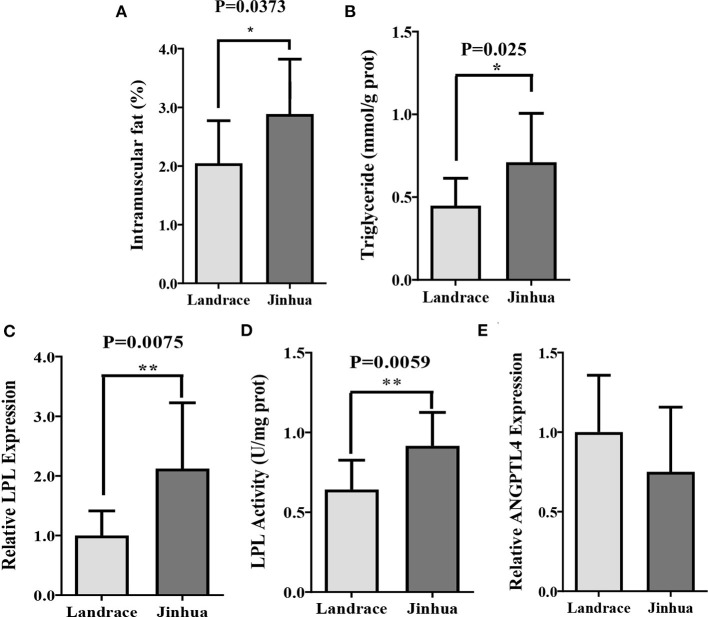
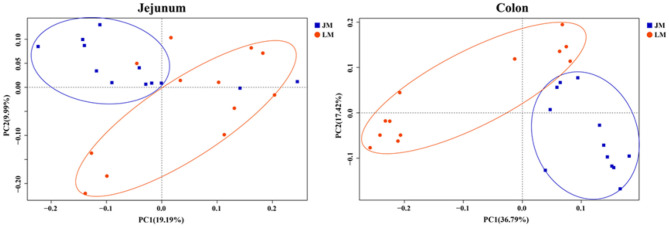
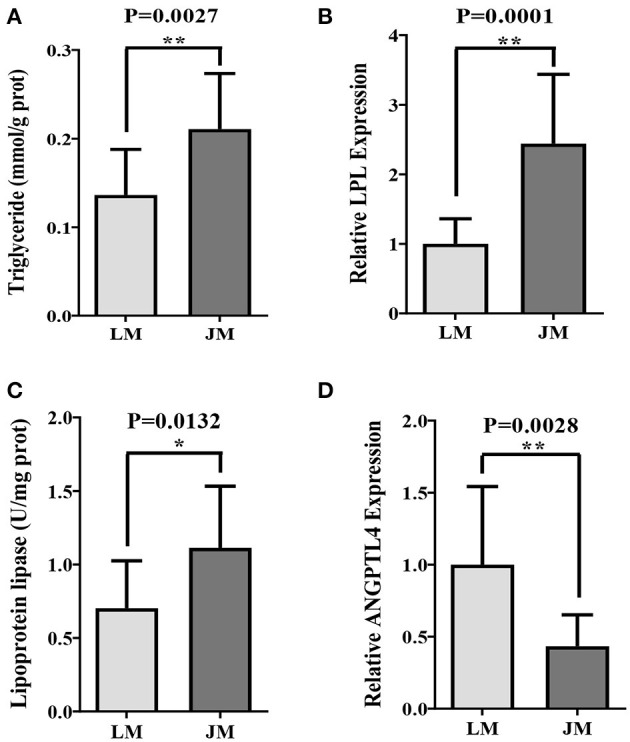
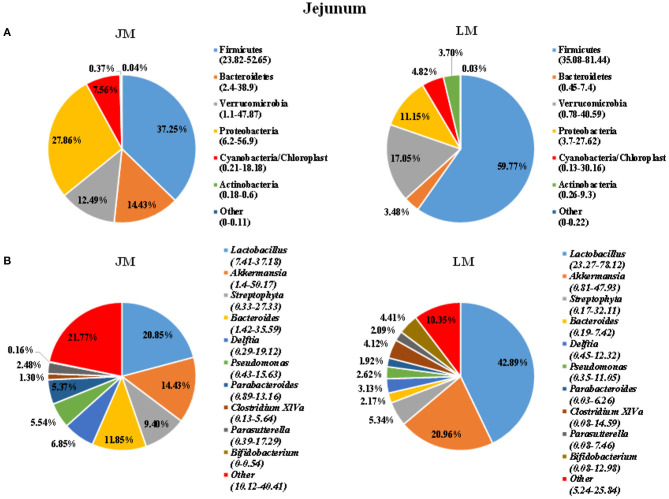
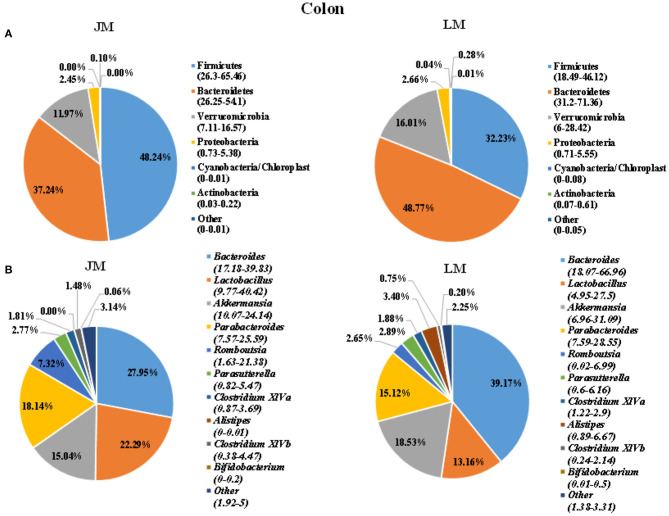
Gut microbiota is recognized as a strong determinant of host physiology including fat metabolism and can transfer obesity-associated phenotypes from donors to recipients. However, the relationship between gut microbiota and intramuscular fat (IMF) is still largely unknown. Obese Jinhua pigs (JP) have better meat quality that is associated with higher IMF content than lean Landrace pigs (LP). The present study was conducted to test the contribution of gut microbiota to IMF properties by transplanting fecal microbiota of adult JP and LP to antibiotics-treated mice. Similar to JP donors, the mice receiving JP's microbiota (JM) had elevated lipid and triglyceride levels and the lipoprotein lipase activity, as well as reduced mRNA level of angiopoietin-like 4 (ANGPTL4) in the gastrocnemius muscles, compared to those in mice receiving LP's microbiota (LM). High-throughput 16S rRNA sequencing confirmed that transplantation of JP and LP feces differently reconstructed the gut microbiota in both jejunum and colon of mouse recipients. In colonic samples, we observed an elevated ratio of Firmicutes to Bacteroidetes and increased abundance of genus in JM, which were positively correlated with obesity. Furthermore, the abundance of decreased in JM, which is positively correlated with lean. Colonic concentrations of acetate ( = 0.047) and butyrate ( = 0.014) were significantly lower in JM than in LM, and consistently, the terminal genes for butyrate synthesis, butyryl CoA: acetate CoA transferase were less abundant in colonic microbiota of JM. Taken together, these gut microbiota of obese JP intrinsically promotes IMF accumulation and can transfer the properties to mouse recipients. Manipulation of intestinal microbiota will, therefore, have the potential to improve the meat quality and flavor of pigs and even to ameliorate the metabolic syndrome in human.
肠道微生物群被认为是宿主生理机能(包括脂肪代谢)的一个重要决定因素,并且能够将肥胖相关表型从供体传递给受体。然而,肠道微生物群与肌内脂肪(IMF)之间的关系仍 largely 未知。肥胖的金华猪(JP)比瘦肉型长白猪(LP)具有更好的肉质,这与更高的 IMF 含量有关。本研究通过将成年 JP 和 LP 的粪便微生物群移植到经抗生素处理的小鼠体内,来测试肠道微生物群对 IMF 特性的贡献。与 JP 供体相似,与接受 LP 微生物群的小鼠(LM)相比,接受 JP 微生物群的小鼠(JM)血脂和甘油三酯水平升高,脂蛋白脂肪酶活性增强,腓肠肌中血管生成素样 4(ANGPTL4)的 mRNA 水平降低。高通量 16S rRNA 测序证实,JP 和 LP 粪便的移植以不同方式重塑了小鼠受体空肠和结肠中的肠道微生物群。在结肠样本中,我们观察到 JM 中厚壁菌门与拟杆菌门的比例升高,属丰度增加,这与肥胖呈正相关。此外,JM 中 的丰度降低,这与瘦肉呈正相关。JM 中乙酸盐( = 0.047)和丁酸盐( = 0.014)的结肠浓度显著低于 LM,并且一致地,丁酸盐合成的末端基因丁酰辅酶 A:乙酰辅酶 A 转移酶在 JM 的结肠微生物群中丰度较低。综上所述,肥胖 JP 的这些肠道微生物群本质上促进了 IMF 的积累,并能够将这些特性传递给小鼠受体。因此,操纵肠道微生物群有可能改善猪的肉质和风味,甚至改善人类的代谢综合征。