Institute of Experimental Immunology, University of Zürich, Winterthurerstr. 190, 8057, Zurich, Switzerland.
Semin Immunopathol. 2021 Jun;43(3):295-306. doi: 10.1007/s00281-021-00856-x. Epub 2021 Apr 30.
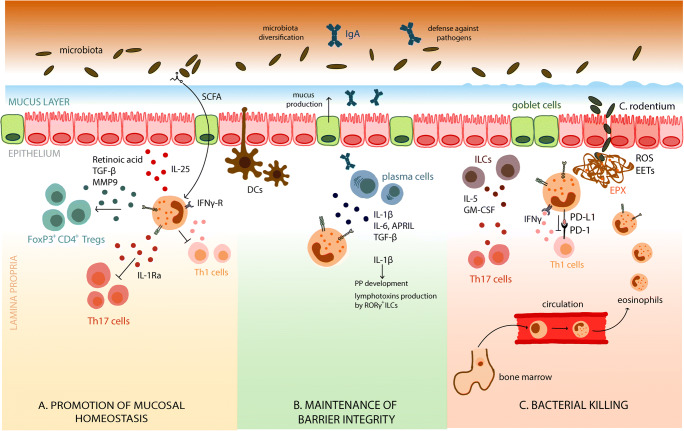
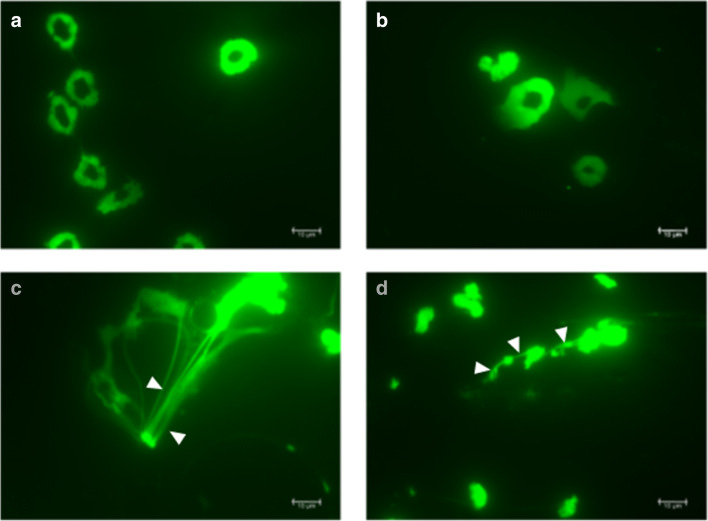
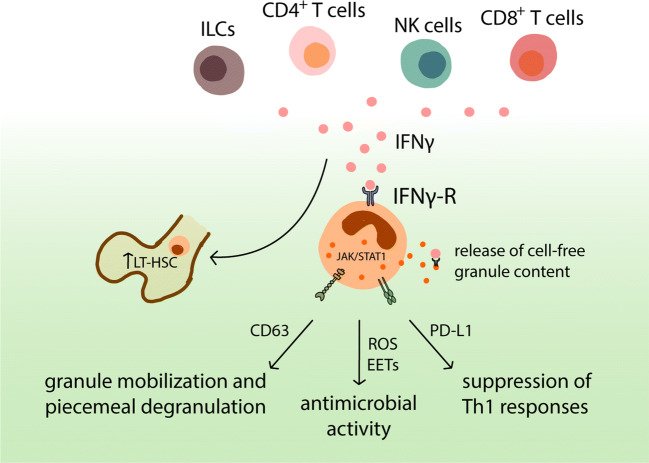
Eosinophils are traditionally considered as end-stage effector cells involved in the pathogenesis of Th2 immune-mediated disorders as well as in the protection against parasite infection. However, this restricted view has recently been challenged by a series of studies revealing the highly plastic nature of these cells and implication in various homeostatic processes. Large numbers of eosinophils reside in the lamina propria of the gastrointestinal tract, at the front line of host defence, where they contribute to maintain the intestinal epithelial barrier function in the face of inflammation-associated epithelial cell damage. Eosinophils confer active protection against bacterial pathogens capable of penetrating the mucosal barrier through the release of cytotoxic compounds and the generation of extracellular DNA traps. Eosinophils also integrate tissue-specific cytokine signals such as IFN-γ, which synergise with bacterial recognition pathways to enforce different context-dependent functional responses, thereby ensuring a rapid adaptation to the ever-changing intestinal environment. The ability of eosinophils to regulate local immune responses and respond to microbial stimuli further supports the pivotal role of these cells in the maintenance of tissue homeostasis at the intestinal interface.
嗜酸性粒细胞传统上被认为是终末效应细胞,参与 Th2 免疫介导的疾病发病机制以及寄生虫感染的保护。然而,最近一系列研究揭示了这些细胞的高度可塑性及其在各种稳态过程中的作用,这一传统观点受到了挑战。大量的嗜酸性粒细胞存在于胃肠道的固有层,处于宿主防御的第一线,在面对与炎症相关的上皮细胞损伤时,它们有助于维持肠道上皮屏障功能。嗜酸性粒细胞通过释放细胞毒性化合物和产生细胞外 DNA 陷阱,为抵抗能够穿透黏膜屏障的细菌病原体提供积极的保护。嗜酸性粒细胞还整合组织特异性细胞因子信号,如 IFN-γ,这些信号与细菌识别途径协同作用,以执行不同的上下文相关功能反应,从而确保对不断变化的肠道环境的快速适应。嗜酸性粒细胞调节局部免疫反应和对微生物刺激作出反应的能力进一步支持这些细胞在维持肠道界面组织稳态方面的关键作用。