Department of Cell Biology, Emory University School of Medicine, Atlanta, GA, 30322, USA.
Department of Physiology, Emory University School of Medicine, Atlanta, GA, 30322, USA.
Mol Brain. 2021 Apr 30;14(1):75. doi: 10.1186/s13041-021-00783-w.
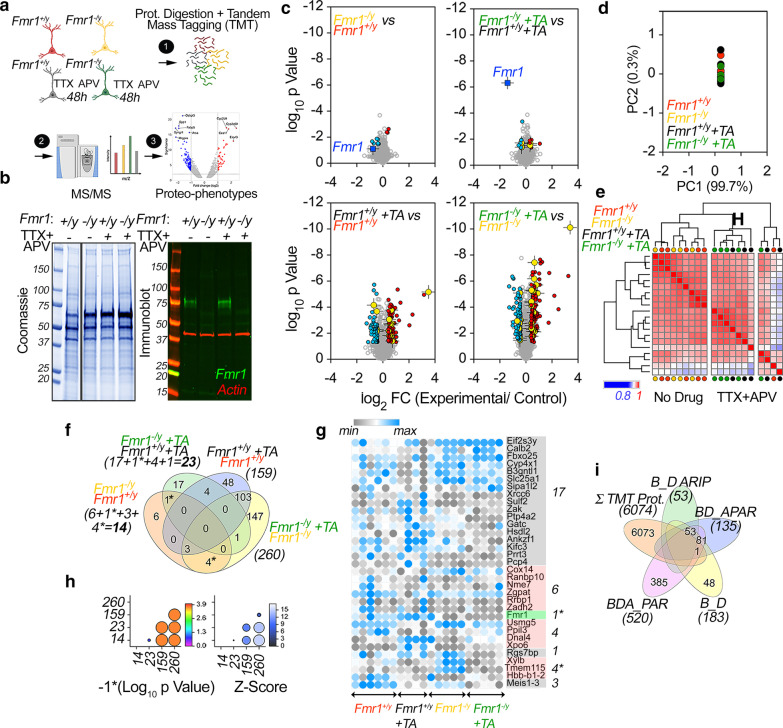
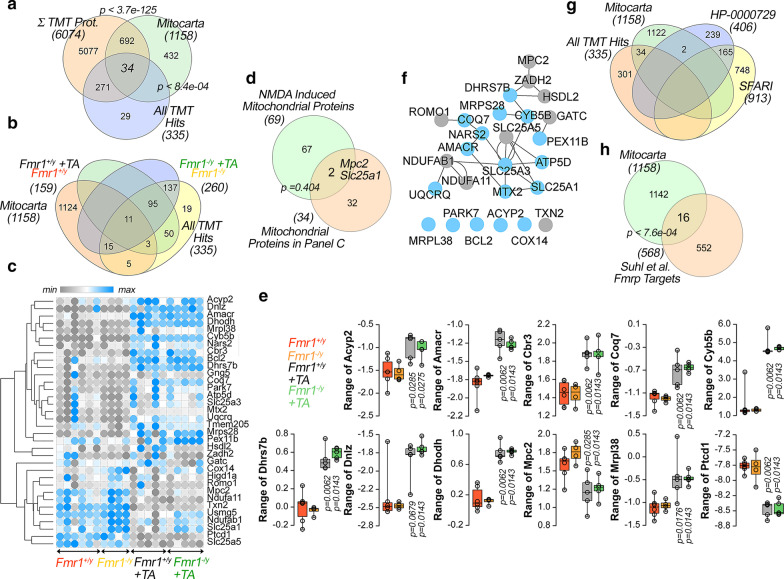
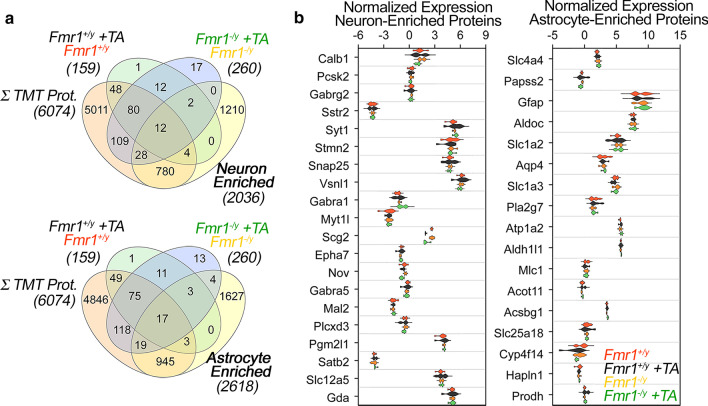
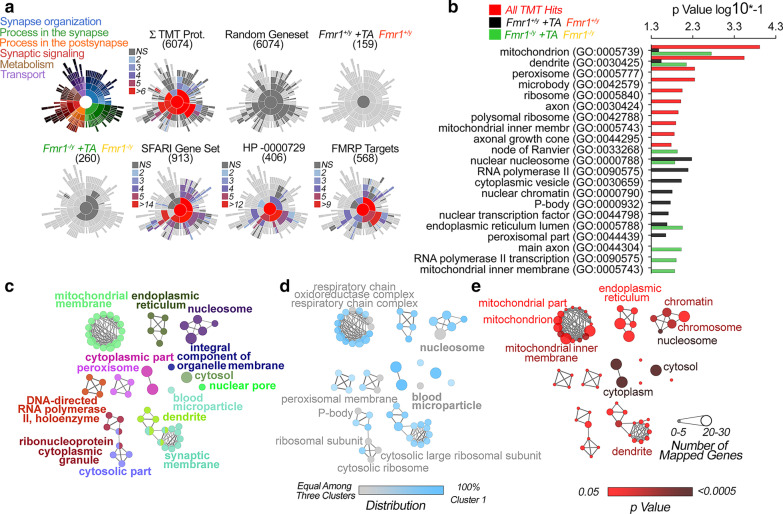
Homeostatic plasticity is necessary for the construction and maintenance of functional neuronal networks, but principal molecular mechanisms required for or modified by homeostatic plasticity are not well understood. We recently reported that homeostatic plasticity induced by activity deprivation is dysregulated in cortical neurons from Fragile X Mental Retardation protein (FMRP) knockout mice (Bulow et al. in Cell Rep 26: 1378-1388 e1373, 2019). These findings led us to hypothesize that identifying proteins sensitive to activity deprivation and/or FMRP expression could reveal pathways required for or modified by homeostatic plasticity. Here, we report an unbiased quantitative mass spectrometry used to quantify steady-state proteome changes following chronic activity deprivation in wild type and Fmr1 cortical neurons. Proteome hits responsive to both activity deprivation and the Fmr1 genotype were significantly annotated to mitochondria. We found an increased number of mitochondria annotated proteins whose expression was sensitive to activity deprivation in Fmr1 cortical neurons as compared to wild type neurons. These findings support a novel role of FMRP in attenuating mitochondrial proteome modifications induced by activity deprivation.
内稳态可塑性对于功能性神经元网络的构建和维持是必要的,但内稳态可塑性所必需的或被其修饰的主要分子机制还不是很清楚。我们最近报道,活性剥夺诱导的内稳态可塑性在脆性 X 智力迟钝蛋白 (FMRP) 敲除小鼠的皮质神经元中失调(Bulow 等人,在 Cell Rep 26:1378-1388 e1373,2019)。这些发现使我们假设,鉴定对活性剥夺和/或 FMRP 表达敏感的蛋白质可以揭示内稳态可塑性所必需的或被其修饰的途径。在这里,我们报告了一种无偏的定量质谱法,用于在野生型和 Fmr1 皮质神经元中慢性活性剥夺后定量稳态蛋白质组变化。对活性剥夺和 Fmr1 基因型均有反应的蛋白质组命中显著注释为线粒体。我们发现,与野生型神经元相比,Fmr1 皮质神经元中,有更多的线粒体注释蛋白的表达对活性剥夺敏感。这些发现支持 FMRP 在减弱活性剥夺诱导的线粒体蛋白质组修饰中的新作用。