Li Peng, Tian Jia, Guo Changkui, Luo Shuping, Li Jiang
College of Forestry and Horticulture, Xinjiang Agricultural University, Urumqi, 830052, China.
Research Institute of Pomology, Chinese Academy of Agricultural Sciences, Xingcheng, 125100, China.
Hortic Res. 2021 May 1;8(1):94. doi: 10.1038/s41438-021-00527-w.
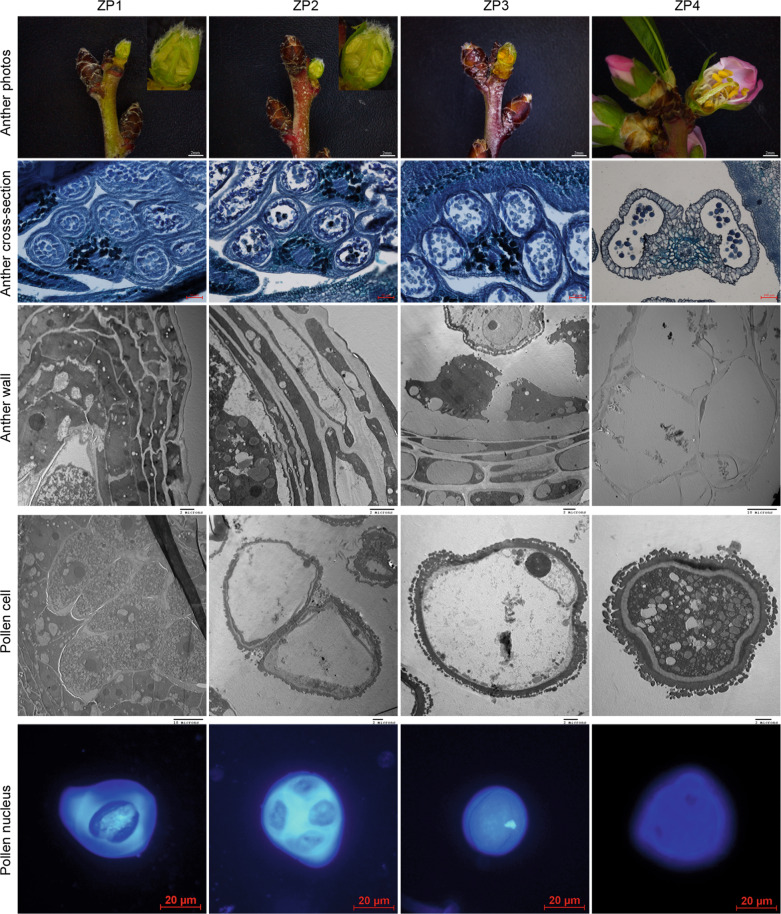
Low temperature causes anther dysfunction, severe pollen sterility and, ultimately, major yield losses in crop plants. Previous studies have shown that the gibberellic acid (GA) metabolic pathway plays an important role in this process by regulating tapetum function and pollen development. However, the interaction mechanism of GA with other hormones mediating anther development is still unclear. Herein, we collected and analyzed almond (Amygdalus communis L.) anthers at the meiosis, tetrad, 1-nucleus, and mature 2-nucleus stages. The growth rate per 1000 anthers exhibited a significant positive correlation with the total bioactive GA compound content, and the levels of all bioactive GA compounds were highest in the 1-nucleus pollen stage. GA treatment experiments indicated that exogenous GA increased the levels of indole-3-acetic acid (IAA), trans-zeatin (tZ), and jasmonic acid (JA) and decreased the levels of salicylic acid (SA) and abscisic acid (ABA); moreover, GA improved pollen viability and quantities under cold conditions, whereas PP (paclobutrazol, an inhibitor of GA biosynthesis) was antagonistic with GA in controlling anther development. RNA-seq and qRT-PCR results showed that GA played an important role in anther development by regulating the expression of other phytohormone pathway genes, dehydration-responsive element-binding/C-repeat binding factor (DREB1/CBF)-mediated signaling genes, and anther development pathway genes. Our results reveal the novel finding that GA interacts with other hormones to balance anther development under normal- and low-temperature conditions in almond.
低温会导致作物花药功能障碍、严重的花粉不育,最终造成大幅减产。先前的研究表明,赤霉素(GA)代谢途径通过调节绒毡层功能和花粉发育,在这一过程中发挥重要作用。然而,GA与其他介导花药发育的激素之间的相互作用机制仍不清楚。在此,我们收集并分析了扁桃(Amygdalus communis L.)在减数分裂、四分体、单核和成熟双核阶段的花药。每1000个花药的生长速率与生物活性GA化合物总含量呈显著正相关,且所有生物活性GA化合物的水平在单核花粉阶段最高。GA处理实验表明,外源GA提高了吲哚-3-乙酸(IAA)、反式玉米素(tZ)和茉莉酸(JA)的水平,降低了水杨酸(SA)和脱落酸(ABA)的水平;此外,GA在低温条件下提高了花粉活力和数量,而多效唑(PP,一种GA生物合成抑制剂)在控制花药发育方面与GA起拮抗作用。RNA测序和定量逆转录聚合酶链反应结果表明,GA通过调节其他植物激素途径基因、脱水响应元件结合/C-重复结合因子(DREB1/CBF)介导的信号基因和花药发育途径基因的表达,在花药发育中发挥重要作用。我们的研究结果揭示了一个新发现,即GA与其他激素相互作用,以平衡扁桃在正常和低温条件下的花药发育。