Guillamón Jesús Guillamón, Prudencio Ángela Sánchez, Yuste José Enrique, Dicenta Federico, Sánchez-Pérez Raquel
Department of Plant Breeding. CEBAS-CSIC, Campus Universitario de Espinardo, 30100, Espinardo, Spain.
Metabolomics Platform of CEBAS-CSIC, Campus Universitario de Espinardo, 30100, Espinardo, Spain.
Hortic Res. 2020 Dec 1;7(1):203. doi: 10.1038/s41438-020-00427-5.
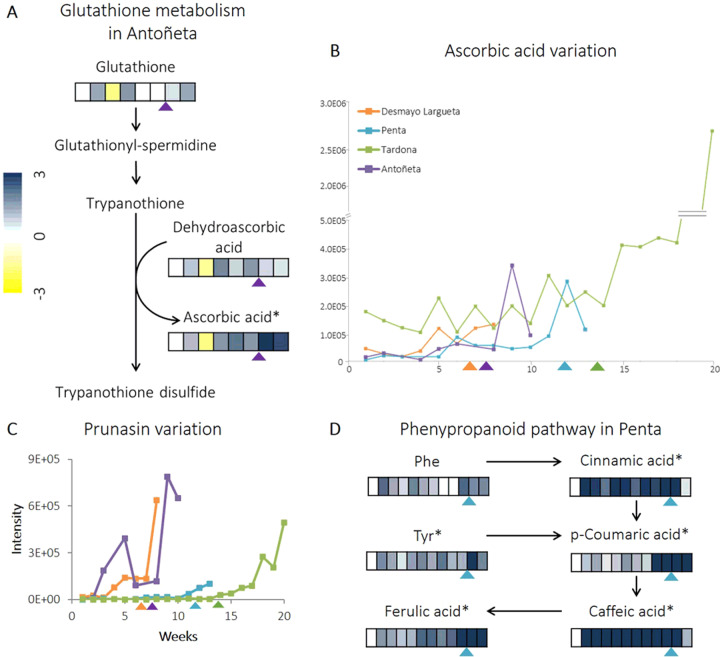
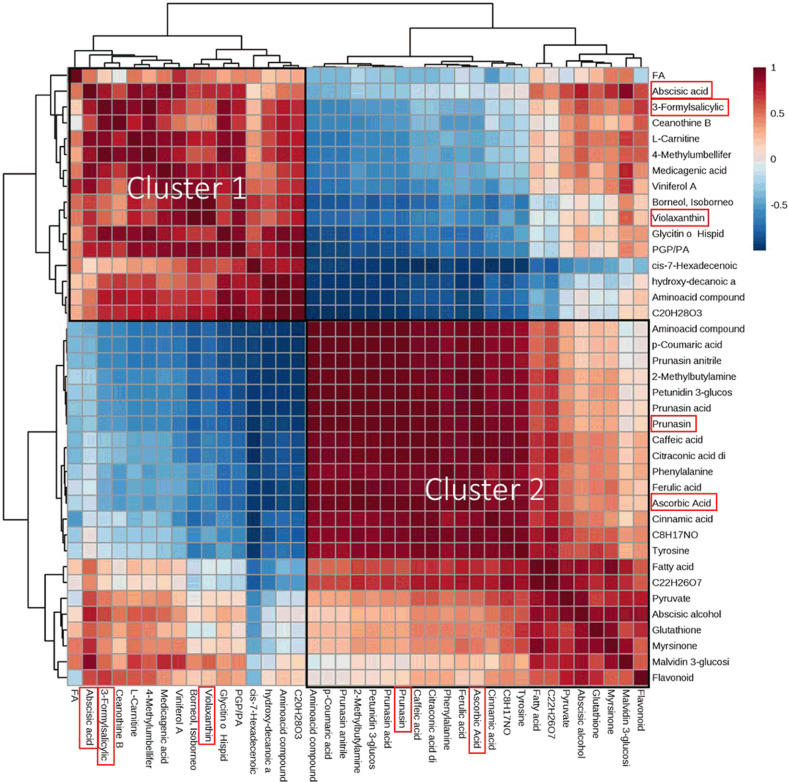
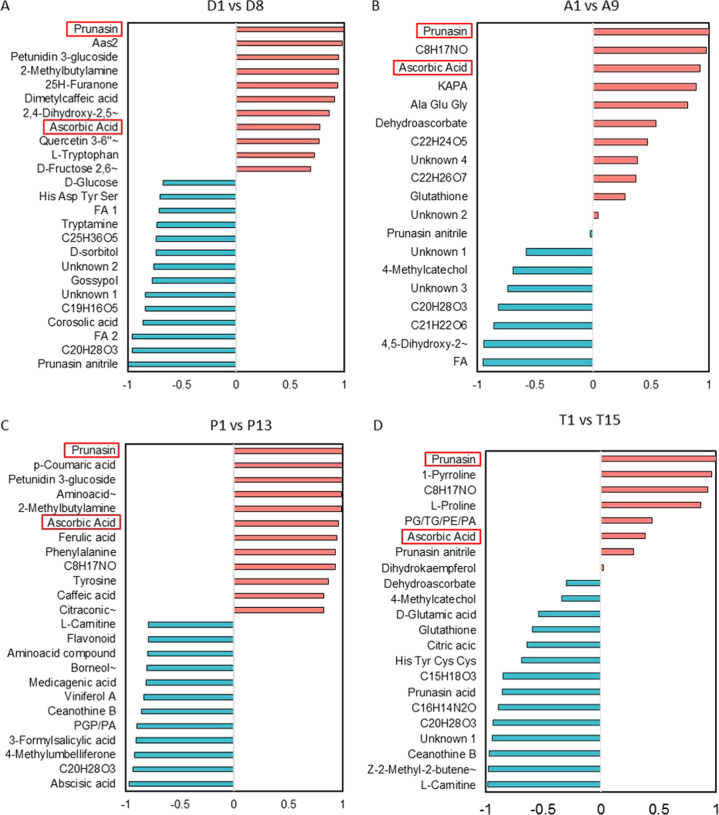
Temperate fruit trees belonging to Prunus species have the ability to suspend (induce dormancy) and resume growth periodically in response to environmental and seasonal conditions. Endodormancy release requires the long-term accumulation of chill. Upon accumulation of cultivar-specific chill requirements, plants enter the state of ecodormancy, which means the ability to grow has been restored, depending on the fulfilment of heat requirements. As many different metabolic pathways are implicated in endodormancy release, we have performed a metabolomic analysis, using the ultra-high-performance liquid chromatography-quadrupole time-of-flying (UPLC-QToF) technique. We assayed flower buds in different stages of endodormancy in four almond cultivars with different flowering times: the extra-early Desmayo Largueta, the late Antoñeta, the extra-late Penta, and the ultra-late Tardona. An orthogonal projection to latent-structure discriminant-analysis model was created to observe differences between endodormant and ecodormant flower buds. The metabolites showing the most significant variation were searched against the Metlin, HMDB, and KEGG libraries, which allowed us to identify 87 metabolites. These metabolites were subsequently assigned to specific pathways, such as abscisic acid biosynthesis, phenylpropanoid biosynthesis, and D-sorbitol metabolism, among others. The two metabolites that exhibited the most significant variations in all the cultivars studied with fold changes of up to 6.49 were ascorbic acid and prunasin. For the first time, these two metabolites have been proposed as potential biomarkers for endodormancy release in almond. Given the high synteny present between the Rosaceae species, these results could be extrapolated to other important crops like peach, plum, cherry, or apricot, among others.
属于李属的温带果树能够根据环境和季节条件周期性地暂停生长(诱导休眠)并恢复生长。内休眠的解除需要长期积累低温。当积累了特定品种所需的低温量后,植物进入生态休眠状态,这意味着根据热量需求的满足情况,其生长能力已恢复。由于许多不同的代谢途径都与内休眠的解除有关,我们使用超高效液相色谱-四极杆飞行时间(UPLC-QToF)技术进行了代谢组学分析。我们测定了四个开花时间不同的杏仁品种处于内休眠不同阶段的花芽:极早熟的Desmayo Largueta、晚熟的Antoñeta、极晚熟的Penta和超晚熟的Tardona。创建了一个潜在结构判别分析模型的正交投影,以观察内休眠和生态休眠花芽之间的差异。将显示出最显著差异的代谢物与Metlin、HMDB和KEGG库进行比对,这使我们能够鉴定出87种代谢物。这些代谢物随后被归类到特定途径,如脱落酸生物合成、苯丙烷类生物合成和D-山梨醇代谢等。在所有研究的品种中,变化最显著、倍数变化高达6.49的两种代谢物是抗坏血酸和苦杏仁苷。这两种代谢物首次被提议作为杏仁内休眠解除的潜在生物标志物。鉴于蔷薇科物种之间存在高度的同源性,这些结果可以外推到其他重要作物,如桃、李、樱桃或杏等。