Peng Ze, He Yanhong, Parajuli Saroj, You Qian, Wang Weining, Bhattarai Krishna, Palmateer Aaron J, Deng Zhanao
University of Florida, IFAS, Department of Environmental Horticulture, Gulf Coast Research and Education Center, 14625 County Road 672, Wimauma, FL, 33598, USA.
State Key Laboratory for Conservation and Utilization of Subtropical Agro-Bioresources, South China Agricultural University, 510642, Guangzhou, China.
Hortic Res. 2021 May 1;8(1):108. doi: 10.1038/s41438-021-00543-w.
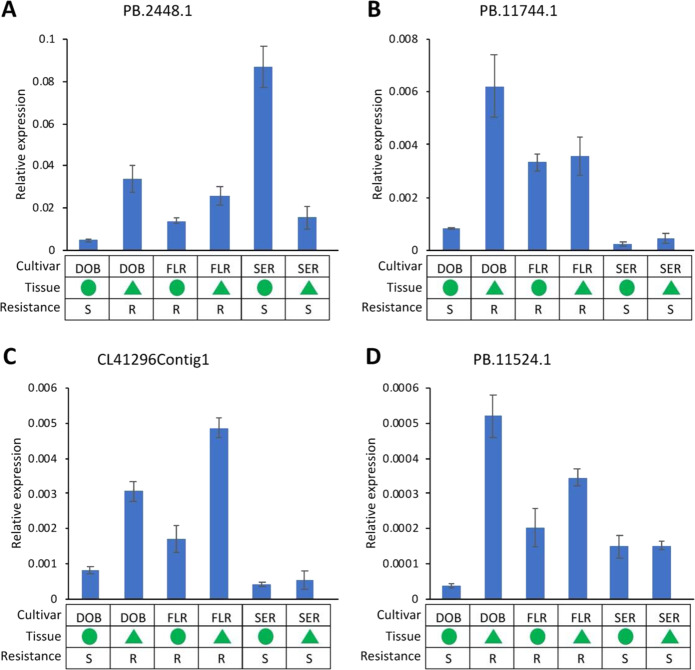
Downy mildew (DM), caused by obligate parasitic oomycetes, is a destructive disease for a wide range of crops worldwide. Recent outbreaks of impatiens downy mildew (IDM) in many countries have caused huge economic losses. A system to reveal plant-pathogen interactions in the early stage of infection and quickly assess resistance/susceptibility of plants to DM is desired. In this study, we established an early and rapid system to achieve these goals using impatiens as a model. Thirty-two cultivars of Impatiens walleriana and I. hawkeri were evaluated for their responses to IDM at cotyledon, first/second pair of true leaf, and mature plant stages. All I. walleriana cultivars were highly susceptible to IDM. While all I. hawkeri cultivars were resistant to IDM starting at the first true leaf stage, many (14/16) were susceptible to IDM at the cotyledon stage. Two cultivars showed resistance even at the cotyledon stage. Histological characterization showed that the resistance mechanism of the I. hawkeri cultivars resembles that in grapevine and type II resistance in sunflower. By integrating full-length transcriptome sequencing (Iso-Seq) and RNA-Seq, we constructed the first reference transcriptome for Impatiens comprised of 48,758 sequences with an N50 length of 2060 bp. Comparative transcriptome and qRT-PCR analyses revealed strong candidate genes for IDM resistance, including three resistance genes orthologous to the sunflower gene RGC203, a potential candidate associated with DM resistance. Our approach of integrating early disease-resistance phenotyping, histological characterization, and transcriptome analysis lay a solid foundation to improve DM resistance in impatiens and may provide a model for other crops.
霜霉病(DM)由专性寄生卵菌引起,是全球范围内多种作物的毁灭性病害。近期许多国家凤仙花霜霉病(IDM)的爆发造成了巨大经济损失。人们期望建立一种系统,以揭示感染早期的植物-病原体相互作用,并快速评估植物对霜霉病的抗性/易感性。在本研究中,我们以凤仙花为模型建立了一个早期快速系统来实现这些目标。对32个新几内亚凤仙和霍氏凤仙品种在子叶期、第一/二对真叶期和成熟植株期对IDM的反应进行了评估。所有新几内亚凤仙品种对IDM高度敏感。虽然所有霍氏凤仙品种从第一片真叶期开始对IDM具有抗性,但许多品种(14/16)在子叶期对IDM敏感。有两个品种即使在子叶期也表现出抗性。组织学特征表明,霍氏凤仙品种的抗性机制类似于葡萄中的抗性机制以及向日葵中的II型抗性。通过整合全长转录组测序(Iso-Seq)和RNA-Seq,我们构建了第一个凤仙花参考转录组,由48,758个序列组成,N50长度为2060 bp。比较转录组和qRT-PCR分析揭示了IDM抗性的强候选基因,包括三个与向日葵基因RGC203直系同源的抗性基因,这是一个与霜霉病抗性相关的潜在候选基因。我们整合早期抗病表型分析、组织学特征分析和转录组分析的方法为提高凤仙花对霜霉病的抗性奠定了坚实基础,并可能为其他作物提供一个模型。