Department of Public Administration, College of Economics and Management, East China Normal University, Shanghai, China.
King's Health Economics, Health Service and Population Research Department, Institute of Psychiatry, Psychology, and Neuroscience at King's College London, London, UK.
Value Health. 2021 May;24(5):615-624. doi: 10.1016/j.jval.2020.12.009. Epub 2021 Feb 21.
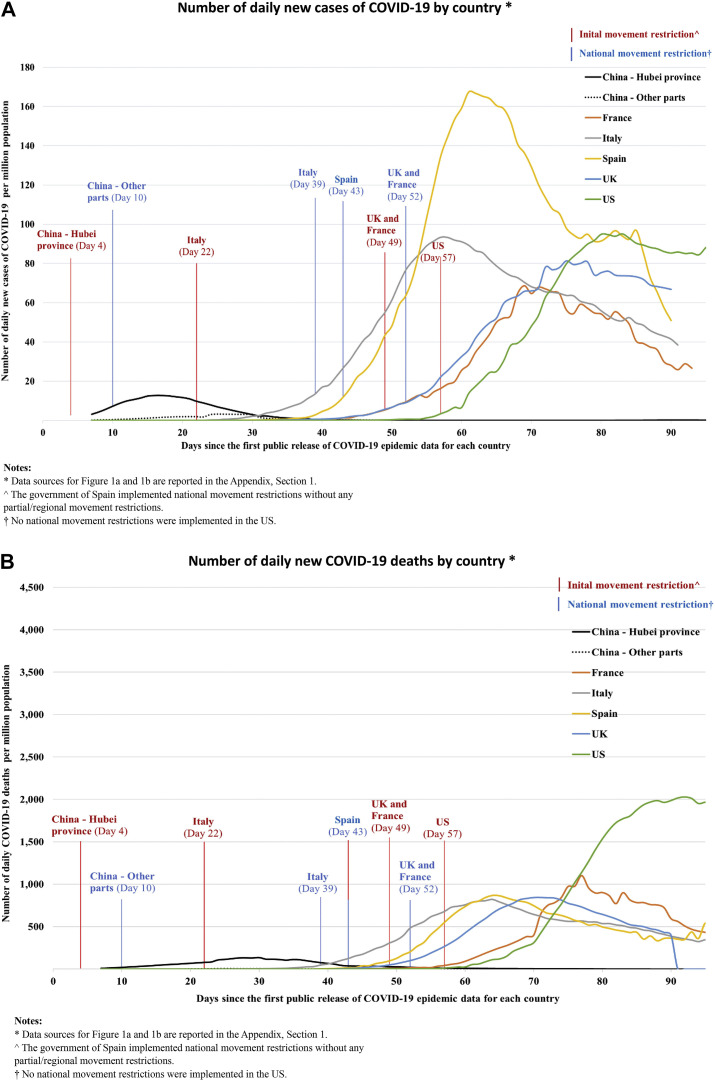
Movement restriction policies (MRPs) are effective in preventing/delaying COVID-19 transmission but are associated with high societal cost. This study aims to estimate the health burden of the first wave of COVID-19 in China and the cost-effectiveness of early versus late implementation of MRPs to inform preparation for future waves.
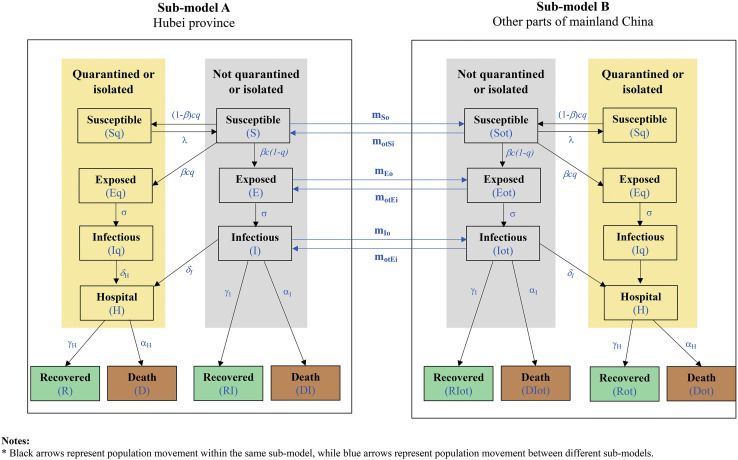
The SEIR (susceptible, exposed, infectious, and recovered) modeling framework was adapted to simulate the health and cost outcomes of initiating MRPs at different times: rapid implementation (January 23, the real-world scenario), delayed by 1 week, delayed by 2 weeks, and delayed by 4 weeks. The end point was set as the day when newly confirmed cases reached zero. Two costing perspectives were adopted: healthcare and societal. Input data were obtained from official statistics and published literature. The primary outcomes were disability-adjusted life-years, cost, and net monetary benefit. Costs were reported in both Chinese renminbi (RMB) and US dollars (USD) at 2019 values.
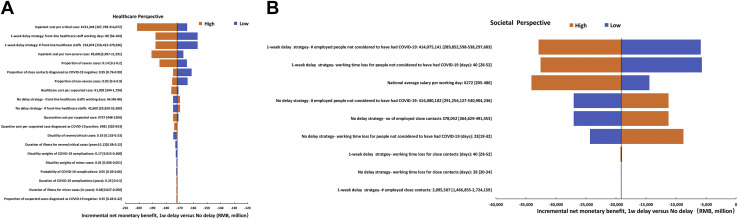
The first wave of COVID-19 in China resulted in 38 348 disability adjusted life-years lost (95% CI 19 417-64 130) and 2639 billion RMB losses (95% CI 1347-4688). The rapid implementation strategy dominated all other delayed strategies. This conclusion was robust to all scenarios tested. At a willingness-to-pay threshold of 70 892 RMB (the national annual GDP per capita) per disability-adjusted life-year saved, the probability for the rapid implementation to be the optimal strategy was 96%.
Early implementation of MRPs in response to COVID-19 reduced both the health burden and societal cost and thus should be used for future waves of COVID-19.
行动限制政策(MRP)在预防/延迟 COVID-19 传播方面非常有效,但会带来高昂的社会成本。本研究旨在评估 COVID-19 在中国第一波疫情的健康负担,以及早期与晚期实施 MRP 的成本效益,以为未来波次的疫情做好准备。
采用 SEIR(易感、暴露、感染和恢复)建模框架,模拟不同时间点实施 MRP 的健康和成本结果:快速实施(1 月 23 日,实际情况)、延迟 1 周、延迟 2 周和延迟 4 周。终点设定为新确诊病例清零的那一天。采用两种成本视角:医疗保健和社会。输入数据来自官方统计数据和已发表的文献。主要结果是伤残调整生命年、成本和净货币效益。成本以 2019 年的人民币(RMB)和美元(USD)报告。
中国第一波 COVID-19 导致 38348 个伤残调整生命年丧失(95%CI 19417-64130)和 26390 亿元人民币损失(95%CI 1347-4688)。快速实施策略主导了所有其他延迟策略。这一结论在所有测试的情景中都具有稳健性。在 70892 元人民币(全国人均年度 GDP)每挽救一个伤残调整生命年的意愿支付阈值下,快速实施策略成为最优策略的概率为 96%。
针对 COVID-19 实施早期的 MRP 可减轻健康负担和社会成本,因此应在未来的 COVID-19 波次中使用。