Department of Medical Sciences, University of Turin, Turin, Italy.
A.O.U. Città della Salute e della Scienza di Torino, Turin, Italy.
ESC Heart Fail. 2021 Aug;8(4):2907-2919. doi: 10.1002/ehf2.13371. Epub 2021 May 2.
Risk stratification in patients with advanced chronic heart failure (HF) is an unmet need. Circulating microRNA (miRNA) levels have been proposed as diagnostic and prognostic biomarkers in several diseases including HF. The aims of the present study were to characterize HF-specific miRNA expression profiles and to identify miRNAs with prognostic value in HF patients.
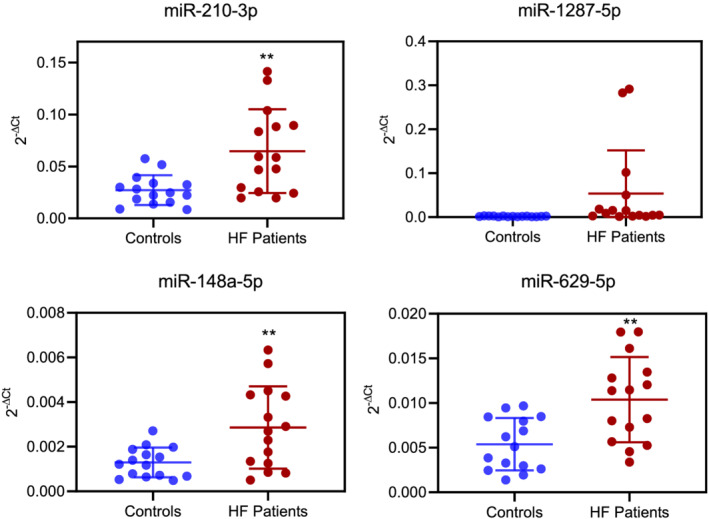
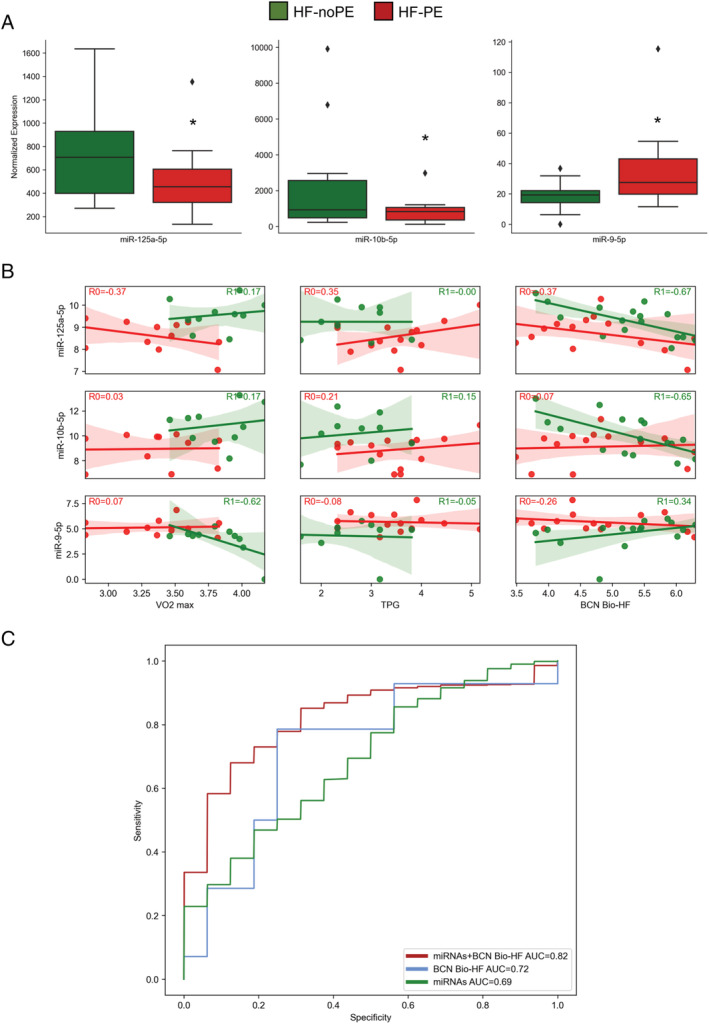
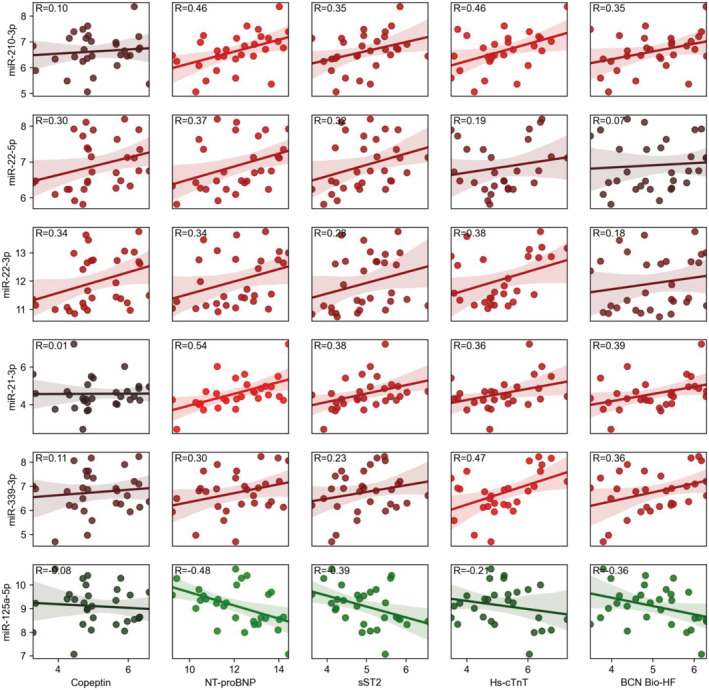
We performed a global miRNome analysis using next-generation sequencing in the plasma of 30 advanced chronic HF patients and of matched healthy controls. A small subset of miRNAs was validated by real-time PCR (P < 0.0008). Pearson's correlation analysis was computed between miRNA expression levels and common HF markers. Multivariate prediction models were exploited to evaluate miRNA profiles' prognostic role. Thirty-two miRNAs were found to be dysregulated between the two groups. Six miRNAs (miR-210-3p, miR-22-5p, miR-22-3p, miR-21-3p, miR-339-3p, and miR-125a-5p) significantly correlated with HF biomarkers, among which N-terminal prohormone of brain natriuretic peptide. Inside the cohort of advanced HF population, we identified three miRNAs (miR-125a-5p, miR-10b-5p, and miR-9-5p) altered in HF patients experiencing the primary endpoint of cardiac death, heart transplantation, or mechanical circulatory support implantation when compared with those without clinical events. The three miRNAs added substantial prognostic power to Barcelona Bio-HF score, a multiparametric and validated risk stratification tool for HF (from area under the curve = 0.72 to area under the curve = 0.82).
This discovery study has characterized, for the first time, the advanced chronic HF-specific miRNA expression pattern. We identified a few miRNAs able to improve the prognostic stratification of HF patients based on common clinical and laboratory values. Further studies are needed to validate our results in larger populations.
在晚期慢性心力衰竭(HF)患者中,风险分层是未满足的需求。循环 microRNA(miRNA)水平已被提出作为几种疾病(包括 HF)的诊断和预后生物标志物。本研究的目的是描述 HF 特异性 miRNA 表达谱,并确定在 HF 患者中具有预后价值的 miRNA。
我们使用下一代测序对 30 名晚期慢性 HF 患者和匹配的健康对照者的血浆进行了全局 miRNAome 分析。通过实时 PCR(P < 0.0008)验证了一小部分 miRNA。计算了 miRNA 表达水平与常见 HF 标志物之间的 Pearson 相关分析。利用多元预测模型评估 miRNA 谱的预后作用。两组之间发现有 32 个 miRNA 失调。其中 6 个 miRNA(miR-210-3p、miR-22-5p、miR-22-3p、miR-21-3p、miR-339-3p 和 miR-125a-5p)与 HF 生物标志物显著相关,其中包括脑钠肽前体 N 末端。在晚期 HF 人群中,我们确定了三个在 HF 患者中发生心脏死亡、心脏移植或机械循环支持植入的主要终点时发生改变的 miRNA(miR-125a-5p、miR-10b-5p 和 miR-9-5p)与没有临床事件的患者相比。这三个 miRNA 为巴塞罗那生物 HF 评分(一种多参数和经过验证的 HF 风险分层工具)增加了大量预后价值(从曲线下面积为 0.72 增加到曲线下面积为 0.82)。
本发现研究首次描述了晚期慢性 HF 特异性 miRNA 表达模式。我们确定了一些 miRNA,能够基于常见的临床和实验室值改善 HF 患者的预后分层。需要进一步的研究来验证我们在更大人群中的结果。