
脑出血后的预后评估:综述
Prognostication after intracerebral hemorrhage: a review.
作者信息
Witsch Jens, Siegerink Bob, Nolte Christian H, Sprügel Maximilian, Steiner Thorsten, Endres Matthias, Huttner Hagen B
机构信息
Department of Neurology, Weill Cornell Medicine, 525 East 68th Street, New York, NY, 10065, USA.
Center for Stroke Research Berlin, Charité Universitätsmedizin, Berlin, Germany.
出版信息
Neurol Res Pract. 2021 May 3;3(1):22. doi: 10.1186/s42466-021-00120-5.
BACKGROUND
Approximately half of patients with spontaneous intracerebral hemorrhage (ICH) die within 1 year. Prognostication in this context is of great importance, to guide goals of care discussions, clinical decision-making, and risk stratification. However, available prognostic scores are hardly used in clinical practice. The purpose of this review article is to identify existing outcome prediction scores for spontaneous intracerebral hemorrhage (ICH) discuss their shortcomings, and to suggest how to create and validate more useful scores.
MAIN TEXT
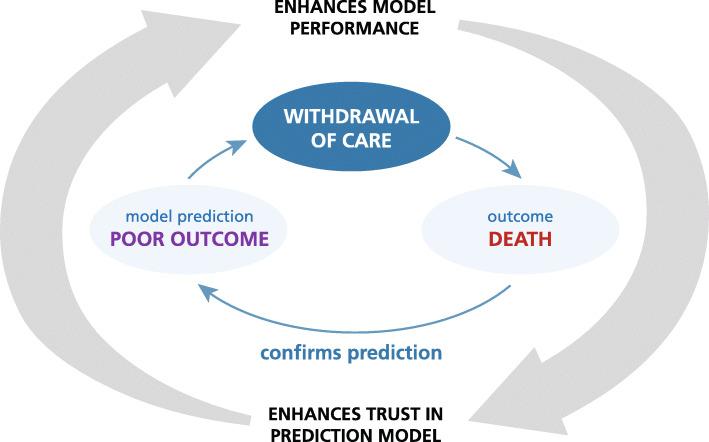
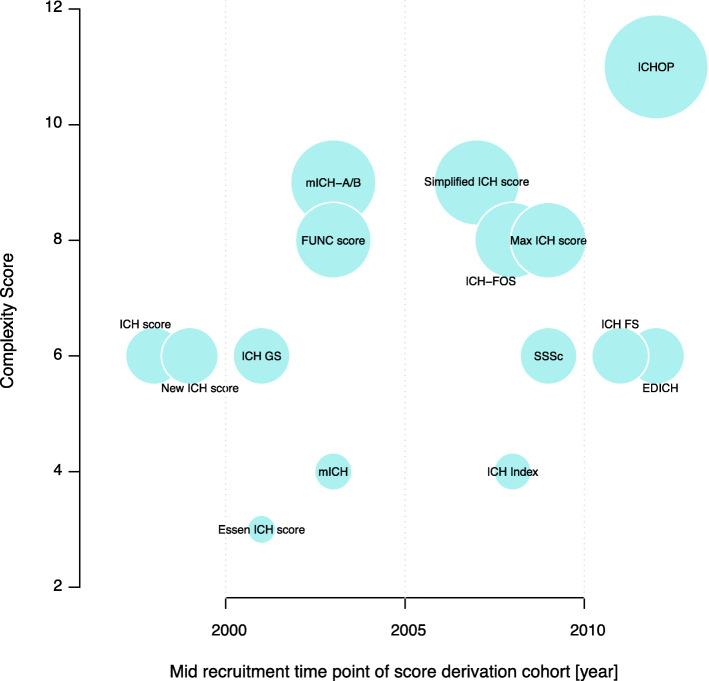
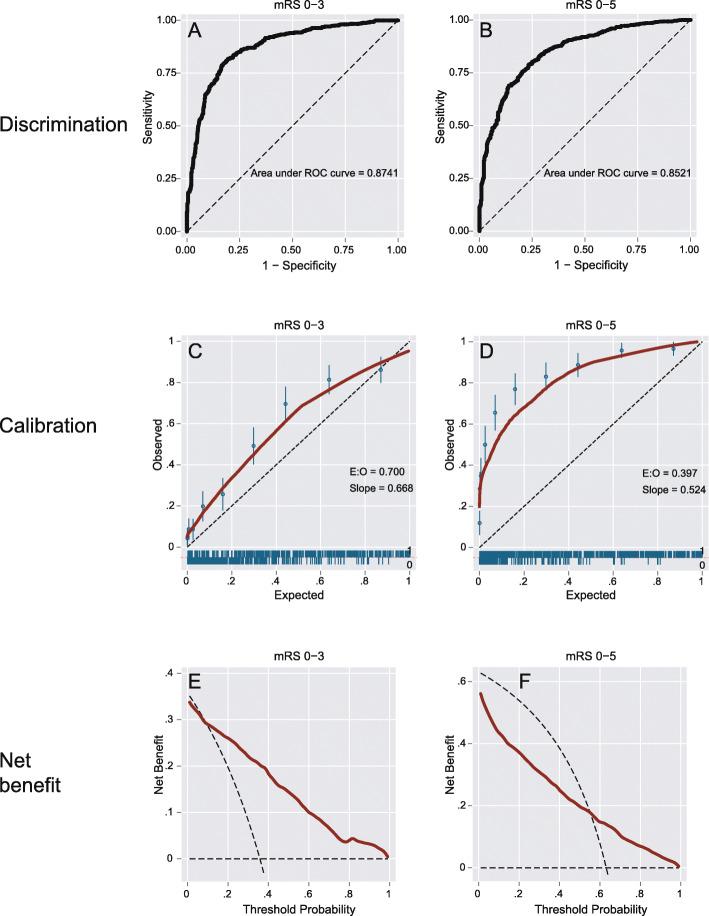
Through a literature review this article identifies existing ICH outcome prediction models. Using the Essen-ICH-score as an example, we demonstrate a complete score validation including discrimination, calibration and net benefit calculations. Score performance is illustrated in the Erlangen UKER-ICH-cohort (NCT03183167). We identified 19 prediction scores, half of which used mortality as endpoint, the remainder used disability, typically the dichotomized modified Rankin score assessed at variable time points after the index ICH. Complete score validation by our criteria was only available for the max-ICH score. Our validation of the Essen-ICH-score regarding prediction of unfavorable outcome showed good discrimination (area under the curve 0.87), fair calibration (calibration intercept 1.0, slope 0.84), and an overall net benefit of using the score as a decision tool. We discuss methodological pitfalls of prediction scores, e.g. the withdrawal of care (WOC) bias, physiological predictor variables that are often neglected by authors of clinical scores, and incomplete score validation. Future scores need to integrate new predictor variables, patient-reported outcome measures, and reduce the WOC bias. Validation needs to be standardized and thorough. Lastly, we discuss the integration of current ICH scoring systems in clinical practice with the awareness of their shortcomings.
CONCLUSION
Presently available prognostic scores for ICH do not fulfill essential quality standards. Novel prognostic scores need to be developed to inform the design of research studies and improve clinical care in patients with ICH.
背景
约半数自发性脑出血(ICH)患者在1年内死亡。在此背景下进行预后评估对于指导医疗护理目标讨论、临床决策和风险分层至关重要。然而,现有的预后评分在临床实践中很少被使用。这篇综述文章的目的是识别现有的自发性脑出血(ICH)结局预测评分,讨论其缺点,并提出如何创建和验证更有用的评分。
正文
通过文献综述,本文识别了现有的ICH结局预测模型。以埃森脑出血评分(Essen-ICH-score)为例,我们展示了完整的评分验证,包括区分度、校准和净效益计算。评分性能在埃尔朗根UKER-ICH队列(NCT03183167)中得到说明。我们识别出19种预测评分,其中一半以死亡率作为终点,其余的以残疾作为终点,通常是在首次脑出血后的不同时间点评估的二分法改良Rankin评分。按照我们的标准进行的完整评分验证仅适用于最大脑出血评分(max-ICH score)。我们对埃森脑出血评分预测不良结局的验证显示出良好的区分度(曲线下面积为0.87)、尚可的校准(校准截距为1.0,斜率为0.84),以及将该评分用作决策工具的总体净效益。我们讨论了预测评分的方法学缺陷,例如放弃治疗(WOC)偏倚、临床评分作者常常忽略的生理预测变量,以及不完整的评分验证。未来的评分需要整合新的预测变量、患者报告的结局指标,并减少WOC偏倚。验证需要标准化且全面。最后,我们在意识到现有ICH评分系统缺点的情况下,讨论了其在临床实践中的整合。
结论
目前可用的ICH预后评分未达到基本质量标准。需要开发新的预后评分,以指导研究设计并改善ICH患者的临床护理。
 Zotero 插件